
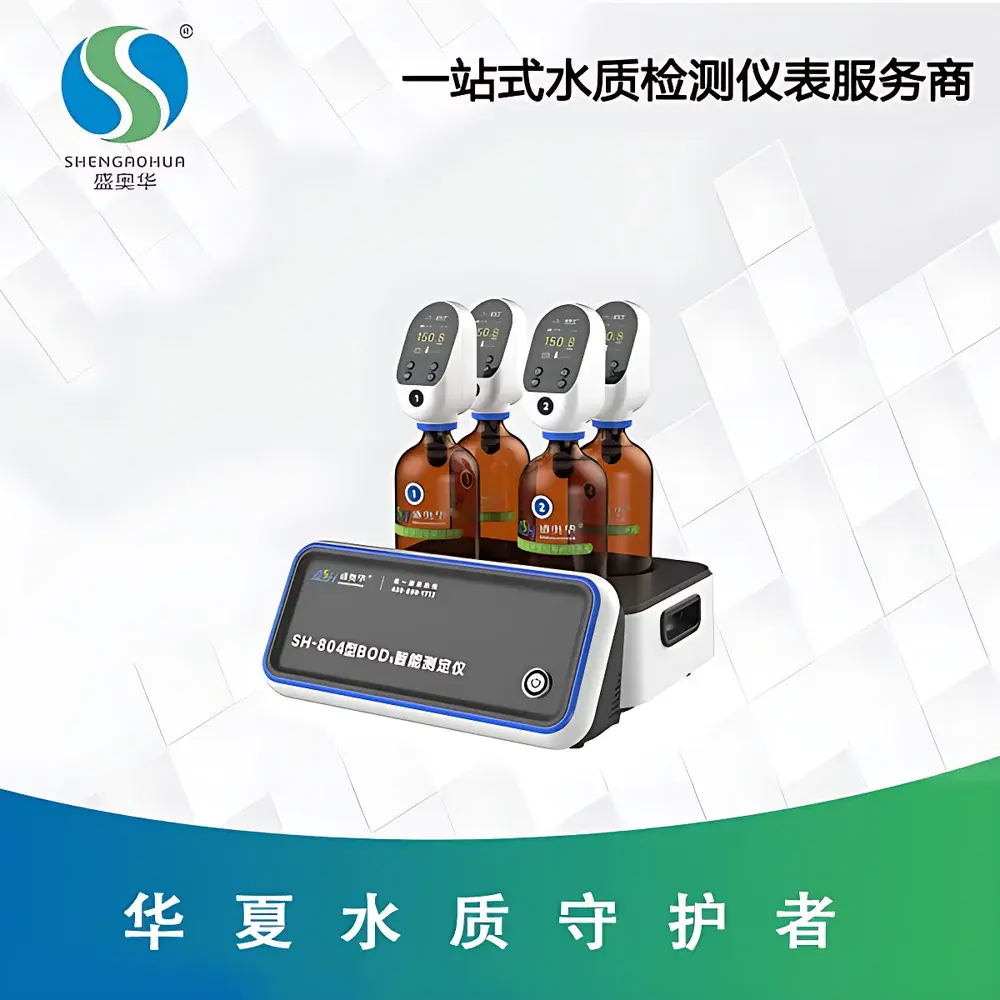
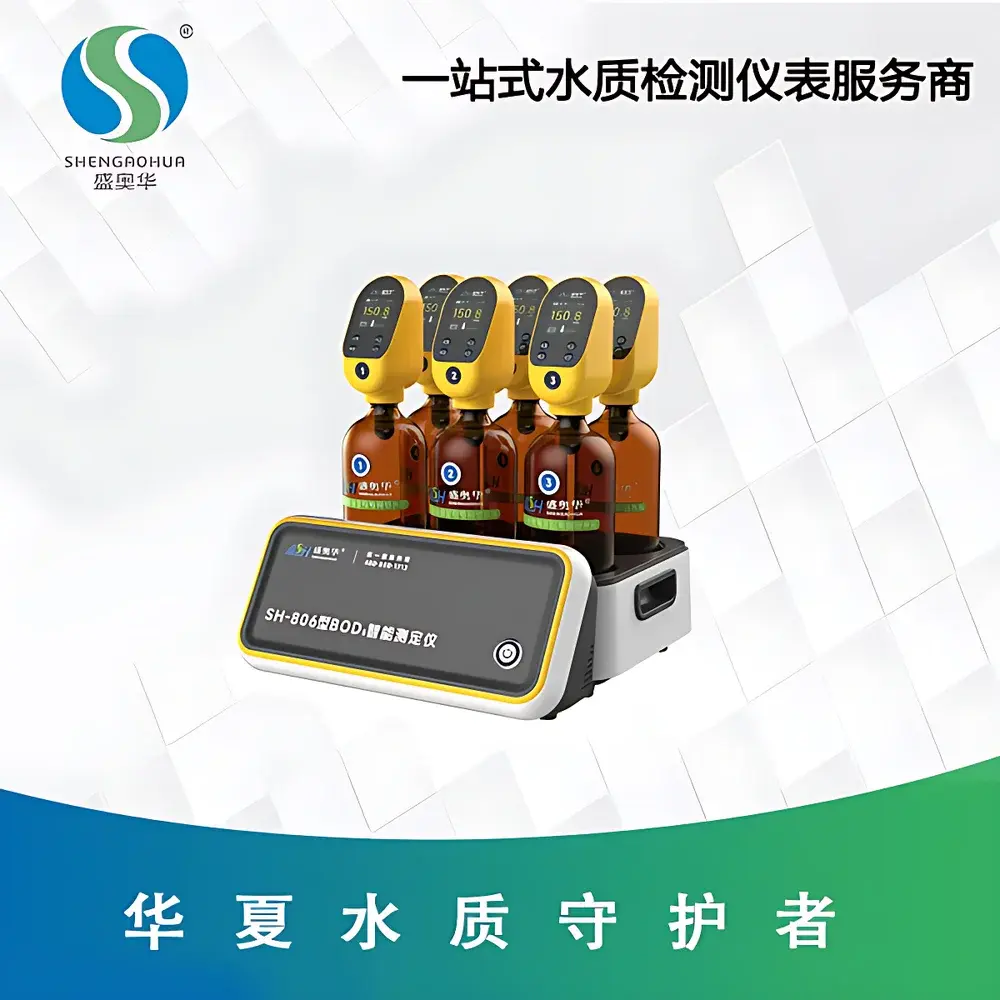
Shengaohua SH-804/806 BOD₅ Intelligent Analyzer
| Brand | Shengaohua |
|---|---|
| Origin | Jiangsu, China |
| Manufacturer Type | Direct Manufacturer |
| Product Category | Domestic |
| Model | SH-804 / SH-806 |
| Instrument Type | Laboratory BOD Analyzer |
| Measurement Principle | Manometric (Pressure-Difference) Method |
| Measurement Range | 0–4000 mg/L |
| Detection Limit | 0.1 mg/L |
| Accuracy | ±8% |
| Single-Sample Incubation Duration | 5 days |
| Repeatability | 3% |
| Sample Capacity | 4 (SH-804) / 6 (SH-806) per batch |
| Display | Independent Color LCD |
| Stirring Mechanism | Electromagnetic |
| Temperature Control | 20 °C ±1 °C |
| Data Logging Interval | Every 2 hours |
| Storage Capacity | 10,000 data sets |
| Resolution | 0.1 mg/L |
| Power Rating | 20 W |
| Net Weight | 1.6 kg (SH-804), 2.5 kg (SH-806) |
| Dimensions | 200 × 300 × 150 mm (SH-804), 300 × 300 × 150 mm (SH-806) |
Overview
The Shengaohua SH-804/806 BOD₅ Intelligent Analyzer is a laboratory-grade, manometric (pressure-difference) instrument engineered for precise and compliant measurement of biochemical oxygen demand (BOD₅) in aqueous samples according to HJ 505–2009 — the People’s Republic of China Environmental Protection Standard for the five-day incubation method. Unlike traditional dilution or titrimetric approaches, this system quantifies BOD₅ by monitoring real-time pressure differentials within sealed, CO₂-absorbing test vessels. During standard 5-day incubation at 20 °C ±1 °C, microbial oxidation of organic matter consumes dissolved oxygen; concurrently, evolved CO₂ is chemically trapped by potassium hydroxide (KOH) absorbent in the lid, inducing a measurable pressure drop proportional to oxygen consumption. This physical correlation eliminates mercury-based manometers and avoids volumetric calibration errors, delivering direct, traceable BOD₅ concentration output in mg/L without post-test calculation.
Key Features
- Mercury-free manometric detection with high-stability imported pressure sensors ensuring long-term signal integrity and metrological reliability
- Independent operation per sample vessel: each of the 4 (SH-804) or 6 (SH-806) chambers features autonomous temperature control, stirring, data acquisition, and on-device display
- Integrated color LCD interface with auto-sleep and one-touch wake-up functionality; supports real-time BOD₅ value visualization and dynamic trend graphs
- Electromagnetic stirring mechanism ensures uniform suspension of microbial consortia without mechanical wear or contamination risk
- Configurable incubation parameters: user-adjustable start delay, logging interval (default 2 h), and selectable among 10 built-in calibration curves optimized across sub-ranges (e.g., 0–20, 20–100, 100–4000 mg/L)
- Onboard rechargeable lithium battery enables portable deployment and uninterrupted operation during power fluctuations or field use
- Molded unibody chassis with ergonomic footprint (200 × 300 × 150 mm for SH-804; 300 × 300 × 150 mm for SH-806) designed for benchtop stability and lab space efficiency
Sample Compatibility & Compliance
The SH-804/806 accommodates standard 60 mL BOD bottles (glass or disposable) and is validated for use with domestic wastewater, industrial effluents, surface water, groundwater, agricultural runoff, and treated effluent streams. It meets functional equivalence to ISO 5815-1:2019 (Water quality — Determination of biochemical oxygen demand after n days — Part 1: BOD₅) and aligns with ASTM D5210–17 (Standard Test Method for Determining Anaerobic Biodegradation of Plastic Materials Under High-Solids Anaerobic Digestion Conditions) for aerobic respiration assessment. While not certified for GLP or 21 CFR Part 11 out-of-the-box, its audit-ready data logs (timestamped, immutable, with full parameter metadata) support integration into validated QA/QC workflows under ISO/IEC 17025-accredited laboratories.
Software & Data Management
All models record up to 10,000 time-stamped entries with automatic 2-hour sampling intervals. Data are stored internally with retention of incubation start time, temperature profile, pressure delta history, and final BOD₅ result. Export is supported via USB interface to CSV-compatible spreadsheets. The system allows manual calibration point entry and curve re-mapping using user-provided reference standards — critical for matrix-specific validation (e.g., high-salinity or low-nutrient samples). No proprietary software is required; raw files open natively in Excel or Python/Pandas for statistical analysis, outlier detection, and compliance reporting.
Applications
This analyzer serves routine BOD₅ monitoring in municipal wastewater treatment plants (influent/effluent QC), environmental consulting firms conducting discharge permit verification, university environmental engineering labs teaching standard methods, and agro-industrial facilities assessing process water biodegradability. Its portability and battery operation also support short-term field deployments for watershed assessments or emergency spill response where rapid, on-site BOD estimation is needed prior to confirmatory lab analysis.
FAQ
Does the SH-804/806 comply with U.S. EPA Method 405.1 or ISO 5815?
It implements the same biological principle and incubation conditions as ISO 5815-1:2019 and HJ 505–2009. While not formally EPA-recognized, its pressure-difference methodology satisfies the performance criteria outlined in EPA Method 405.1 for alternative BOD measurement techniques.
Can it measure samples with high turbidity or suspended solids?
Yes — unlike optical BOD sensors, the manometric method is unaffected by turbidity, color, or particulate load, provided the sample remains within the 0–4000 mg/L range and does not clog the KOH absorbent chamber.
Is external calibration required before each run?
No. Factory calibration is stable over time; however, users may perform optional two-point verification (zero air + known glucose-glutamic acid standard) per ISO 5815 recommendations for critical applications.
What maintenance is required for long-term reliability?
Routine replacement of KOH absorbent pellets (every 5–10 runs) and periodic sensor zero-check using ambient air are the only scheduled interventions. No fluid refills, electrode polishing, or optical cleaning are necessary.
How is data integrity ensured during extended 5-day runs?
The device logs all measurements with embedded timestamps and thermal metadata; power loss triggers automatic resume from last saved state, preserving continuity without data gap or interpolation.







