
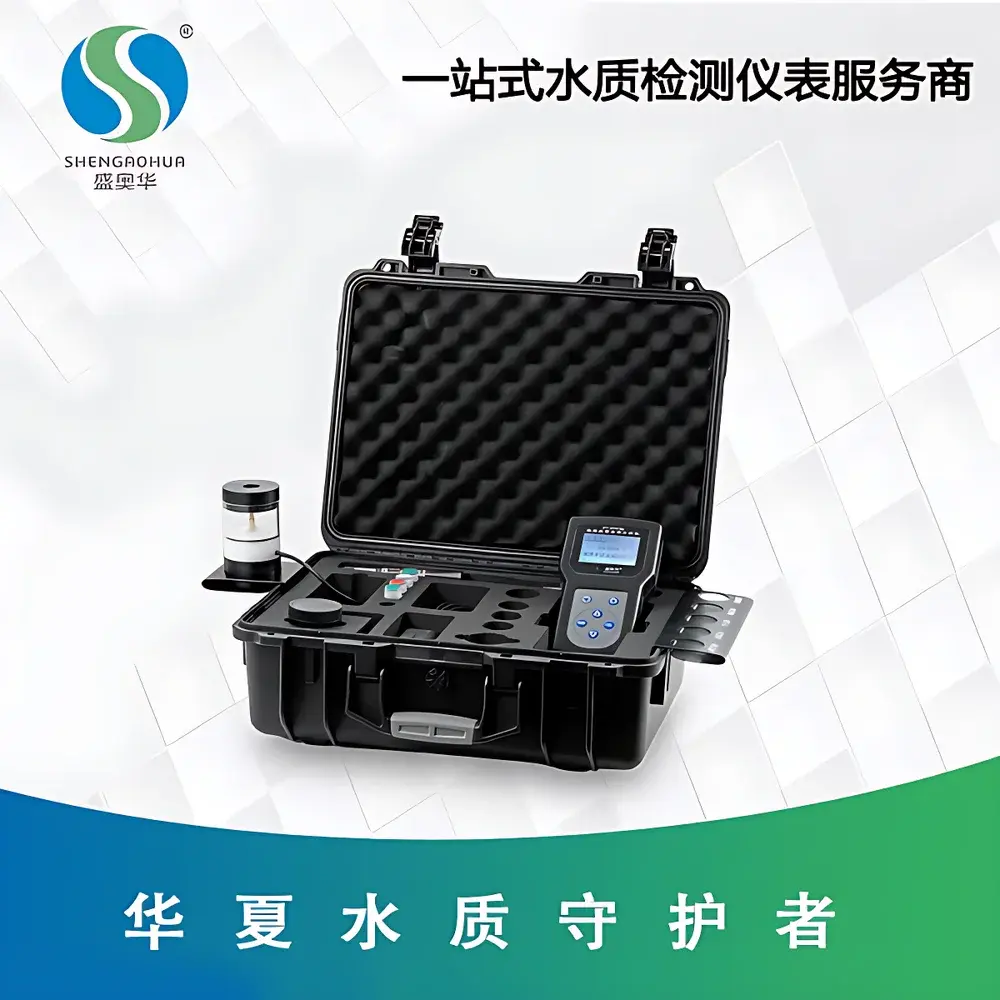
Shengaohua SH-9008 (V11) Portable Heavy Metals Analyzer
| Brand | Shengaohua |
|---|---|
| Origin | Jiangsu, China |
| Manufacturer Type | Direct Manufacturer |
| Product Category | Domestic |
| Model | SH-9008 (V11) |
| Instrument Type | Portable |
| Detection Principle | Anodic Stripping Voltammetry (ASV) |
| Detectable Metals | Cu, Pb, Cd, Zn, Hg, As(III) |
| Analysis Time | ≤3 min per sample |
| Accuracy | ≤±3% |
| Resolution | 0.01 ppb |
| Measurement Range (Zn) | 0.5 ppb–40 ppm |
| Measurement Range (Pb) | 0.5 ppb–50 ppm |
| Measurement Range (Cd) | 0.1 ppb–40 ppm |
| Measurement Range (Cu) | 0.1 ppb–30 ppm |
| Measurement Range (Hg) | 0.1 ppb–6 ppm |
| Measurement Range (As(III)) | 1 ppb–20 ppm |
| Repeatability (RSD) | ≤5% |
| Operating Temperature | 0–50 °C |
| Relative Humidity | 10–90% RH |
| Power Supply | Internal Li-ion battery + 12 V DC adapter |
| Dimensions (L×W×H) | 220 × 110 × 40 mm |
| Net Weight | 4.8 kg |
Overview
The Shengaohua SH-9008 (V11) Portable Heavy Metals Analyzer is a field-deployable electrochemical instrument engineered for rapid, on-site quantification of priority toxic metals in aqueous matrices. It employs anodic stripping voltammetry (ASV), a well-established electroanalytical technique standardized under GB/T 3914–2008 and GB 17378.4–2007, to deliver trace-level detection with high specificity and reproducibility. ASV operates by first pre-concentrating target metal ions onto a working electrode surface via controlled reduction (deposition), followed by oxidative stripping under a linearly scanned potential. The resulting current peaks are directly proportional to analyte concentration and exhibit characteristic peak potentials that enable multi-element discrimination. Designed for regulatory compliance and operational resilience, the SH-9008 (V11) supports environmental monitoring workflows requiring immediate decision-making—such as emergency response to industrial spills, routine river basin surveillance, drinking water source assessment, aquaculture management, and coastal seawater quality verification.
Key Features
- True portable architecture: Compact footprint (220 × 110 × 40 mm) and lightweight design (4.8 kg net) enable single-operator deployment in remote or constrained field environments without external power infrastructure.
- Dual-mode operation: Integrated rechargeable Li-ion battery and 12 V DC input provide uninterrupted operation during extended campaigns; runtime exceeds 8 hours under typical measurement cycles.
- Multi-parameter independent electrode module: Modular working electrodes for Zn, Pb, Cd, Cu, Hg, and As(III) operate autonomously—eliminating cross-contamination and enabling concurrent calibration or sequential analysis without hardware reconfiguration.
- Automated electrode maintenance: Onboard electrochemical cleaning protocol ensures consistent electrode surface activity across >500 measurements, minimizing manual intervention and inter-run variability.
- Intuitive dual-language interface: Graphical user interface supports seamless switching between English and Chinese, with context-sensitive prompts guiding users through sampling, calibration, and analysis steps—no prior electrochemistry expertise required.
- High-fidelity data acquisition: 24-bit analog-to-digital conversion and real-time background subtraction yield stable baseline resolution down to 0.01 ppb, meeting trace quantification requirements for WHO and EPA screening thresholds.
Sample Compatibility & Compliance
The SH-9008 (V11) is validated for direct analysis of unfiltered or minimally pretreated water samples—including surface water, groundwater, wastewater effluents, seawater, aquaculture pond water, and potable water sources. Sample volume requirement is ≤15 mL per test. Matrix tolerance has been verified across salinities up to 35 ppt (seawater) and turbidities ≤100 NTU. All reported performance metrics—including accuracy (≤±3%), repeatability (RSD ≤5%), and detection limits—are determined per ISO 8466-1:2021 (calibration validation) and aligned with method performance criteria in US EPA Method 7000B for ASV-based metal analysis. Instrument firmware supports audit-trail logging compliant with GLP principles, including timestamped operator ID, calibration history, and raw voltammogram storage.
Software & Data Management
On-device data storage accommodates ≥1,000 complete analytical records, each containing full voltammograms, peak identification metadata, calibration coefficients, and environmental condition stamps (temperature, humidity). Optional PC connectivity via USB-C enables bidirectional data exchange with Shengaohua’s proprietary desktop software, which supports batch report generation in PDF/CSV formats, statistical trend analysis, and customizable certificate-of-analysis templates. Software architecture adheres to FDA 21 CFR Part 11 functional expectations—including electronic signature capability, role-based access control, and immutable audit logs—for laboratories operating under regulated quality systems.
Applications
- Rapid response to industrial discharge incidents involving heavy metal contamination
- Regulatory compliance monitoring at wastewater treatment plant outfalls and receiving waters
- Baseline and longitudinal assessment of river, lake, and estuarine ecosystems
- Drinking water safety verification at intake points and distribution nodes
- Marine environmental monitoring in ports, marinas, and offshore aquaculture zones
- Field screening for remediation site characterization and post-treatment verification
- Academic and governmental research programs requiring high-temporal-resolution metal speciation data
FAQ
What electrochemical method does the SH-9008 (V11) use, and how is it validated?
It implements anodic stripping voltammetry (ASV) per GB/T 3914–2008 and GB 17378.4–2007. Validation includes spike recovery studies (85–115%), matrix interference testing, and inter-laboratory comparison against ICP-MS reference methods.
Can the instrument measure As(III) selectively in the presence of As(V)?
Yes—the ASV protocol targets As(III) specifically; As(V) requires pre-reduction (e.g., using KI/ascorbic acid) and is not detected without this step.
Is method-specific certification available for regulatory submissions?
Instrument performance documentation, including LOD/LOQ determination reports and precision studies, is provided with each unit and meets minimum evidentiary requirements for local environmental authority acceptance.
How often must the electrodes be replaced or serviced?
Under normal field use (≤10 analyses/day), the solid-state working electrodes maintain performance for ≥12 months; replacement kits and recalibration services are available directly from Shengaohua.
Does the device support external GPS tagging of sample locations?
GPS integration is not embedded; however, location metadata can be manually appended during sample registration or synchronized via third-party GIS-compatible export formats.
Related Products







