

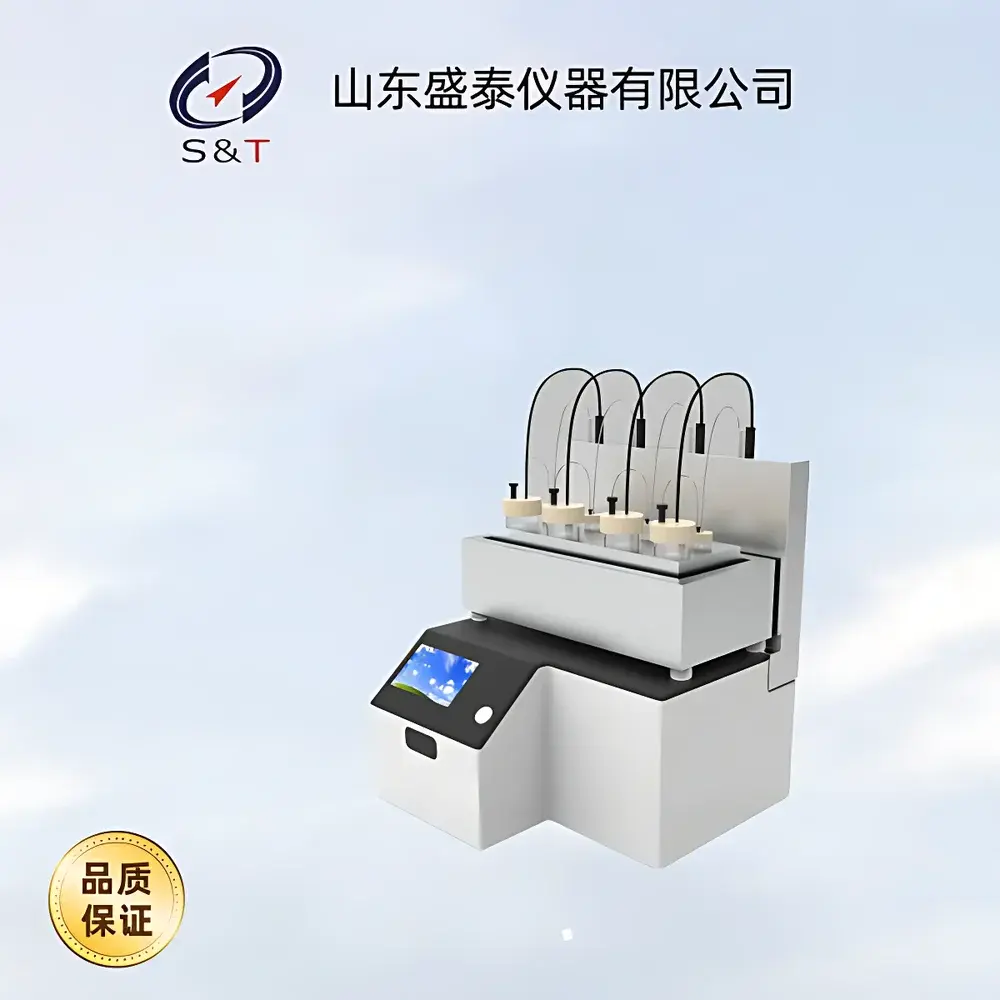
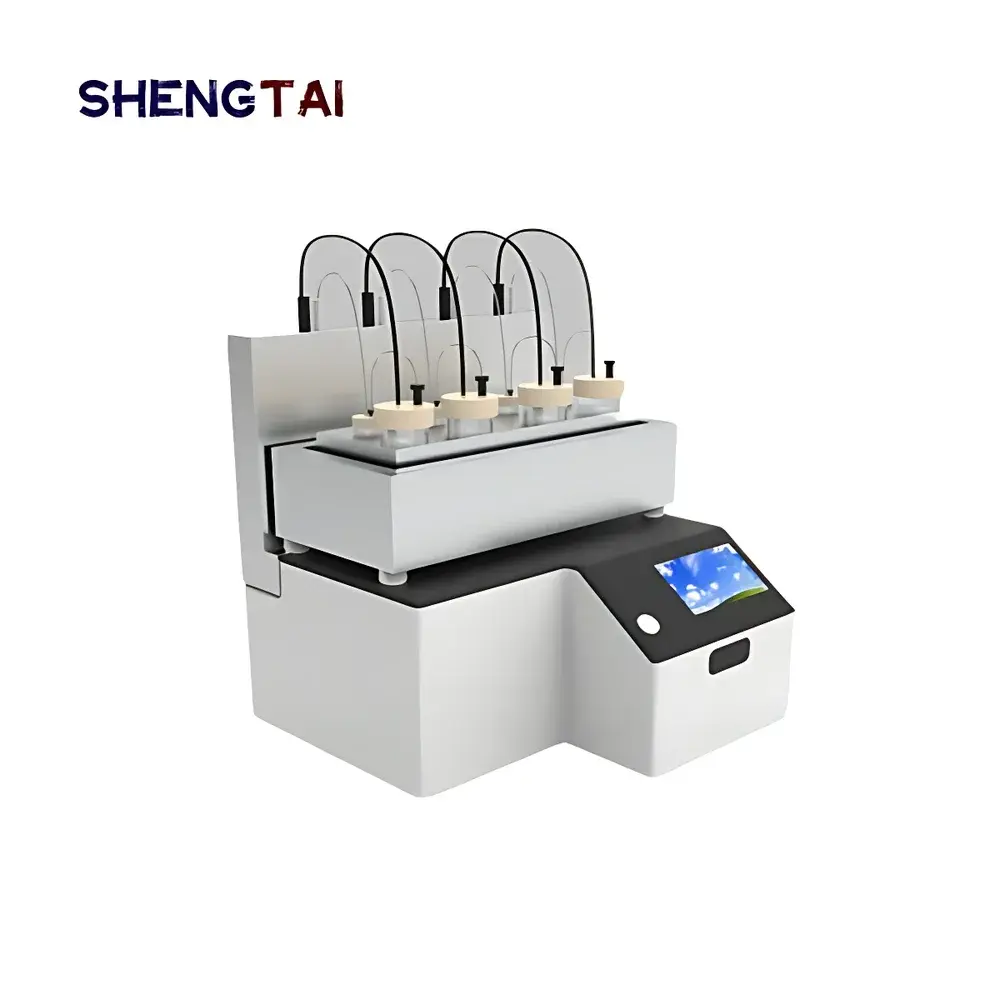
Shengtai Instruments ST-149 Automated Oil Oxidative Stability Analyzer (OSI)
| Brand | Shengtai Instruments |
|---|---|
| Origin | Shandong, China |
| Manufacturer Type | Direct Manufacturer |
| Country of Origin | China |
| Model | ST-149 |
| Price Range | USD 28,000–71,000 |
| Standard Compliance | GB/T 21121-2007, ISO 6886:2006, JIS CDM 2.4.28.2-93 |
| Sample Mass | 3 g |
| Temperature Control Range | Ambient to 220 °C |
| Max Safety Cut-off | 260 °C |
| Heating Method | Metal Bath with Four Independent Zones |
| Air Flow Range | 1–30 L/h at 25 °C and 101.325 kPa |
| Conductivity Measurement Range | 0–500 µS/cm |
| Conductivity Resolution | 0.1 µS/cm |
| Data Storage Capacity | 199 test records |
| Output Format | CSV / Excel via USB flash drive |
| Display | 7-inch color LCD touchscreen |
| Software | Embedded & PC-compatible OSI calculation engine with second-derivative induction point detection |
| Dimensions (W×D×H) | 420 × 390 × 480 mm |
| Net Weight | 26 kg |
Overview
The Shengtai Instruments ST-149 Automated Oil Oxidative Stability Analyzer is an engineered solution for the quantitative assessment of oxidative stability in edible oils, fats, and lipid-containing matrices using the Accelerated Oxidation Test (AOT) principle. It operates on the standardized Rancimat method—measuring the conductometric shift induced by volatile organic acids generated during forced oxidation. In this process, a precisely regulated stream of synthetic air is passed through an oil sample maintained at a constant elevated temperature in a metal bath heating block. As oxidation progresses, low-molecular-weight carboxylic acids (e.g., formic, acetic, propionic) volatilize and are carried into a conductivity cell where they dissolve in deionized water, increasing its ionic conductivity. The instrument continuously monitors electrical conductivity in real time; the inflection point—identified algorithmically as the maximum of the second derivative of the conductivity curve—corresponds to the end of the induction period (IP), reported as the Oxidative Stability Index (OSI) in hours. This measurement provides a reproducible, comparative metric for shelf-life prediction, antioxidant efficacy evaluation, and quality control across food, feed, and biofuel applications.
Key Features
- Four independently controlled metal bath heating zones (ambient to 220 °C), each programmable with discrete setpoints or synchronized operation
- Integrated precision diaphragm air pump with electronic mass flow control (1–30 L/h, calibrated at 25 °C and 101.325 kPa)
- High-resolution conductometric detection system (0–500 µS/cm range, 0.1 µS/cm resolution) with continuous real-time acquisition
- 7-inch full-color LCD touchscreen interface supporting standalone operation, including live curve visualization, status monitoring, and manual start/stop controls
- Automated induction period calculation using second-derivative peak detection—aligned with ISO 6886:2006 Annex A recommendations
- Temperature over-limit protection: automatic shutdown at 260 °C to prevent thermal damage or safety hazards
- Onboard data storage for up to 199 complete test records, with timestamped metadata (date, temperature, airflow, sample ID)
- USB flash drive export capability supporting CSV and Excel (.xlsx) formats for long-term archiving and external statistical analysis
- Optional barcode scanner integration for rapid, error-resistant sample identification and traceability
- Comprehensive software suite compatible with Windows OS, enabling remote instrument control, multi-batch scheduling, and GLP-compliant audit trail generation
Sample Compatibility & Compliance
The ST-149 supports a broad spectrum of lipid samples per internationally recognized protocols. It is validated for direct analysis of refined vegetable oils (soybean, sunflower, rapeseed, palm, peanut), animal fats (butter, lard, fish oil), and fat-rich food products—including cosmetics, margarine, cereals, baked goods, nuts, cured meats, and sausages—following lipid extraction per AOAC 993.21 or ISO 12966-2. The system also accommodates biodiesel feedstocks (FAME) and catalytic oxidation studies (e.g., copper-induced degradation per ASTM D2274). Its design fully complies with GB/T 21121-2007, ISO 6886:2006, and JIS CDM 2.4.28.2-93, ensuring regulatory acceptability in Chinese, European, and Japanese markets. All hardware and firmware meet electromagnetic compatibility (EMC) requirements per IEC 61326-1 and functional safety guidelines for laboratory instrumentation.
Software & Data Management
The embedded firmware and companion PC software implement a structured database architecture supporting full traceability and data integrity. Each test record includes raw conductivity vs. time series, calculated OSI value, temperature profile logs, airflow calibration verification, and operator-defined annotations. The software performs automated baseline correction, noise filtering, and robust second-derivative-based induction point determination—minimizing subjective interpretation. Exported datasets include metadata headers compliant with FAIR principles (Findable, Accessible, Interoperable, Reusable). For regulated environments, optional audit trail modules log all user actions (login/logout, parameter changes, result overrides) in accordance with FDA 21 CFR Part 11 requirements when configured with electronic signatures and role-based access control.
Applications
- Quality assurance of crude and refined edible oils during production and storage
- Evaluation of natural and synthetic antioxidant performance (e.g., tocopherols, TBHQ, BHA/BHT, rosemary extract)
- Stability screening of novel lipid formulations in functional foods and nutraceuticals
- Oxidative degradation kinetics modeling for shelf-life extension studies
- Regulatory compliance testing for labeling claims (e.g., “high oleic”, “antioxidant-enriched”)
- R&D support for biodiesel (FAME) oxidation resistance optimization
- Investigation of pro-oxidant effects (e.g., transition metals, light exposure, processing residues)
- Method transfer and validation across QC laboratories operating under ISO/IEC 17025 accreditation
FAQ
What standards does the ST-149 comply with?
The instrument is designed and verified against GB/T 21121-2007, ISO 6886:2006, and JIS CDM 2.4.28.2-93 for oxidative stability determination.
Can multiple samples be tested simultaneously?
Yes—the four independent heating blocks allow parallel testing of up to four samples at identical or different temperatures and airflow conditions.
Is calibration required before each test?
No routine recalibration is needed; the system uses factory-traceable Pt100 sensors and pre-calibrated airflow electronics. Daily verification with reference oil (e.g., AOCS Cd 12b-92 certified standard) is recommended for QA/QC.
How is the induction period determined mathematically?
The software computes the second derivative of the conductivity curve and identifies its global maximum, which corresponds to the steepest inflection—consistent with ISO 6886:2006 Annex A methodology.
Does the system support network connectivity or LIMS integration?
While native Ethernet or Wi-Fi is not included, exported CSV/Excel files are fully compatible with common LIMS platforms; custom API integration can be implemented via RS-232 or USB virtual COM port upon request.






