
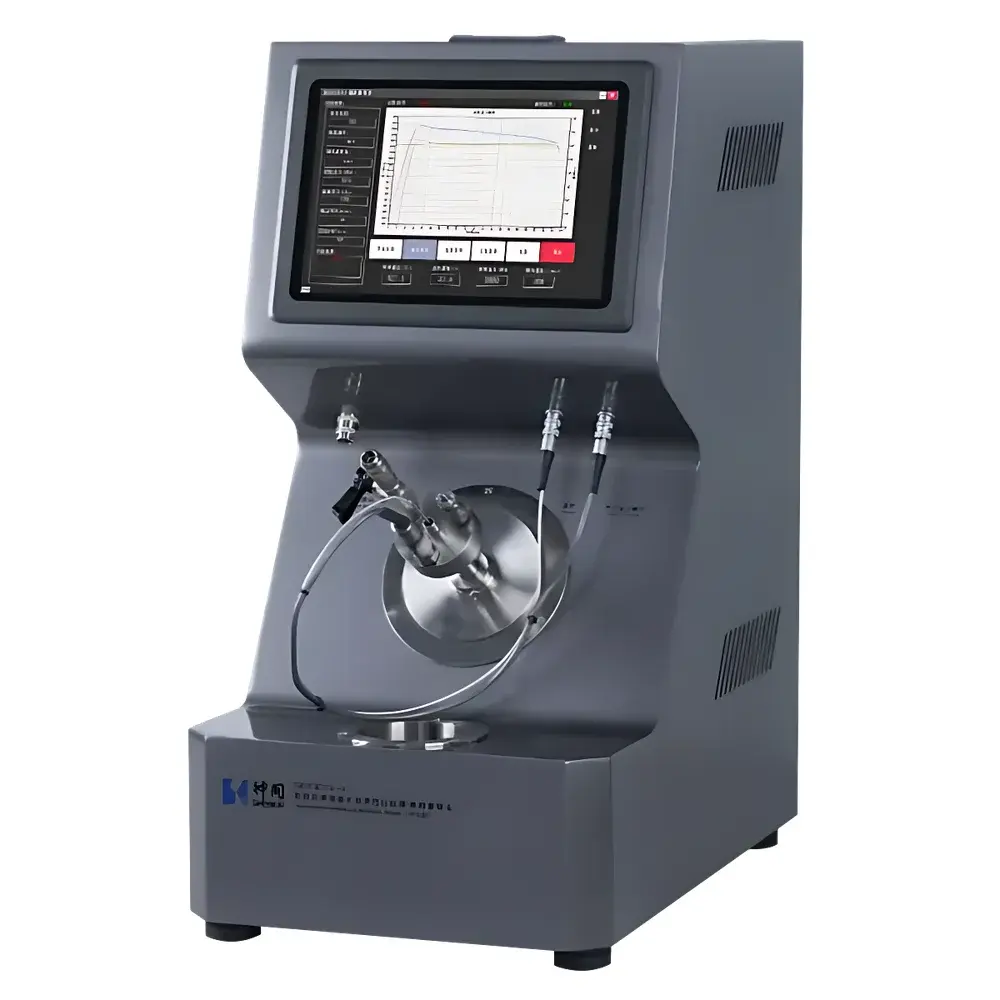
Shenkai SKY3012-III Automatic Oxidation Stability Tester for Lubricating Oils (Rotating Pressure Vessel Method)
| [Brand | Shenkai |
|---|---|
| Origin | Shanghai, China |
| Model | SKY3012-III |
| Test Method Compliance | ASTM D2272, ASTM D2112, SH/T 0193, IP 229 |
| Temperature Control Accuracy | ±0.1°C at 140.0°C and 150.0°C |
| Sample Mass | 50 g ±0.5 g |
| Oxygen Bomb Rotation Speed | 100 rpm ±1 rpm |
| Oxygen Charging Pressure | 620 kPa ±1.4 kPa (max 680 kPa) |
| Pressure Measurement Range | 0–1.6 MPa, accuracy 0.1% FS |
| Oxygen Bomb Tilt Angle | 30° |
| Heating Medium | Solid metal bath |
| Power Supply | AC 220 V ±10%, 50/60 Hz, 1400 W |
| Dimensions (W×D×H) | 320 × 540 × 640 mm |
| Net Weight | 63 kg |
| Ambient Operating Conditions | 20–30°C, 20–80% RH] |
Overview
The Shenkai SKY3012-III Automatic Oxidation Stability Tester is an engineered solution for quantitative assessment of oxidation resistance in turbine oils, mineral insulating oils, and other petroleum-based lubricants containing antioxidant additives. It operates on the rotating pressure vessel oxidation test principle—commonly referred to as the Rotating Bomb Oxidation Test (RBOT)—in strict accordance with ASTM D2272, ASTM D2112, SH/T 0193, and IP 229. In this method, a precisely weighed oil sample (50 g ±0.5 g) is introduced into a stainless-steel oxygen bomb along with a standardized copper catalyst wire. The sealed bomb is pressurized with high-purity oxygen (>99.5%), rotated at 100 rpm ±1 rpm at a fixed tilt angle of 30°, and immersed in a thermally stable metal bath maintained at either 140.0°C or 150.0°C with ±0.1°C precision. Oxidation progress is monitored continuously via real-time pressure decay kinetics; the inflection point in the pressure–time curve—corresponding to rapid peroxide decomposition—is automatically detected as the endpoint. This physical–chemical endpoint correlates directly with oxidative induction time and provides reproducible, traceable data for quality control, formulation development, and in-service oil condition monitoring.
Key Features
- iSKvator™ intelligent automation architecture enables fully unattended operation from sample loading through endpoint detection and report generation
- Patented solid metal bath heating system eliminates dependence on silicone oil—removing risks associated with thermal degradation, vapor inhalation, fluid replenishment, and post-test cleaning complexity
- High-stability magnetic coupling drive ensures smooth, vibration-free rotation under elevated temperature and pressure conditions, preventing demagnetization or slippage during extended tests
- Front-access oxygen manifold with integrated micro-charging/micro-venting valves allows precise pressure adjustment without requiring fume hood containment
- Dual-mode oxygen control: automatic pressure regulation with ambient temperature compensation, plus manual override for method-specific calibration or validation protocols
- Modular magnetic-latch enclosure design simplifies maintenance access while maintaining structural rigidity and thermal isolation integrity
- Embedded precision pressure transducer (0–1.6 MPa, 0.1% FS) and calibrated analog pressure gauge (0.25 class) provide redundant, NIST-traceable pressure monitoring
Sample Compatibility & Compliance
The SKY3012-III is validated for use with new and in-service turbine oils sharing identical base oil–additive chemistry, as well as new antioxidant-containing mineral insulating oils. Its mechanical and thermal specifications align with the dimensional, material, and procedural constraints defined in ASTM D2272-2022 (including both Option A and Option B reporting formats), ASTM D2112, SH/T 0193, and IP 229. Copper catalyst wire dimensions and metallurgical grade are pre-verified against ASTM-specified tolerances. All critical process parameters—including bath temperature stability, oxygen partial pressure, rotational dynamics, and leak detection thresholds—are programmatically enforced and logged with timestamped audit trails. The instrument supports GLP-compliant workflows through configurable user access levels, electronic signatures, and tamper-evident data storage—facilitating alignment with FDA 21 CFR Part 11 requirements when integrated into regulated laboratory environments.
Software & Data Management
The Windows-based instrument control software functions as a centralized analytical workflow manager. It orchestrates temperature ramping, oxygen charging, real-time pressure/temperature acquisition, leak verification cycles, kinetic curve analysis, and automated endpoint determination. Raw sensor data (10 Hz sampling rate) is stored in encrypted binary format with metadata tagging (sample ID, operator, method version, calibration status). Reports—generated upon test completion—include sample name, batch ID, initial/peak pressure, time-to-peak, total duration, and pass/fail classification per selected standard. Historical results are indexed by sample attribute and timestamp, enabling cross-batch trend analysis. Native USB and RJ-45 Ethernet interfaces support direct integration with enterprise LIMS platforms via ASTM E1384-compliant messaging or HL7-compatible adapters. Audit logs record all parameter modifications, user logins, and system events for regulatory review.
Applications
- Quality assurance of new turbine and insulating oils prior to commissioning
- Comparative evaluation of antioxidant package efficacy across lubricant formulations
- In-service oil monitoring to assess remaining useful life and schedule proactive replacement
- Research into oxidation mechanisms and catalytic effects of metallic contaminants
- Validation of re-refined base oil stability following regeneration processes
- Support for ISO 55001 asset management programs through predictive oil health analytics
FAQ
Does the SKY3012-III comply with the latest revision of ASTM D2272?
Yes—it implements ASTM D2272-2022 and supports both Option A (fixed-time termination) and Option B (inflection-point detection) reporting modes.
Can the instrument be operated without a dedicated ventilation hood?
Yes—the front-access oxygen handling system and absence of volatile heating media eliminate mandatory fume hood use, though local safety protocols should still be observed.
Is remote monitoring or multi-instrument synchronization supported?
Yes—via Ethernet interface and standardized TCP/IP command set, enabling centralized lab-wide instrument supervision and coordinated test scheduling.
How is calibration traceability maintained for pressure and temperature measurements?
Pressure sensors are factory-calibrated against NIST-traceable deadweight testers; temperature uniformity across the metal bath is verified using ASTM E74-compliant reference thermocouples.
What happens if a pressure leak is detected during a test?
The system halts oxygen charging, triggers audible/visual alerts, logs the event with diagnostic codes, and suspends further automation until user confirmation or corrective action.





