
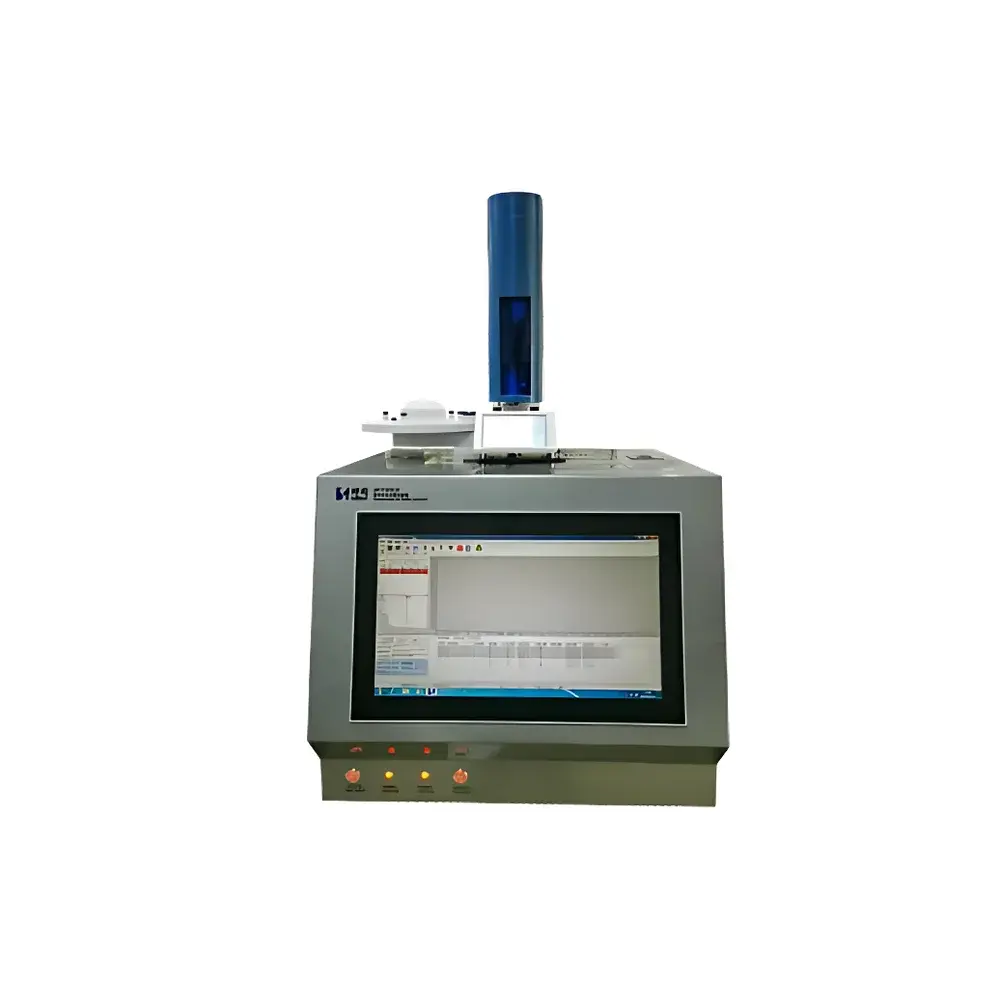
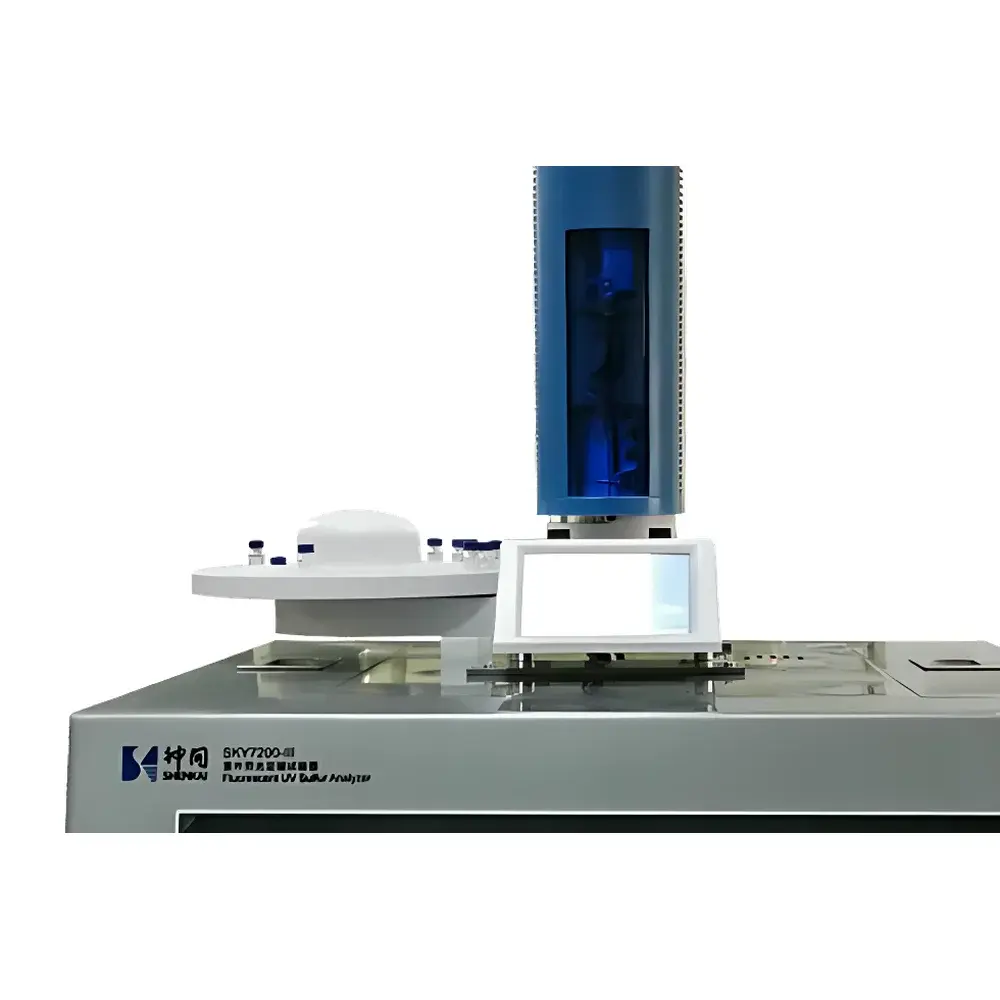
Shenkai SKY7200-III Automated UV Fluorescence Total Sulfur Analyzer
| Brand | Shenkai |
|---|---|
| Origin | Shanghai, China |
| Model | SKY7200-III |
| Detection Method | High-Temperature Combustion UV Fluorescence |
| Detection Range | 0.2–10,000 mg/kg |
| LOD | 0.2 mg/kg |
| Sample Type | Liquid hydrocarbons (gasoline, diesel, jet fuel, biodiesel, naphtha, ethanol, FAME) |
| Compliance | ASTM D5453, SH/T 0689, GB/T 34100 |
| Furnace Temp | Up to 1075 °C ±25 °C |
| Sample Volume | 5–50 µL |
| Autosampler | 16- or 156-position |
| Gas Control | Triple high-precision mass flow controllers (Ar, O₂-inlet, O₂-pyrolysis) |
| Drying | Imported membrane dryer with auto-backflush |
| Display | 19″ color touchscreen IPC |
| Data Storage | >5,000 test records |
| Power | AC 220 V ±5%, 50 Hz, ≥3 kW |
| Dimensions (H×W×D) | Main unit 525×694×603 mm |
| Weight | 60 kg |
| Operating Environment | 10–30 °C, 20–80% RH |
Overview
The Shenkai SKY7200-III Automated UV Fluorescence Total Sulfur Analyzer is a dedicated benchtop instrument engineered for precise, trace-level quantification of total sulfur in liquid petroleum products. It implements the high-temperature combustion ultraviolet fluorescence (UVF) detection principle per ASTM D5453, SH/T 0689, and GB/T 34100. In this method, a precisely metered liquid sample is injected into a quartz pyrolysis tube operating at up to 1075 °C under controlled oxygen-rich conditions. Complete oxidative decomposition converts all organic and inorganic sulfur species into sulfur dioxide (SO₂). The resulting SO₂ gas stream is dried via a high-efficiency imported membrane dryer and carried by ultra-pure argon into a reaction chamber where it is exposed to 190–230 nm UV light. This excites SO₂ molecules, which subsequently emit characteristic fluorescence at ~340 nm. A calibrated photomultiplier tube detects the emitted signal intensity, which is linearly proportional to sulfur concentration across the full dynamic range of 0.2–10,000 mg/kg. The system’s design eliminates matrix-dependent bias, enabling accurate sulfur measurement regardless of compound class—whether thiophenes, sulfides, mercaptans, or sulfate esters—making it indispensable for refinery QC, fuel certification, and regulatory compliance testing.
Key Features
- Triple high-accuracy mass flow controllers for independent, real-time regulation of carrier argon, inlet oxygen, and pyrolysis oxygen—ensuring stoichiometric combustion consistency and minimizing low-concentration drift.
- Vertical quartz pyrolysis tube with optimized geometry and catalyst-free operation, reducing carbon deposition and extending service intervals between maintenance cycles.
- Imported membrane dryer with automated backflush function to remove moisture and volatile interferences without consumables or manual intervention.
- Integrated industrial PC with 19-inch capacitive touchscreen interface—supporting full local control, method setup, calibration management, and real-time status monitoring without external computers.
- Dual-capacity autosampler options (16- or 156-position) with temperature-stable syringe drive and sealed vial handling, delivering long-term injection repeatability and eliminating operator-induced variability.
- Digital furnace temperature control with ±25 °C stability across the full 25–1075 °C range, ensuring consistent thermal decomposition kinetics and minimizing inter-run variance.
- Comprehensive hardware safety interlocks: automatic abort on insufficient furnace temperature, low O₂/Ar pressure, or gas flow deviation—preventing incomplete combustion and carbon fouling.
- UV lamp, PMT, optical filters, and membrane dryer components sourced from original equipment manufacturers in Europe and Japan to guarantee long-term photometric stability and signal reproducibility.
Sample Compatibility & Compliance
The SKY7200-III is validated for direct analysis of volatile and non-volatile liquid hydrocarbon matrices without derivatization or pre-treatment. Compatible samples include gasoline, diesel fuel, jet fuel (Jet A-1, JP-8), biodiesel (B100), fatty acid methyl esters (FAME), naphtha, ethanol blends (E10, E85), and lubricant base stocks. Its performance meets or exceeds the precision requirements of ASTM D5453 (repeatability ≤4% RSD above 10 mg/kg; ≤9% at 1–10 mg/kg), SH/T 0689 (Chinese national standard for light petroleum products), and GB/T 34100 (for automotive fuels). Instrument design supports GLP-compliant operation: audit-trail-enabled software logs all parameter changes, calibration events, and run metadata. Optional 21 CFR Part 11 compliance packages are available for regulated laboratories requiring electronic signature, role-based access control, and immutable data archiving.
Software & Data Management
The embedded Windows-based software provides full method development, calibration curve generation (single-point or multi-point with quadratic or linear fitting), and real-time chromatogram-like display of UVF response. Each analysis generates timestamped metadata including furnace temperature profile, gas flow rates, peak area/intensity, and calculated sulfur concentration. Data export supports CSV, PDF, and XML formats. Native LIMS integration is achieved via ASTM E1384-compliant HL7 messaging or direct SQL database push. Over 5,000 test records—including raw signals, calibration history, and QC check results—are retained locally with configurable auto-backup to network drives or USB storage. All data fields support user-defined annotations for batch tracking, analyst ID, and instrument maintenance logs.
Applications
- Refinery process control: Monitoring sulfur removal efficiency in hydrotreaters and FCC units.
- Fuel certification: Verifying compliance with Euro 5/6, EPA Tier 3, and China VI sulfur limits (≤10 mg/kg).
- Biodiesel quality assurance: Quantifying residual sulfur from feedstock contamination or catalyst carryover.
- Research & development: Screening novel desulfurization catalysts and evaluating sulfur speciation impact on engine emissions.
- Contract testing laboratories: High-throughput analysis for third-party verification of commercial fuel shipments.
- Regulatory enforcement: Supporting customs and environmental agencies in verifying fuel sulfur declarations.
FAQ
What detection principle does the SKY7200-III use, and why is it preferred for low-level sulfur analysis?
It employs high-temperature combustion followed by UV fluorescence detection—a method recognized for its exceptional sensitivity (LOD = 0.2 mg/kg), minimal matrix interference, and direct response to total sulfur regardless of molecular form.
Can the instrument analyze viscous or high-boiling samples like heavy fuel oil?
No—the SKY7200-III is optimized for distillate-range liquids (flash point < 100 °C). Heavy fuel oils require dilution or alternative methods such as XRF or WDXRF.
Is calibration traceable to NIST-certified standards?
Yes—calibration is performed using NIST-traceable sulfur standards in toluene or xylene matrices, with certificate of analysis provided for each batch.
How often does the quartz pyrolysis tube require cleaning or replacement?
Under routine use with clean fuels, cleaning is recommended every 500–1,000 injections; tube lifetime typically exceeds 3,000 analyses when operated within specified temperature and oxygen flow parameters.
Does the system support remote diagnostics or preventive maintenance alerts?
Yes—the embedded OS supports secure remote desktop access for technical support, and firmware monitors critical component health (e.g., PMT gain drift, UV lamp intensity decay, membrane dryer efficiency) with configurable warning thresholds.



