
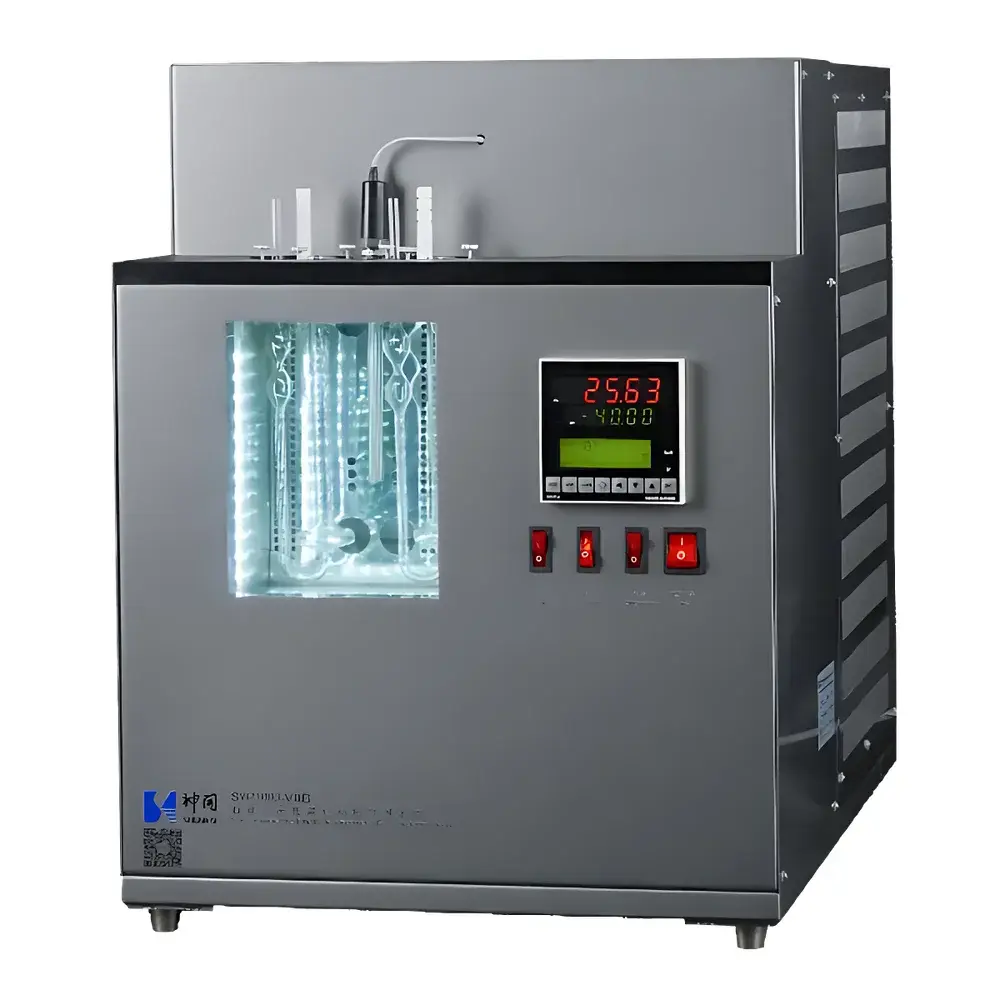
Shenkai SYP1003-VIIIB Low-Temperature Kinematic Viscosity Tester
| Brand | Shenkai |
|---|---|
| Origin | Shanghai, China |
| Model | SYP1003-VIIIB |
| Test Hole Count | 2 |
| Bath Capacity | 4 L |
| Temperature Control Range | −60 °C to 20 °C |
| Temperature Stability | ±0.05 °C |
| Cooling Method | Cascade Refrigeration System |
| Power Supply | AC 220 V ±10%, 50 Hz |
| Total Power Consumption | ≤1500 W |
| Dimensions (W×D×H) | 450 mm × 600 mm × 590 mm |
| Net Weight | 60 kg |
Overview
The Shenkai SYP1003-VIIIB Low-Temperature Kinematic Viscosity Tester is a precision-engineered instrument designed for the standardized determination of kinematic viscosity in liquid petroleum products—specifically Newtonian fluids—at sub-ambient temperatures. It operates in strict accordance with GB/T 265, the Chinese national standard equivalent to ASTM D445 and ISO 3104 for kinematic viscosity measurement by capillary viscometry. The system employs a gravity-driven capillary flow principle: kinematic viscosity (ν) is calculated as the product of the measured efflux time (t) and the calibrated viscometer constant (C), yielding units in mm²/s (equivalent to centistokes, cSt). When required, dynamic viscosity (η) can be derived by multiplying ν by the fluid’s density (ρ) at the test temperature (η = ν × ρ), supporting comprehensive rheological characterization under controlled thermal conditions.
Key Features
- Integrated monoblock architecture minimizes footprint and simplifies installation, calibration, and routine maintenance—no external chillers or auxiliary cooling units required.
- Cascade refrigeration system featuring dual-stage imported compressors enables rapid, stable cooling from ambient to −60 °C, with precise thermal ramping and hold capability across the full operating range.
- Vacuum-insulated double-glazed observation window ensures unobstructed visual monitoring of capillary flow without thermal bridging or condensation interference; integrated high-CRI LED illumination enhances clarity during low-light operation.
- Continuous PID-based temperature control delivers exceptional thermal uniformity (<±0.05 °C) throughout the 4 L stainless-steel cold bath, validated per IEC 61000-4-30 for long-term stability under variable load conditions.
- Dual independent test ports allow concurrent analysis of two samples or reference/blank validation runs, improving throughput while maintaining traceable inter-channel consistency.
Sample Compatibility & Compliance
The SYP1003-VIIIB is validated for use with transparent, homogeneous, Newtonian petroleum liquids—including base oils, diesel fuels, jet fuels (e.g., Jet A-1), lubricants, and hydrocarbon solvents—within specified volatility and cleanliness limits per GB/T 265 Annex A. Non-Newtonian or particulate-laden samples require pre-filtration or alternative testing methods (e.g., rotational rheometry). The instrument supports compliance workflows aligned with ISO/IEC 17025 laboratory accreditation requirements, including documented temperature verification protocols using NIST-traceable PT100 sensors and periodic calibration against certified reference standards (e.g., Cannon-Manning certified oil sets). While not inherently 21 CFR Part 11 compliant, its analog control architecture permits integration into validated environments via external data loggers meeting ALCOA+ principles (Attributable, Legible, Contemporaneous, Original, Accurate, Complete, Consistent, Enduring, Available).
Software & Data Management
The SYP1003-VIIIB operates via embedded microcontroller-based hardware with local digital display and manual timer input. It does not include proprietary software or network connectivity; however, it is fully compatible with third-party laboratory information management systems (LIMS) and electronic lab notebooks (ELN) via RS-232 or optional USB-to-serial interface (available as accessory). All temperature setpoints, dwell times, and efflux measurements are manually recorded in accordance with GLP documentation practices. For GMP-regulated facilities, users may implement audit-trail-enabled external timers and digital thermometers qualified per IQ/OQ protocols. Calibration records, preventive maintenance logs, and bath temperature mapping reports are maintained offline in accordance with internal quality procedures.
Applications
- Quality control of aviation turbine fuels per ASTM D1655 and DEF STAN 91-91, particularly low-temperature operability assessment at −40 °C and below.
- Specification testing of engine oils (SAE J300) and gear oils for low-temperature pumpability and cranking performance.
- Research and development of synthetic lubricants and bio-based fuel blends where viscosity-temperature behavior governs cold-start reliability.
- Reference method validation for inline process viscometers deployed in refinery distillation and blending units.
- Supporting ASTM D5293 (cold cranking simulator) and ASTM D4684 (mini-rotary viscometer) correlation studies through primary kinematic viscosity anchoring.
FAQ
What standards does the SYP1003-VIIIB comply with?
It is designed and verified to meet GB/T 265, which is technically aligned with ASTM D445 and ISO 3104 for kinematic viscosity determination using glass capillary viscometers.
Can this instrument measure dynamic viscosity directly?
No—it measures kinematic viscosity (mm²/s) directly. Dynamic viscosity (mPa·s) must be calculated by multiplying kinematic viscosity by the fluid’s density at the test temperature, as defined in GB/T 265 Section 6.
Is the cold bath suitable for extended-duration tests at −60 °C?
Yes—the cascade refrigeration system and vacuum-insulated bath maintain ±0.05 °C stability for ≥72 hours continuously, confirmed by thermal mapping per ISO/IEC 17025 Clause 6.4.3.
Are capillary viscometers included with the instrument?
No—capillary viscometers (e.g., Ubbelohde or Cannon-Fenske types) must be selected separately based on expected viscosity range and calibrated per GB/T 265 Annex B.
Does the unit support automated data export?
Not natively; data entry is manual. However, optional serial interface modules enable connection to external PCs running validated data acquisition software compliant with 21 CFR Part 11 Annex 11 requirements.






