
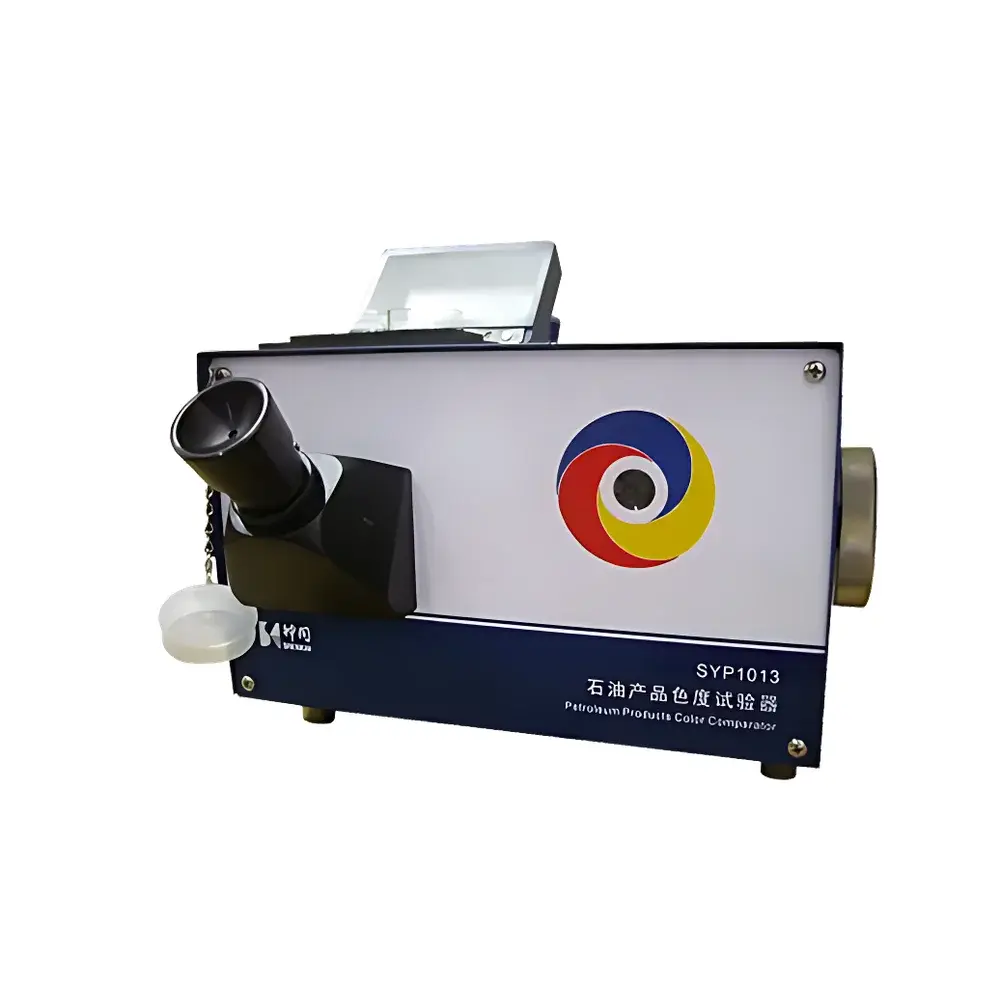
Shenkai SYP1013 Petroleum Product Colorimeter
| Brand | Shenkai |
|---|---|
| Origin | Shanghai, China |
| Model | SYP1013 |
| Light Source | 220 V AC, 100 W frosted incandescent lamp (color temperature 2750 ± 50 K) |
| Color Comparison Tube | Clear, colorless, flat-bottomed glass tube, internal diameter Φ32 mm, height 120–130 mm |
| Standard Color Disc | 26 apertures (Φ14 mm), 25 containing ASTM D1500/GB/T 6540/ISO-compliant colored glass filters (No. 1–25), one blank aperture |
| Optical Viewing System | Dual-lens eyepiece comprising concave and convex lenses enabling side-by-side hemi-circular visual comparison with independent brightness adjustment and focus control |
| Dimensions (L×W×H) | 260 × 300 × 250 mm |
| Net Weight | 15 kg |
Overview
The Shenkai SYP1013 Petroleum Product Colorimeter is a manually operated, visual color comparison instrument engineered for precise determination of color grade in transparent to slightly hazy petroleum products—including lubricating oils, base stocks, distillates, and white oils—according to standardized methodologies. It operates on the principle of subjective visual match between a sample and certified reference color standards under controlled illumination, conforming strictly to SH/T 0168–92 (Chinese industry standard), ASTM D1500 (Standard Test Method for Color of Petroleum Products [ASTM Color Scale]), GB/T 6540 (Petroleum Products—Determination of Colour), and ISO 2049 (Petroleum Products—Determination of Colour by Visual Comparison). The instrument employs a calibrated 100 W incandescent lamp with a color temperature of 2750 ± 50 K—matching the spectral output required by ASTM D1500—to ensure photometric consistency across measurements. Unlike spectrophotometric systems, the SYP1013 delivers traceable, operator-independent results only when used within defined procedural constraints, making it suitable for routine QC laboratories where method compliance and audit readiness are prioritized over spectral data acquisition.
Key Features
- Dual-lens optical eyepiece system integrating concave and convex elements to present simultaneous hemi-circular views of sample and reference standard—enabling direct visual alignment and minimizing parallax error.
- Independent brightness regulation and fine-focus adjustment built into the viewing assembly, accommodating variations in operator visual acuity and ambient light conditions without requiring external shading or auxiliary optics.
- Standardized color disc with 26 precisely aligned 14 mm-diameter apertures: 25 populated with certified interference-filtered glass standards corresponding to ASTM D1500 grades 0.5 through 8.0 (in 0.5-unit increments) and extended GB/T 6540/ISO scales up to No. 25; one aperture reserved as a zero-reference blank.
- Optically matched, non-tapered, flat-bottomed comparison tubes (Φ32 mm ID, 120–130 mm height) manufactured from low-iron borosilicate glass to eliminate intrinsic tint and ensure consistent path length and wall transmission.
- Robust, compact benchtop chassis (260 × 300 × 250 mm) with vibration-damped base and integrated lamp housing—designed for stable operation in industrial QC environments without need for optical tables or climate-controlled rooms.
Sample Compatibility & Compliance
The SYP1013 accepts clear to mildly turbid liquid petroleum samples that meet the clarity and viscosity requirements outlined in SH/T 0168–92 and ASTM D1500—namely, samples must be free of suspended water, sediment, or particulates, and must exhibit Newtonian flow behavior at ambient temperature to avoid stratification during loading. It is not intended for use with opaque fuels, heavy residuals, or emulsified systems. All color assessments performed with this instrument satisfy regulatory reporting requirements for refinery product release, batch certification, and supplier qualification under ISO 9001, API Q1, and CNAS-accredited testing protocols. Documentation supports full traceability to NIM (National Institute of Metrology, China)–certified reference materials and lamp calibration records.
Software & Data Management
As a fully manual, analog color comparator, the SYP1013 does not incorporate embedded firmware, digital interfaces, or software-driven functionality. Results are recorded manually in laboratory notebooks or LIMS-compatible worksheets following GLP-compliant documentation practices. While no electronic data capture is provided, the instrument’s design enables straightforward integration into 21 CFR Part 11–aligned workflows when paired with validated electronic lab notebooks (ELNs) that enforce user authentication, audit trails, and version-controlled SOPs. Calibration verification logs—including lamp voltage checks, disc rotation indexing, and tube cleanliness verification—are recommended at start-of-shift and after every 10 determinations.
Applications
- Final quality release testing of turbine oils, hydraulic fluids, and transformer oils per ASTM D1500 and IEC 60296 specifications.
- In-process monitoring of solvent-refined base oil fractions during dewaxing and hydrotreating operations.
- Supplier qualification audits for white mineral oils used in pharmaceutical excipients (USP compliant grades) and food-grade lubricants (NSF H1).
- Regulatory submission support for color stability studies under accelerated aging per ASTM D2872 (RBM) or ISO 12922.
- Training platform for new analysts learning standardized visual color assessment methodology prior to transition to automated spectrophotometers.
FAQ
What color scales does the SYP1013 support?
The instrument supports ASTM D1500 (0.5–8.0), GB/T 6540 (1–25), and ISO 2049 (1–25) via physically installed glass filter standards—no interpolation or digital scaling is applied.
Is lamp replacement included in routine maintenance?
Yes—lamp life is rated at approximately 1,000 hours; replacement lamps must comply with 2750 ± 50 K color temperature and 100 W power rating to maintain method validity.
Can the SYP1013 be used for biodiesel or bio-blended fuels?
Only if the blend exhibits optical clarity equivalent to conventional distillates and complies with the sample preparation requirements of SH/T 0168–92; oxidation-induced haze invalidates readings.
Does the instrument require annual third-party calibration?
While not mandated by ASTM D1500, accredited labs typically verify optical alignment, disc indexing accuracy, and lamp spectral output annually using NIST-traceable reference kits.
How is operator variability minimized during testing?
Through standardized viewing procedure training, mandatory use of the dual-lens comparator, controlled ambient lighting (≤50 lux ambient), and requirement for two independent analyst readings with ≤1-grade agreement per SH/T 0168–92 Section 6.3.





