
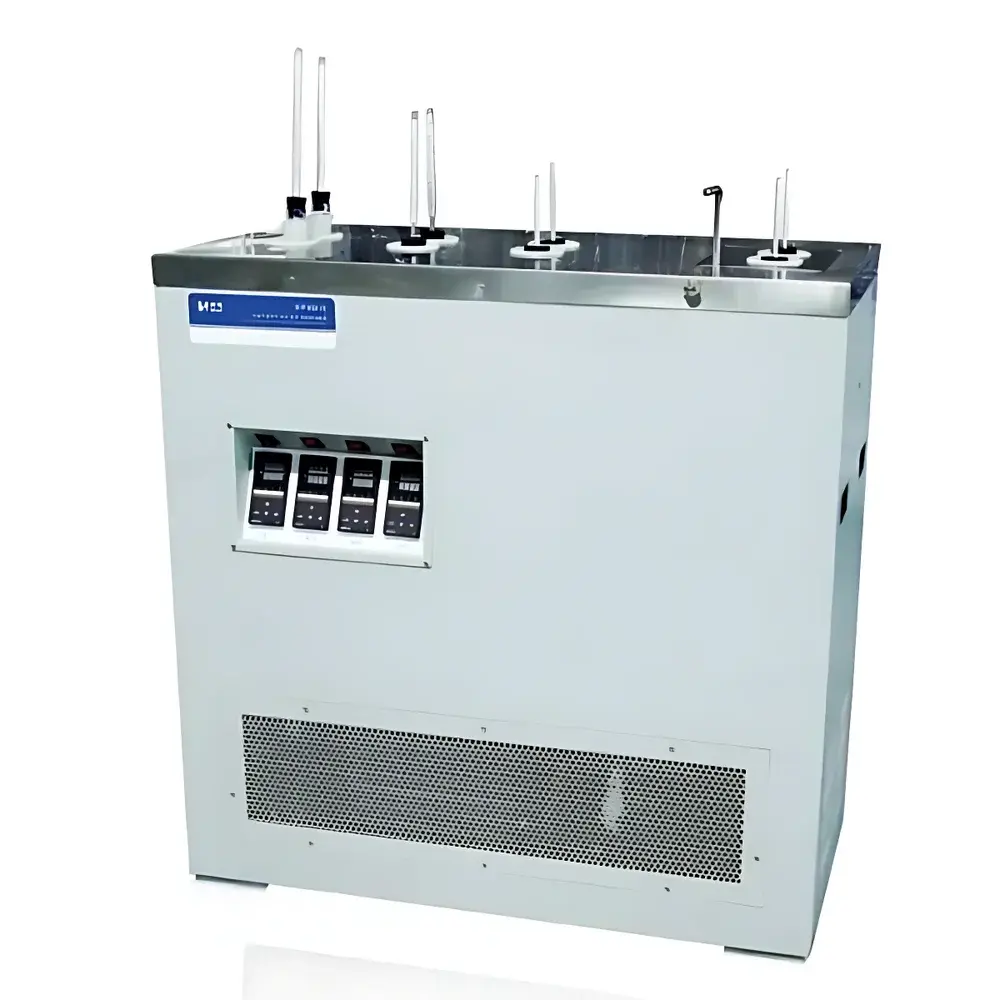
Shenkai SYP1022-III Petroleum Low-Temperature Multifunctional Tester
| Brand | Shenkai |
|---|---|
| Origin | Shanghai, China |
| Model | SYP1022-III |
| Cooling Principle | Single-stage & cascade compressor refrigeration |
| Temperature Control Range | Bath I: −20 °C to 10 °C |
| Bath II | −28 °C to 10 °C |
| Bath III | −35 °C to 10 °C |
| Bath IV (tiltable 45°) | −69 °C to 10 °C |
| Temperature Stability | ±0.5 °C (Baths I–III), ±1.0 °C (Bath IV) |
| Cooling Capacity | Four independent baths, eight sample positions |
| Power Rating | 900 W |
| Input Voltage | 198–242 V AC |
| Frequency | 49–51 Hz |
| Compliance Standards | GB/T 3535, GB/T 510, GB/T 6986, SH/T 0248, ASTM D97, ASTM D2500, ASTM D6371, ISO 3016, ISO 3015, IP 309 |
Overview
The Shenkai SYP1022-III Petroleum Low-Temperature Multifunctional Tester is an engineered platform for standardized determination of critical low-temperature performance parameters in petroleum products and distillate fuels. It operates on the principle of controlled thermal descent under defined ambient and kinetic conditions, enabling precise measurement of pour point (PP), cloud point (CP), cold filter plugging point (CFPP), and freezing point (FP)—parameters directly linked to fuel operability in cold climates, storage stability, and pipeline transport safety. Designed for compliance with both Chinese national standards (GB/T series) and internationally harmonized methods—including ASTM, ISO, and IP protocols—the instrument delivers reproducible, auditable results required for quality control laboratories, refinery QC departments, and third-party testing facilities operating under GLP or ISO/IEC 17025 frameworks.
Key Features
- Four independently controlled cooling baths with eight total sample positions—enabling concurrent multi-parameter analysis across diverse sample types (e.g., diesel, jet fuel, lubricating oils, and biodiesel blends).
- Cascade compressor refrigeration system delivering rapid, stable cooling down to −69 °C in Bath IV—eliminating reliance on cryogenic solvents or external chiller units.
- Tiltable Bath IV (45° inclination) with integrated automatic timing function: initiates 60-second dwell period upon tilt; triggers audible/visual alarm at completion—ensuring strict adherence to CFPP test timing per ASTM D6371 and SH/T 0248.
- Direct metal-bath temperature regulation—no ethanol or glycol bath media required—reducing maintenance, evaporation loss, and cross-contamination risk.
- High-resolution digital display showing real-time and setpoint temperatures for all four baths simultaneously—supporting immediate deviation detection and manual intervention if needed.
- Low-power architecture (900 W nominal) with condensation-resistant thermal insulation—minimizing energy consumption and preventing moisture accumulation on exterior surfaces during extended sub-zero operation.
Sample Compatibility & Compliance
The SYP1022-III accommodates standard ASTM/ISO sample containers (e.g., 40-mL glass tubes per ASTM D97, 100-mL cylindrical vessels per ISO 3015) and supports viscous and paraffinic hydrocarbon matrices without modification. Its thermal uniformity profile across all eight wells meets repeatability requirements specified in GB/T 510 (±1.0 °C for replicate pour point determinations) and ASTM D2500 (cloud point precision ≤0.5 °C). The system is validated for use in environments requiring traceable calibration—compatible with NIST-traceable reference thermometers and suitable for inclusion in laboratory quality management systems aligned with ISO/IEC 17025:2017 Clause 6.4 (Equipment) and FDA 21 CFR Part 11 where electronic records are implemented via external data logging.
Software & Data Management
While the SYP1022-III operates as a standalone hardware platform with embedded microcontroller-based PID temperature regulation, its analog voltage outputs (0–5 V or 4–20 mA optional) enable integration into centralized LIMS or SCADA architectures. Time-stamped temperature logs from each bath can be captured externally using compliant data acquisition modules supporting CSV export and audit trail generation. For regulated environments, users may pair the unit with validated PC-based software that enforces user access controls, electronic signatures, and change history tracking—meeting ALCOA+ principles (Attributable, Legible, Contemporaneous, Original, Accurate, Complete, Consistent, Enduring, Available) for raw test data integrity.
Applications
- Refinery final product release testing for winter-grade diesel (EN 590, ASTM D975) and aviation turbine fuel (ASTM D1655).
- Formulation development of cold-flow improvers (CFIs) and wax crystal modifiers—quantifying dose-response relationships for PP and CFPP depression.
- Contract testing laboratories performing accredited analyses for ISO 8217 marine fuels or biodiesel blends (ASTM D7467).
- Storage facility QA/QC programs monitoring seasonal fuel transitions and long-term stability of stored distillates.
- Research applications investigating phase separation kinetics and wax nucleation onset in heavy crudes and vacuum gas oils.
FAQ
Does the SYP1022-III require external coolant or dry ice?
No. The integrated cascade compressor system achieves −69 °C autonomously—no consumables, cryogens, or auxiliary chillers are necessary.
Can all four baths operate at different temperatures simultaneously?
Yes. Each bath has independent PID control and digital setpoint entry—allowing concurrent PP (−20 °C), CP (−10 °C), CFPP (−30 °C), and FP (−65 °C) determinations in a single run.
Is the tilting mechanism for Bath IV motorized or manual?
Manual tilt with mechanical lock; activation of the 60-second timer is fully automatic upon reaching 45° orientation—verified by internal inclination sensor.
What calibration documentation is supplied?
Factory calibration certificate traceable to CNAS-accredited reference standards is included; users must perform periodic verification using certified thermometers per ISO/IEC 17025 Section 6.6.
Is the instrument compatible with ASTM D5853 for crude oil pour point?
Yes—though D5853 specifies larger sample volume and modified cooling rate, the SYP1022-III’s programmable ramp profiles and wide temperature range support method adaptation under laboratory validation protocols.






