
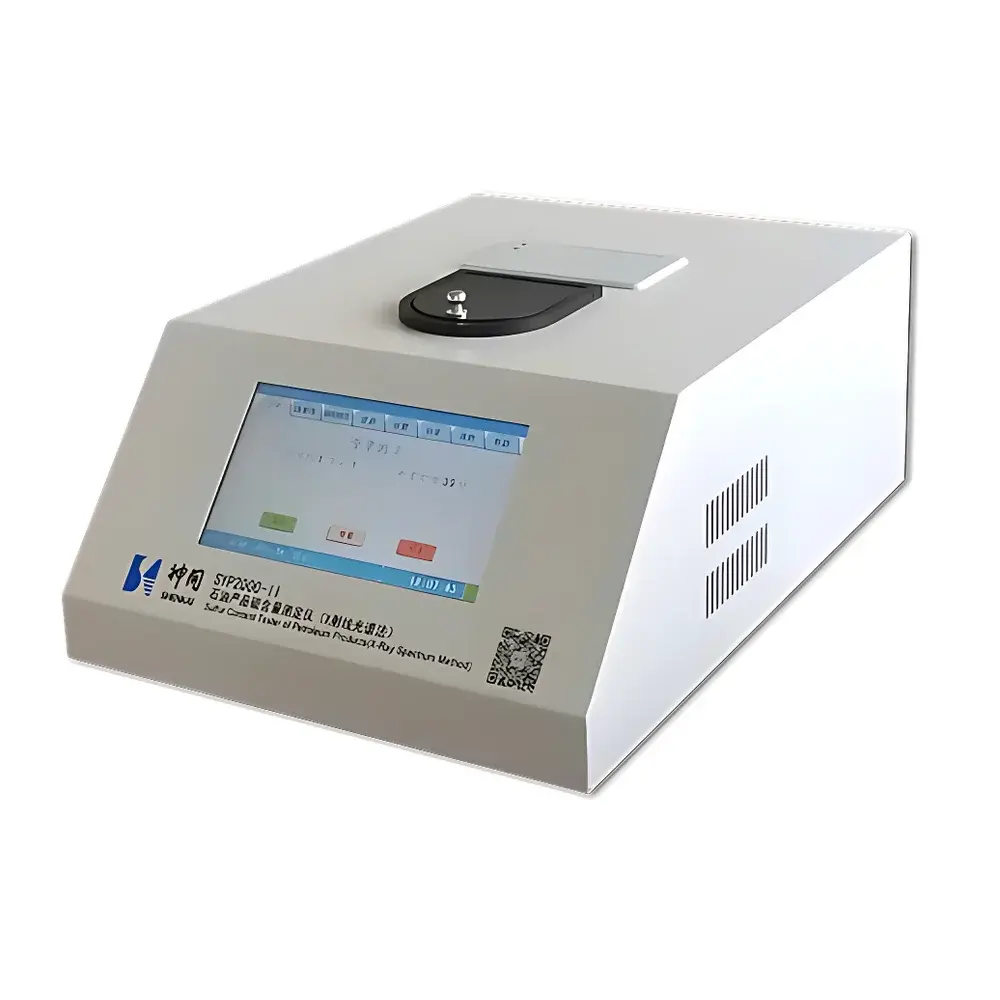
Shenkai SYP2000-II Energy-Dispersive X-ray Fluorescence (EDXRF) Sulfur Analyzer for Petroleum Products
| Brand | Shenkai |
|---|---|
| Origin | Shanghai, China |
| Model | SYP2000-II |
| Detection Principle | Energy-Dispersive X-ray Fluorescence (EDXRF) |
| Measurement Range | 0.005–5 wt% S |
| Detection Limit | 5 ppm (S) |
| Minimum Quantification Limit | 50 ppm (S) |
| Analysis Time | 30–300 s (default 100 s) |
| X-ray Tube | ≤20 kV, ≤1 mA, ≤10 W |
| Detector | Ultra-thin Beryllium-window Proportional Counter |
| Sample Form | Solid or Liquid (non-destructive, no digestion required) |
| Operating Temperature | 5–40 °C |
| Relative Humidity | ≤85% at 30 °C |
| Power Supply | 220 V ±20 V, 50 Hz, ≤100 W |
| Dimensions | 285 × 405 × 165 mm (W×D×H) |
| Weight | 10 kg |
| Compliance | GB/T 17040, ASTM D4294 |
| Data Storage | Internal non-volatile memory with power-loss protection |
| Interface | Touchscreen GUI, USB data export |
Overview
The Shenkai SYP2000-II is a benchtop energy-dispersive X-ray fluorescence (EDXRF) sulfur analyzer engineered for rapid, accurate, and non-destructive quantification of total sulfur (S) in petroleum products and related hydrocarbon matrices. Based on fundamental XRF physics—where primary X-rays excite sulfur Kα characteristic fluorescence emissions (2.307 keV) from sample atoms—the instrument delivers trace-level sulfur measurement without chemical digestion, combustion, or vacuum/gas requirements. It complies fully with internationally recognized test methods including ASTM D4294 (Standard Test Method for Sulfur in Petroleum and Petroleum Products by Energy-Dispersive X-ray Fluorescence Spectrometry) and GB/T 17040 (Chinese national standard for sulfur determination in petroleum products). Designed for routine QC/QA laboratories in refineries, fuel blending facilities, lubricant manufacturers, and third-party testing labs, the SYP2000-II replaces wet-chemistry alternatives such as UV fluorescence or oxidative microcoulometry where speed, operator safety, and long-term method robustness are critical.
Key Features
- Non-contact, non-destructive analysis: Samples remain physically intact; no acid digestion, high-temperature combustion, or hazardous reagents required.
- Ultra-low detection limit: Achieves 5 ppm (mass) sulfur detection capability using an ultra-thin Be-window proportional counter and optimized secondary filtration.
- Automated C/H ratio correction: Compensates for matrix effects across diverse hydrocarbon types (e.g., gasoline, diesel, residual fuel oil, asphalt, petroleum coke).
- Multi-curve auto-switching: Pre-calibrated working curves for different sulfur concentration ranges (e.g., 0.005–0.1%, 0.1–1%, 1–5%) enable seamless transition across sample types without manual recalibration.
- Digital multi-channel analyzer with variable gain: Supports real-time pulse processing, ratio-based spectral correction, and long-term drift compensation to maintain measurement stability over months.
- Integrated touchscreen interface: Fully embedded GUI enables one-button operation—from sample loading to result display—in under 10 seconds of user interaction.
- Class-exempt radiation design: Meets IEC 61010-1 and national regulatory requirements for X-ray equipment; no licensing or shielding infrastructure needed in standard lab environments.
Sample Compatibility & Compliance
The SYP2000-II accepts liquid and solid samples in standard polypropylene or Mylar-film-sealed cups (10–40 mm diameter, up to 15 mm depth). Validated matrices include gasoline, diesel fuel, jet fuel, naphtha, crude oil, fuel oil (IFO 180/380), lubricating oils, petroleum additives, bitumen, petroleum coke, and coal-derived feedstocks such as crude benzene. Solid samples require homogenization but no grinding or pelletizing. The system supports ASTM D4294 Annex A1 (liquid calibration), Annex A2 (solid calibration), and GB/T 17040 Clause 6 (routine verification protocol). All firmware and calibration files are traceable and support GLP-compliant audit trails when connected to external LIMS via USB export. Instrument validation includes daily check standards, intermediate precision verification per ISO 8258, and annual performance qualification per ASTM E1601 guidelines.
Software & Data Management
The embedded operating system provides full local data governance: measurement records—including spectrum metadata, acquisition time, tube parameters, and curve ID—are stored in non-volatile flash memory with automatic timestamping and power-loss resilience. Up to 10,000 test results can be retained onboard. Data export is supported via USB 2.0 to FAT32-formatted drives in CSV format compatible with Excel, LIMS, and statistical process control (SPC) platforms. No proprietary software installation is required on host PCs. Firmware updates are delivered via signed binary packages with SHA-256 checksum verification. While the system does not implement FDA 21 CFR Part 11 electronic signature controls natively, its deterministic workflow, immutable result logs, and absence of post-acquisition data editing satisfy core ALCOA+ principles (Attributable, Legible, Contemporaneous, Original, Accurate) for regulated environments.
Applications
- Refinery process control: Real-time sulfur monitoring of hydrotreater feed and product streams to ensure compliance with Tier 3 gasoline (≤10 ppm S) and Euro VI diesel (≤10 ppm S) specifications.
- Fuel certification: Verification of sulfur content in marine distillate fuels (IMO 2020 <0.5% S) and residual fuels prior to bunkering.
- Lubricant formulation QA: Quantitative assessment of sulfur-bearing anti-wear additives (e.g., ZDDP derivatives) and contaminant screening.
- Crude assay support: Rapid screening of sour vs. sweet crudes during procurement and blending optimization.
- Research & development: Catalyst deactivation studies, sulfur speciation correlation (via complementary techniques), and feedstock compatibility testing in hydroprocessing units.
- Contract laboratory services: High-throughput analysis for ISO/IEC 17025-accredited testing per clause 5.9 (method validation) and clause 7.7 (result reporting).
FAQ
Does the SYP2000-II require helium purge or vacuum for sulfur analysis?
No. The instrument operates under ambient air conditions using an ultra-thin Be window detector optimized for low-energy S Kα emission. No gas supply, vacuum pump, or evacuation cycle is necessary.
Can it analyze viscous or semi-solid samples like asphalt or petroleum coke?
Yes. Samples are placed directly into shallow cups and measured as-is. Homogeneity is the only prerequisite; no dilution, dissolution, or fusion is required.
How often must calibration standards be verified?
Per ASTM D4294 Section 9.2, a certified reference material (CRM) should be measured at least once per eight-hour shift. Drift correction is automatically applied using internal reference channels.
Is spectral interference from chlorine or silicon a concern in refinery samples?
Chlorine Kα (2.622 keV) and silicon Kα (1.740 keV) peaks are spectrally resolvable from sulfur Kα (2.307 keV) using the instrument’s 145 eV FWHM resolution at Mn Kα. Software peak deconvolution further minimizes cross-talk.
What maintenance is required beyond routine cleaning?
Annual verification of X-ray tube output and detector gain stability is recommended. No consumables—such as electrodes, membranes, or catalysts—are used in EDXRF operation.





