
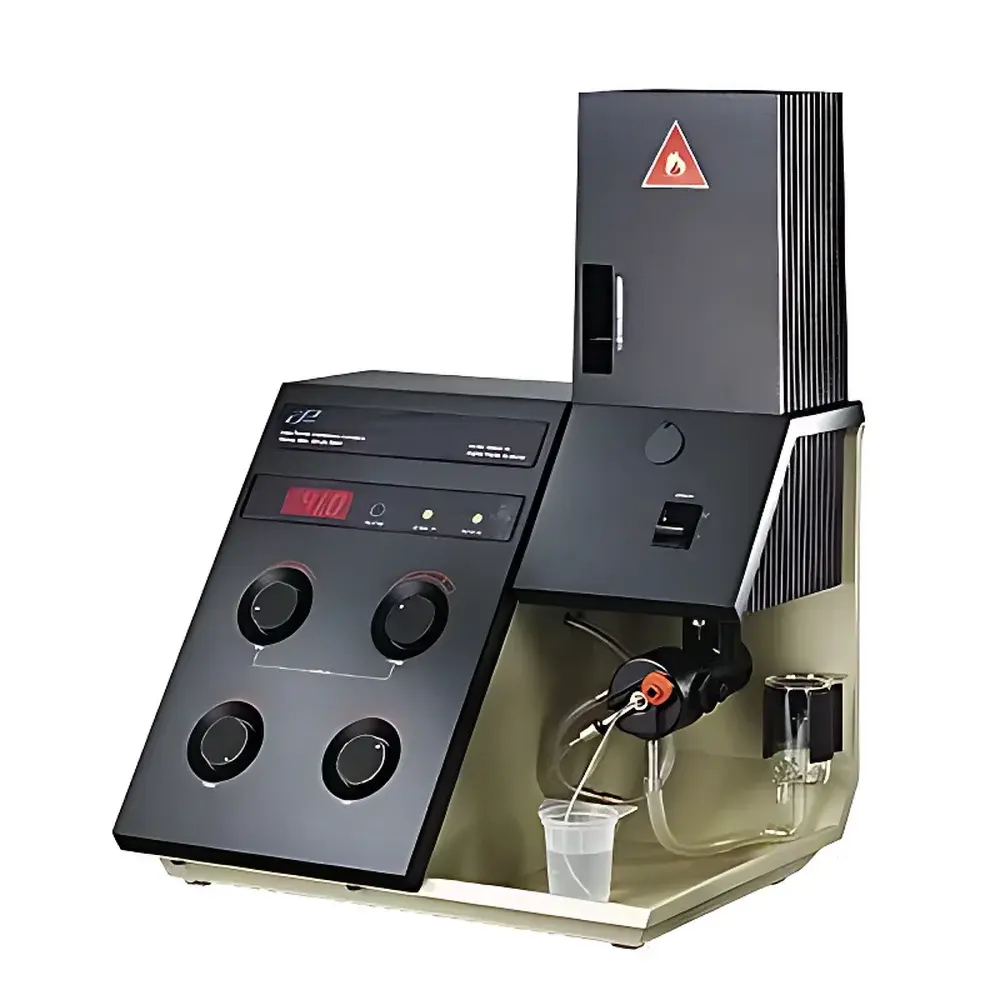
Sherwood M410 Basic Flame Photometer
| Brand | Sherwood |
|---|---|
| Origin | United Kingdom |
| Model | M410 |
| Measurement Principle | Emission Spectroscopy (Flame Excitation) |
| Elements Measured | Na, K, Ca |
| Detection Limit | <20 ppb for Na and K |
| Sensitivity | <0.5 ppm for Na and K |
| Linearity | Better than 2% (at 3 ppm for Na/K) |
| Drift | <2% per hour (after 30-min warm-up, 10 ppm Na) |
| Repeatability | <1% RSD (n=20, 10 ppm Na/K) |
| Response Time | Stabilization within 20 s after sample introduction |
| Sample Introduction Rate | 2–6 mL/s |
| Fuel Gas | Propane, butane, or propane/butane mixture at 30 psi |
| Air Supply | Compressed air (included) |
| Gas Regulation | Integrated dual-stage pressure regulator |
| Optical Filters | Interchangeable Na, K, and Ca bandpass filters (front-access, tool-free) |
| Safety Features | Flame-out auto-shutoff solenoid valve, insulated chimney hood |
| Output Signal | 100 mV analog recorder output |
| Display | 3½-digit LED |
Overview
The Sherwood M410 Basic Flame Photometer is a benchtop atomic emission instrument engineered for routine quantitative analysis of alkali and alkaline earth metals—specifically sodium (Na), potassium (K), and calcium (Ca)—in aqueous solutions. It operates on the principle of flame emission spectroscopy: liquid samples are nebulized into a low-temperature premixed air–fuel flame (typically propane or butane), where thermal energy excites valence electrons of target metal ions. Upon relaxation, these ions emit characteristic wavelengths of visible light—589 nm (Na), 766/769 nm (K), and 422 nm (Ca)—which are isolated by precision optical bandpass filters and measured via a photodetector. The M410 delivers stable, reproducible signal intensity proportional to elemental concentration, enabling direct calibration against standard solutions without spectral deconvolution or background correction. Designed for laboratories requiring robust, low-maintenance elemental quantification—not high-resolution multi-element capability—the M410 prioritizes operational simplicity, intrinsic safety, and compliance-ready documentation support.
Key Features
- Front-panel sample inlet and tool-free filter access—no disassembly required for routine maintenance or element switching.
- Integrated dual-stage gas pressure regulator ensures consistent fuel and air delivery across varying line pressures, minimizing flame instability and signal drift.
- Automatic flame-out detection and solenoid-driven fuel cutoff provide fail-safe operation in case of accidental extinction or airflow interruption.
- Thermally insulated chimney hood reduces operator exposure to radiant heat and improves ambient thermal stability around the optical path.
- Dedicated 3½-digit LED display with linear analog output (100 mV) enables direct connection to chart recorders, data loggers, or legacy LIMS interfaces without additional signal conditioning.
- Factory-calibrated optical alignment and pre-aligned burner head minimize setup time and reduce inter-operator variability.
Sample Compatibility & Compliance
The M410 accepts clarified, low-suspended-solids aqueous samples with total dissolved solids (TDS) ≤ 0.5%. Viscosity should not exceed 3 cP; samples exceeding this may require dilution or filtration through 0.45 µm membrane filters prior to analysis. It complies with core safety standards for laboratory gas appliances (BS EN 61010-1, IEC 61010-1) and supports GLP/GMP workflows through documented calibration procedures, traceable standard preparation (certified 1000 ppm Na/K/Ca stock solutions included), and audit-ready parameter logging when paired with external recording devices. While not inherently 21 CFR Part 11 compliant (as it lacks user authentication or electronic signature functionality), its analog output and manual calibration logs are routinely accepted in regulated environments where paper-based records remain validated.
Software & Data Management
The M410 operates as a standalone analog instrument with no embedded microprocessor or proprietary software. Quantitative analysis relies on manual calibration curves generated using the supplied 1000 ppm stock standards (six 100 mL vials each for Na, K, and Ca) and serial dilution. Concentration calculation follows first-order linear regression (y = mx + b) applied to peak-height or steady-state output voltage versus known concentration. Laboratories integrating the M410 into modern digital workflows typically route its 100 mV output to USB data acquisition systems (e.g., National Instruments DAQmx) or programmable logic controllers (PLCs) for automated data capture, real-time trending, and CSV export. All calibration parameters—including dilution factors, blank offsets, and curve coefficients—are maintained externally in laboratory notebooks or validated spreadsheet templates aligned with ISO/IEC 17025 documentation requirements.
Applications
The M410 serves as a cost-effective, high-reproducibility solution for industries requiring frequent, low-cost Na/K/Ca monitoring where detection limits below 20 ppb are sufficient and matrix complexity is moderate. Key use cases include: quality control of beverage electrolyte formulations (sports drinks, bottled water); soil extract analysis (Mehlich-3, ammonium acetate extracts) in agronomy labs; raw material screening in pharmaceutical excipient manufacturing (e.g., calcium carbonate purity); brine composition verification in oilfield chemistry; ash leachate testing in coal and mineral processing; and clinical serum/plasma electrolyte spot-checking in resource-constrained settings. Its 2–6 mL/s aspiration rate and 20-second stabilization support throughput of ~30–40 samples per hour with minimal operator intervention.
FAQ
What gases are compatible with the M410?
Propane, butane, or commercially available propane/butane blends (e.g., Campingaz) are approved. A regulated inlet pressure of 30 psi is required; the unit includes an integrated dual-stage regulator to maintain consistent flow under variable supply conditions.
Can the M410 measure lithium or barium?
No. The M410 is optically configured only for Na, K, and Ca via fixed-wavelength interference filters. No alternative filter sets or wavelength-tunable optics are available for this model.
Is daily recalibration required?
For GLP-compliant operation, a full 3-point calibration (blank + two standards spanning expected range) is recommended before each analytical batch. A single-point verification check using a mid-range standard is acceptable between batches if instrument drift remains within ±2% over 1 hour.
What maintenance intervals apply to the nebulizer and burner?
Nebulizer capillaries should be inspected weekly and cleared with 5% HNO₃ followed by DI water flush. The stainless-steel burner head requires quarterly cleaning with ultrasonic bath (10% detergent in DI water) and visual inspection for carbon buildup or misalignment.
Does the M410 meet ISO 6955 for flame photometric determination of sodium and potassium?
Yes—the M410 satisfies the instrumental performance criteria outlined in ISO 6955:2000 (including sensitivity, linearity, and repeatability specifications) when operated per manufacturer instructions and calibrated using certified reference materials traceable to NIST SRMs.




