
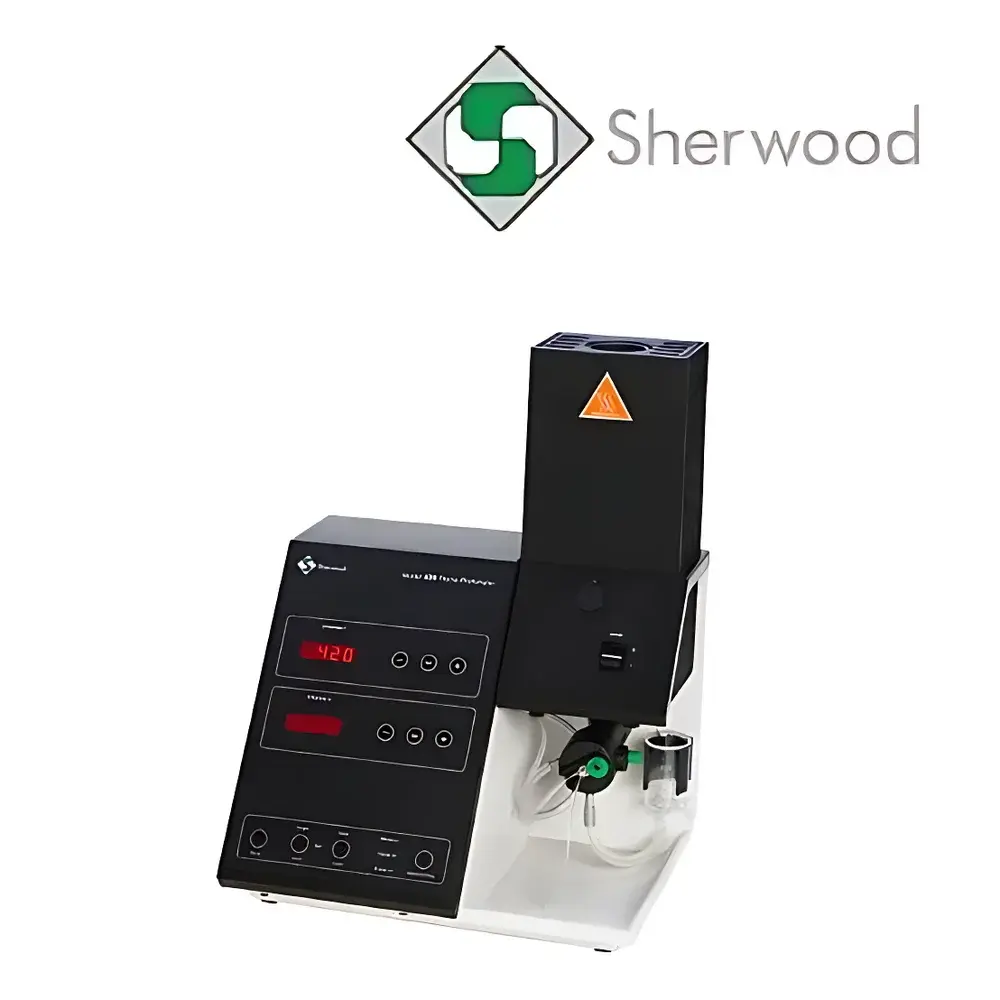
Sherwood M410 Flame Photometer
| Brand | Sherwood |
|---|---|
| Origin | United Kingdom |
| Model | M410 |
| Element Detection | Na, K, Li, Ca, Ba |
| Output Units | ppm, mg/L |
| Compliance | ISO 7635, ASTM D2189, USP <731> |
| Software Interface | RS-232 serial output for data logging |
Overview
The Sherwood M410 Flame Photometer is a benchtop atomic emission spectrometer engineered for precise quantitative analysis of alkali and alkaline earth metals—including sodium (Na), potassium (K), lithium (Li), calcium (Ca), and barium (Ba)—in aqueous solution. Operating on the principle of flame atomic emission spectroscopy (FAES), the instrument nebulizes sample solutions into a stable air-propane or air-butane flame, where thermal excitation promotes valence electrons to higher energy states; upon relaxation, characteristic wavelength photons are emitted and measured via interference-filtered photomultiplier detection. Designed and manufactured in Cambridge, UK, the M410 delivers high reproducibility (RSD <2% at 10 ppm Na) and long-term stability under routine laboratory conditions. Its robust mechanical architecture, optimized burner geometry, and precision gas flow control ensure consistent flame temperature and minimal inter-element spectral interference—critical for clinical serum electrolyte profiling, environmental water testing, and agricultural soil extract analysis.
Key Features
- Fixed-wavelength optical system with thermally stabilized interference filters for Na (589 nm), K (766 nm), Li (671 nm), Ca (422 nm), and Ba (553 nm)
- Dual-channel analog output (0–1 V DC) and RS-232 serial interface for integration with LIMS or third-party data acquisition software
- Integrated air compressor with regulated pressure control (0.8–1.2 bar) and built-in moisture trap for consistent nebulization
- Adjustable aspiration rate (3–5 mL/min) and pre-mix burner design minimizing memory effects and carryover between samples
- Calibration modes: single-point, two-point linear, and multi-point non-linear (up to 5 standards); auto-zero and auto-blank functions standard
- Front-panel digital display with real-time signal intensity readout and concentration calculation in ppm or mg/L
Sample Compatibility & Compliance
The M410 accepts clarified aqueous samples with total dissolved solids (TDS) ≤ 0.5% w/v. It supports direct analysis of serum, plasma, urine, plant tissue digests, soil extracts (e.g., Mehlich-3 or ammonium acetate leachates), wastewater effluents, and food homogenates following appropriate dilution and acidification (HNO₃ or HCl, ≤2% v/v). All measurement protocols align with internationally recognized standard methods: ISO 7635 (water quality — determination of sodium and potassium), ASTM D2189 (standard test method for sodium and potassium in lubricating oils), and USP (sodium and potassium content in pharmaceutical excipients). Instrument validation documentation supports GLP-compliant laboratories; audit trails for calibration, maintenance, and user logins can be maintained externally via connected PC-based software.
Software & Data Management
While the M410 operates as a standalone instrument, its RS-232 interface enables bidirectional communication with Windows-based data management platforms. Compatible software packages support automated calibration curve generation, batch sample reporting, statistical summary (mean, SD, CV%), and export to CSV or Excel formats. All exported datasets include timestamp, operator ID, calibration reference values, and raw analog voltage readings—ensuring full traceability per FDA 21 CFR Part 11 requirements when paired with validated electronic signature modules. No proprietary firmware updates are required; configuration parameters (e.g., filter selection, units, alarm thresholds) are retained in non-volatile memory during power cycles.
Applications
- Clinical diagnostics: Quantification of Na⁺ and K⁺ in serum and whole blood for electrolyte imbalance assessment
- Environmental monitoring: Analysis of Na, K, Ca in surface water, groundwater, and wastewater per EPA Method 200.7 (modified)
- Agricultural science: Rapid screening of exchangeable cations in soil testing laboratories supporting fertilizer recommendation systems
- Food & beverage QA/QC: Verification of sodium content in processed foods, dairy products, and bottled waters against Codex Alimentarius limits
- Pharmaceutical manufacturing: Release testing of elemental impurities in active pharmaceutical ingredients (APIs) per ICH Q2(R2) guidelines
- Research laboratories: Supporting ion transport studies in plant physiology and membrane biophysics experiments
FAQ
What flame gases are compatible with the M410?
Propane or butane with compressed air is recommended; acetylene is not supported due to excessive flame temperature and safety constraints.
Can the M410 measure cesium or rubidium?
No—the M410’s optical filters are factory-aligned only for Na, K, Li, Ca, and Ba; no field-replaceable filter kits exist for additional elements.
Is internal standard correction available?
No—internal standardization requires dual-channel simultaneous detection, which is implemented in the M420 and M425 models, not the M410.
What maintenance intervals are recommended?
Nebulizer capillary cleaning every 8 hours of operation; burner head inspection and descaling weekly; annual optical alignment verification by certified service technician.
Does the M410 comply with ISO/IEC 17025 requirements?
Yes—when operated within defined environmental conditions (20–25°C, ≤60% RH), with documented calibration using NIST-traceable standards and controlled uncertainty budgets, it satisfies technical competence criteria for accredited testing laboratories.





