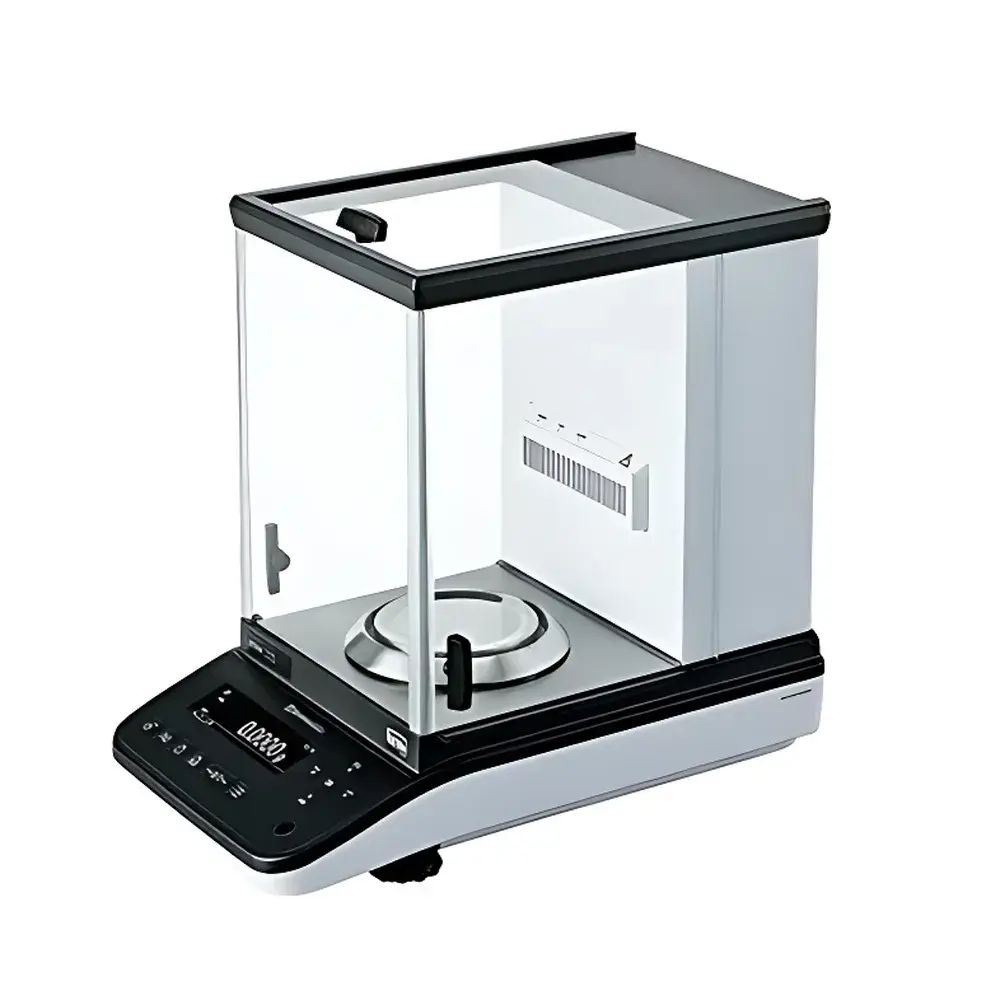
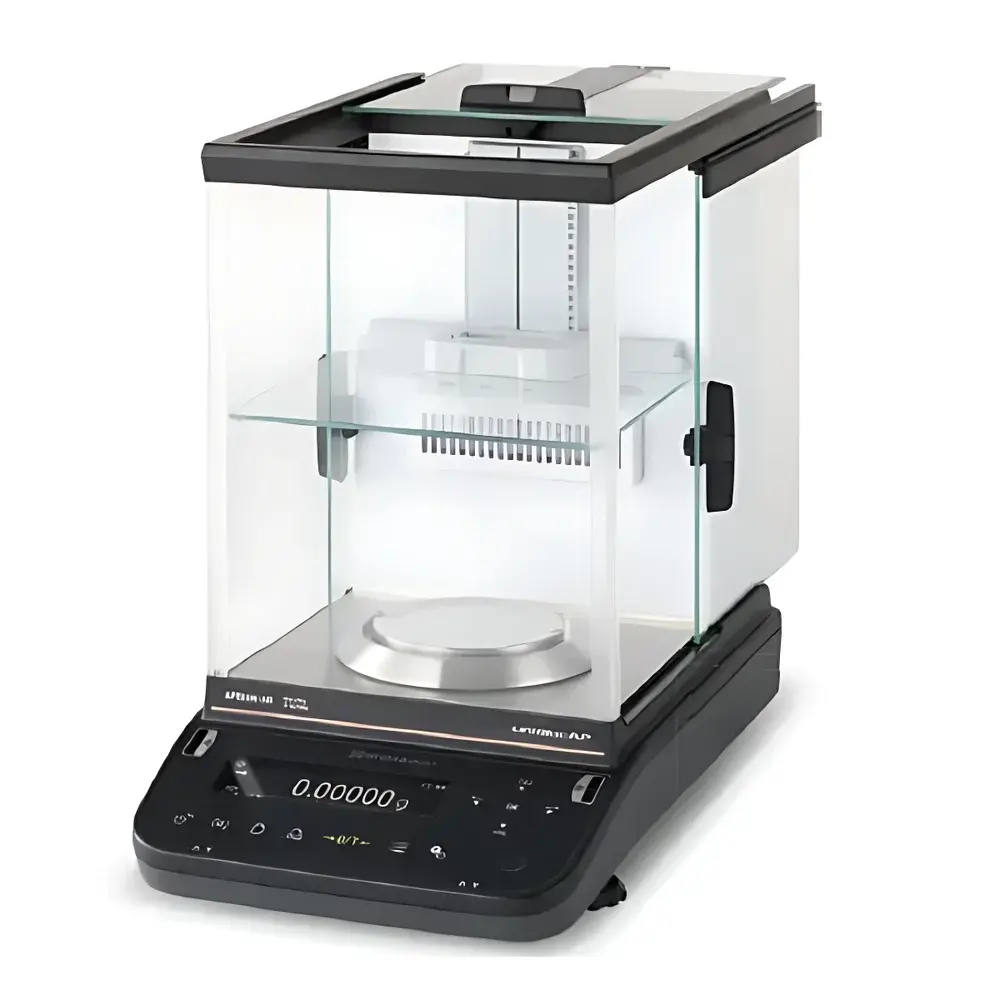
Shimadzu AP225WD Advanced Analytical Balance with 0.01 mg Readability
| Key | Brand: Shimadzu |
|---|---|
| Origin | Japan |
| Model | AP225WD |
| Maximum Capacity | 220 g |
| Readability | 0.01 mg |
| Repeatability | 0.05 mg (at full capacity) |
| Calibration | Internal motorized calibration |
| Draft Shield | Motorized auto-sensing sliding glass door with memory function |
| Electrostatic Control | Integrated STABLO-AP ionizer |
| Weighing Pan Diameter | 91 mm |
| Response Time | ≤8 s (typical stabilization) |
| Compliance | ISO/IEC 17025, ASTM E898, USP <41>, GLP/GMP-ready audit trail support |
Overview
The Shimadzu AP225WD is a high-precision analytical balance engineered for laboratories requiring trace-level mass measurement with uncompromising reliability and operational safety. Designed as part of the AP W-AD series, it employs electromagnetic force restoration (EMFR) technology—a standard in modern micro-analytical balances—to deliver stable, drift-resistant measurements at 0.01 mg readability across its 220 g maximum capacity. Its core innovation lies in fully non-contact operation: integrated proximity sensors enable hands-free tare, zero, print, and unit toggle functions without physical keypresses—critical in biosafety Level 2+ environments, cytotoxic drug formulation, or forensic toxicology workflows where glove-based handling and contamination control are mandatory. The balance meets stringent metrological requirements defined in ISO 9001, ISO/IEC 17025, and pharmacopeial standards including USP for repeatability and accuracy verification.
Key Features
- Non-contact sensor interface: Four programmable proximity zones allow users to assign distinct commands (e.g., tare, print, unit change, start calibration) via hand gestures—eliminating surface contact while maintaining full functionality under gloves or PPE.
- Intelligent draft shield system: Motorized, memory-enabled sliding glass door opens/closes in ≤1 second; opening range is user-configurable to minimize air turbulence and thermal convection—reducing weighing time by up to 30% compared to manual doors.
- Integrated electrostatic neutralization: Built-in STABLO-AP active ionizer continuously suppresses static charge on samples and containers, improving repeatability by up to 50% for low-mass powders, polymers, or glassware.
- Internal motorized calibration: Automatic internal calibration triggered by time, temperature drift (±1°C), or user command ensures long-term traceability without external weights—fully compliant with ISO 17025 clause 6.5.2.
- Modular anti-vibration design: Dual-layer damping base and optimized load cell suspension reduce sensitivity to floor-borne vibrations, enabling stable operation on standard lab benches without dedicated vibration isolation tables.
Sample Compatibility & Compliance
The AP225WD accommodates diverse sample forms—including fine powders, crystalline APIs, lyophilized biologics, and micro-volume liquid aliquots in vials or weighing boats—thanks to its 91 mm stainless-steel pan and optional removable draft shield insert. All firmware and hardware configurations support 21 CFR Part 11 compliance when paired with Shimadzu LabSolutions Balance software, providing electronic signatures, role-based access control, and immutable audit trails for raw weighing data, calibration logs, and maintenance records. The balance conforms to IEC 61326-1 (EMC), IEC 61010-1 (safety), and is certified for use in GxP-regulated environments per EU Annex 11 and FDA guidance on computerized systems.
Software & Data Management
LabSolutions Balance serves as the central hub for seamless integration with Shimadzu’s broader analytical ecosystem—including LC, GC, and UV-Vis platforms. It enables direct export of weighing metadata (timestamp, operator ID, balance ID, environmental conditions) into LIMS or ELN systems via ASTM E1384-compliant ASCII files or ODBC connectivity. Real-time data streaming supports automated batch record generation for pharmaceutical manufacturing, while customizable report templates meet SOP-driven documentation requirements. All data transfers are encrypted using TLS 1.2+, and local database backups comply with ALCOA+ principles (Attributable, Legible, Contemporaneous, Original, Accurate, Complete, Consistent, Enduring, Available).
Applications
- Pharmaceutical QC/QA: Precise formulation of potent compounds (e.g., oncology APIs), content uniformity testing per USP , and reference standard preparation.
- Materials science: Gravimetric analysis of nanomaterials, catalyst loading verification, and moisture loss-on-drying (LOD) studies.
- Clinical research: Weighing of tissue biopsies, dried blood spots, or radiolabeled tracers where cross-contamination risk must be minimized.
- Environmental labs: Preparation of certified reference materials (CRMs) and calibration standards for ICP-MS or GC-MS trace metal analysis.
- Academic research: High-resolution stoichiometric synthesis, polymer molecular weight determination via gravimetric titration, and micro-reaction monitoring.
FAQ
What does “0.01 mg readability” mean in practice?
It indicates the smallest increment the balance can display—equivalent to 10 nanograms—and reflects the resolution of the EMFR sensor system under optimal environmental conditions (20 ±2°C, <50% RH, no drafts).
Is internal calibration sufficient for regulatory audits?
Yes—provided calibration intervals are defined in a validated SOP and supported by documented temperature stability logs. Internal calibration satisfies ISO 17025 requirements when combined with periodic external verification using Class E2 weights.
Can the AP225WD interface with third-party LIMS without LabSolutions?
Yes—via RS-232 or USB virtual COM port using standard SCPI or ASCII protocols; output formatting is configurable to match LIMS field mapping requirements.
How does the STABLO-AP ionizer differ from passive anti-static brushes?
It emits balanced positive/negative ions in real time, neutralizing static charges on both insulating and conductive surfaces—unlike passive tools, which only dissipate charge from grounded objects.
What environmental conditions are required for optimal performance?
Stable ambient temperature (±1°C/hour drift), relative humidity between 40–60%, and placement away from HVAC vents, windows, or centrifuges. A dedicated power line with surge protection is recommended.