
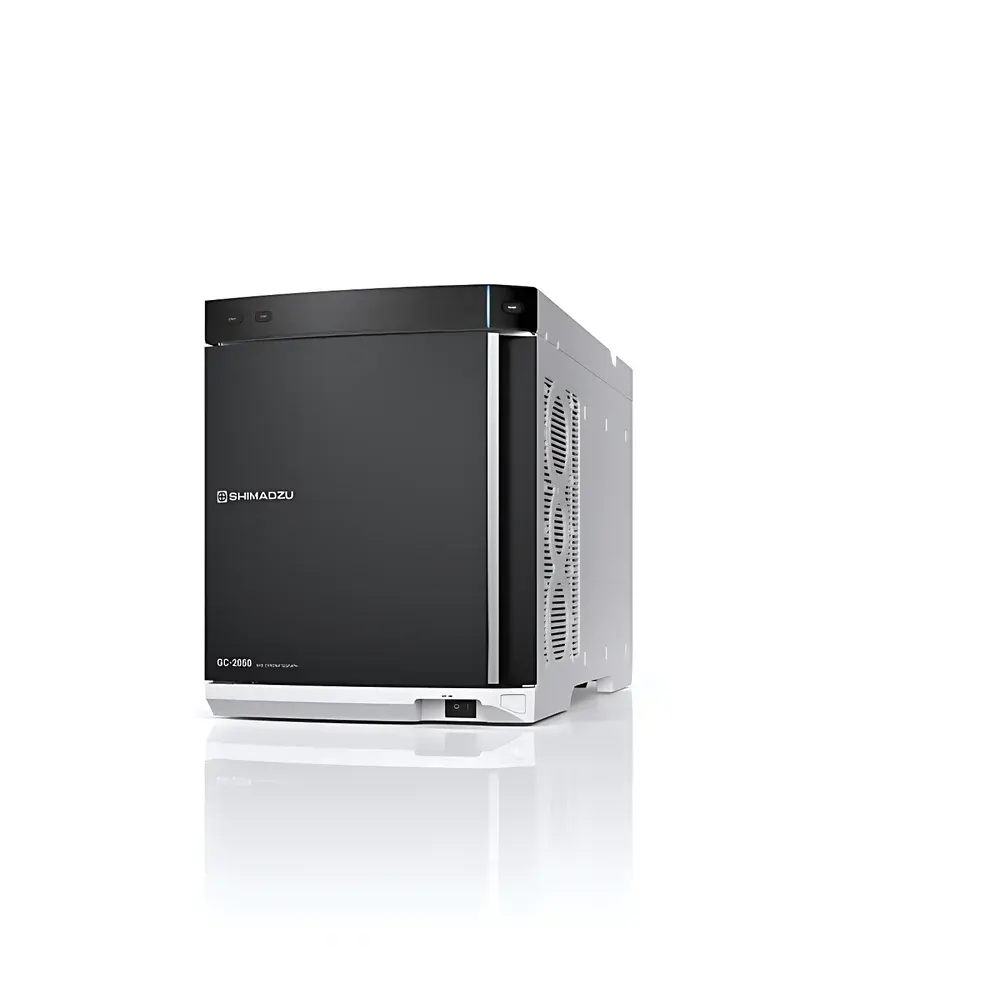
Shimadzu Brevis GC-2050 Gas Chromatograph
| Brand | Shimadzu |
|---|---|
| Origin | Jiangsu, China |
| Manufacturer Type | Original Equipment Manufacturer (OEM) |
| Product Category | Domestic |
| Model | Brevis GC-2050 |
| Instrument Type | Laboratory Gas Chromatograph |
| Application Scope | General-Purpose |
| Oven Temperature Range | Ambient + 4 °C to 450 °C |
| Maximum Ramp Rate | 250 °C/min |
| Carrier Gas Pressure Range & Control | 0–1035 kPa (7 programmable pressure segments) |
| Injector Maximum Operating Temperature | 450 °C |
| Injector Pressure Setting Range | 0–1035 kPa |
| Injector Total Flow Setting Range | 0–1300 mL/min (He or H₂), 0–600 mL/min (N₂) |
Overview
The Shimadzu Brevis GC-2050 is a high-performance, compact laboratory gas chromatograph engineered for precision, reliability, and operational efficiency in routine and advanced analytical environments. Built upon Shimadzu’s proven GC platform architecture, it employs classic capillary column separation principles—utilizing temperature-programmed elution and carrier gas-driven analyte partitioning across stationary phases—to deliver robust retention time reproducibility and peak resolution. Designed for universal deployment across regulated and research laboratories, the Brevis GC-2050 integrates modern thermal management, intelligent gas control, and modular detector compatibility without compromising on core chromatographic fidelity. Its column oven accommodates standard 0.1–0.53 mm ID fused-silica capillaries up to 60 m in length and supports dual-column configurations for parallel or heart-cutting applications—ensuring method transferability from legacy Shimadzu systems such as the Nexis GC-2030.
Key Features
- Compact footprint: 35% narrower than the Nexis GC-2030, optimizing bench space while retaining full column oven volume and mechanical rigidity.
- High-precision temperature control: Oven operating range from ambient + 4 °C to 450 °C with ramp rates up to 250 °C/min and isothermal stability of ±0.01 °C—critical for fast, repeatable method development.
- Intelligent gas management system: Electronically controlled pressure and flow modules support He, H₂, and N₂ carriers; pressure programming across seven independent segments enables complex gradient elution strategies.
- ECO Idling mode: Three-tiered energy-saving protocol (Low / High / System Off) dynamically adjusts heater power and gas flow during idle periods, reducing electrical consumption and carrier gas usage by up to 40% versus continuous operation—fully quantified and visualized via front-panel display.
- Smart injector design: Split/splitless inlet with maximum temperature rating of 450 °C, pressure and total flow programmability, and integrated leak diagnostics—compatible with standard septa, liners, and glass wool packing protocols.
- Self-diagnostics & guided maintenance: Web-based GC/GCMS Maintenance Assistant provides browser-accessible, model-specific troubleshooting guides—including annotated diagrams, step-by-step procedures, and firmware update logs—accessible from desktop, tablet, or mobile devices.
Sample Compatibility & Compliance
The Brevis GC-2050 is validated for use with volatile and semi-volatile organic compounds across diverse matrices including food extracts, petrochemical fractions, environmental water/soil extracts, forensic toxicology samples, and polymer additives. It supports all major detection modalities—including Flame Ionization Detection (FID), Thermal Conductivity Detection (TCD), Electron Capture Detection (ECD), and Nitrogen-Phosphorus Detection (NPD)—with standardized electrical and mechanical interfaces per IEC 61000-6-3 EMC requirements. Instrument control software complies with ALM (Analytical Laboratory Management) workflows and supports audit-trail-enabled operation under GLP and GMP environments. Data acquisition meets FDA 21 CFR Part 11 requirements when paired with Shimadzu LabSolutions GC software (v5.9 or later), including electronic signatures, user-level access control, and immutable raw data storage.
Software & Data Management
Control and data processing are performed using Shimadzu LabSolutions GC, a Windows-based platform supporting method building, sequence scheduling, real-time monitoring, and quantitative reporting. The software features automatic baseline correction, peak integration with customizable retention time windows, and calibration curve generation with weighted linear/non-linear regression. Raw data files (.gcd) are stored in vendor-neutral formats compliant with ASTM E1947 and ISO/IEC 17025 metadata standards. Integration with LIMS is enabled via ODBC and XML-RPC interfaces; instrument status, run logs, and error codes are exportable in CSV or PDF for QA/QC review and regulatory submissions.
Applications
The Brevis GC-2050 serves as a primary analytical tool in quality control laboratories across food safety (pesticide residue screening per EU SANTE/11312/2021), petroleum refining (hydrocarbon group-type analysis per ASTM D5186), environmental testing (VOCs in air/water per EPA Method 8260D), forensic toxicology (blood alcohol and drug metabolite profiling), and industrial chemical manufacturing (residual solvent analysis per ICH Q3C). Its dual-column capability supports confirmatory analysis workflows required under ISO 17025-accredited testing programs.
FAQ
Is the Brevis GC-2050 compatible with existing Shimadzu GC methods and columns?
Yes—retention time alignment and method parameters are fully transferable from Nexis GC-2030 and earlier GC-2010 series instruments due to identical column oven geometry, gas dynamics modeling, and firmware-level retention index calibration.
Does the instrument support unattended overnight operation?
Yes—scheduled start/stop functions, auto-shutdown after sequence completion, and real-time fault detection with email/SNMP alerts enable secure 24/7 operation in shared lab environments.
Can the ECO Idling mode be disabled for method-critical runs?
Yes—ECO settings are configurable per method or globally via system setup; all thermal and pneumatic parameters remain locked during active runs regardless of idling state.
What detector interfaces are supported out-of-the-box?
Standard RS-232, USB, and Ethernet interfaces are provided for FID, TCD, ECD, and NPD detectors; optional GC-MS coupling is available via dedicated transfer line kits and synchronization modules.
Is remote diagnostic support available?
Yes—Shimadzu Remote Support Service (RSS) enables encrypted, consent-based technician access to instrument logs, firmware versions, and hardware status for rapid resolution of configuration or performance issues.
Related Products







