
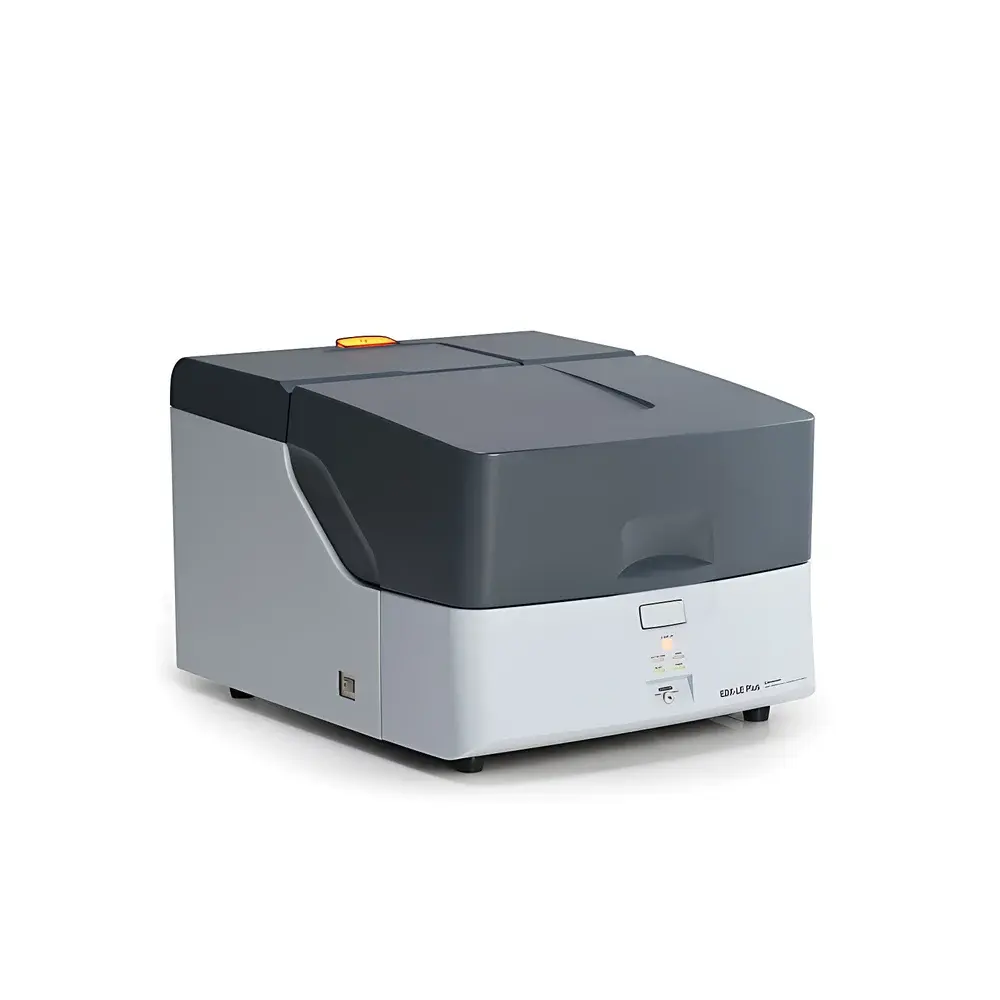
Shimadzu EDX-LE Plus Energy Dispersive X-Ray Fluorescence Spectrometer
| Brand | Shimadzu |
|---|---|
| Origin | Japan |
| Manufacturer Type | Original Equipment Manufacturer (OEM) |
| Import Status | Imported |
| Model | EDX-LE Plus |
| Configuration | Benchtop/Floor-standing |
| Industry Application | Electronics |
| Elemental Range | Al (Z=13) to U (Z=92) |
| Detection Limit | 0.1 ppm |
| Quantitative Range | 0.1 ppm – 99.99 wt% |
| Energy Resolution | <140 eV (Mn Kα) |
| Repeatability | ≤0.1% RSD (at 100 s counting time, for Cr in stainless steel standard) |
Overview
The Shimadzu EDX-LE Plus is a benchtop/floor-standing energy dispersive X-ray fluorescence (EDXRF) spectrometer engineered for rapid, non-destructive elemental screening and quantitative analysis in regulated compliance environments. It operates on the fundamental principle of X-ray fluorescence: primary X-rays from a micro-focus X-ray tube excite atoms in the sample, causing emission of characteristic secondary (fluorescent) X-rays whose energies are element-specific. The high-resolution silicon drift detector (SDD), coupled with Peltier-based electronic cooling, enables precise energy discrimination without liquid nitrogen—ensuring stable spectral acquisition, low background noise, and long-term calibration integrity. Designed explicitly for regulatory screening workflows—including EU RoHS 2.0 (2011/65/EU), China RoHS II (SJ/T 11364-2014), ELV Directive (2000/53/EC), and halogen-free (Br/Cl) verification—the EDX-LE Plus delivers trace-level detection (down to 0.1 ppm) across the full range from aluminum (Z=13) to uranium (Z=92), with measurement repeatability ≤0.1% RSD under standardized conditions.
Key Features
- High-performance silicon drift detector (SDD) with energy resolution <140 eV at Mn Kα—optimized for accurate peak deconvolution of overlapping transitions (e.g., Sb L-lines vs. Pb M-lines, Cl Kα vs. Ca Kα).
- Five-position automatic primary filter changer + OPEN mode—enabling dynamic optimization of excitation conditions for light elements (Al–Cl) and heavy metals (Pb, Cd, Hg, Cr, Br) in a single sequence.
- Large sample chamber (W370 × D320 × H155 mm)—accommodating PCBs, molded connectors, battery packs, and other electronics components without disassembly or subsampling.
- Fully automated “Screening Analysis” workflow: auto-detection of major matrix constituents, intelligent selection of optimal measurement parameters (tube voltage, current, filter, live time), and pass/fail classification against user-defined regulatory thresholds.
- Hardware-based access control and data protection: password-protected method editing, audit-trail-enabled parameter locking, and write-protected result archives compliant with GLP documentation requirements.
- Zero-cryogen operation via thermoelectric cooling—eliminating LN₂ logistics, reducing downtime, and supporting unattended overnight screening runs.
Sample Compatibility & Compliance
The EDX-LE Plus accepts solid, liquid, and powdered samples in their native state—no digestion, pressing, or coating required. Its open-sample design supports direct analysis of heterogeneous electronics assemblies, including multilayer printed circuit boards, solder joints, encapsulated ICs, and plastic housings. Method templates pre-configured for RoHS (Pb, Cd, Hg, Cr⁶⁺ surrogate, Br, Cl), ELV (additional Sb, PBB, PBDE), and halogen-free (Cl, Br < 900 ppm) testing align with ISO 17025-accredited laboratory practices. All analytical protocols adhere to ASTM E1621 (Standard Guide for XRF Elemental Analysis), IEC 62321-5:2013 (RoHS screening by EDXRF), and GB/T 33352–2016 (Chinese RoHS EDXRF methodology). Instrument qualification includes factory-installed reference standards traceable to NIST SRMs, with optional IQ/OQ/PQ documentation packages available for GMP-regulated facilities.
Software & Data Management
The proprietary LabSolution EDX software provides three integrated analysis modes: Screening (pass/fail classification per substance limit), Qualitative (peak identification with library matching), and Quantitative (fundamental parameter-based calibration with matrix correction). All results include full spectral metadata (acquisition time, tube settings, filter position, detector temperature), enabling retrospective reprocessing and inter-laboratory comparison. Data export supports CSV, PDF, and XML formats compatible with LIMS integration. Audit trails record all user actions—including method modification, result deletion, and report generation—with timestamped operator IDs. Software complies with FDA 21 CFR Part 11 requirements when configured with electronic signatures and role-based permissions.
Applications
- Routine RoHS/ELV conformance screening of incoming electronic components, subassemblies, and finished goods.
- Halogen-free verification for IPC-4101D-compliant laminates and solder mask materials.
- Failure analysis support: rapid identification of contamination sources (e.g., Cl residue on PCBs, Pb-rich solder voids, Cr-rich plating layers).
- Supplier qualification audits requiring documented elemental composition reports per material declaration (IMDS, JIG-0011).
- Quality control of metal alloys, plating baths, and polymer additives where regulatory limits apply (e.g., Cd in pigments, Br in flame retardants).
FAQ
Does the EDX-LE Plus require liquid nitrogen for detector cooling?
No. It employs a high-efficiency Peltier cooler for the SDD, eliminating cryogenic handling while maintaining <140 eV resolution and thermal stability over extended operation.
Can it quantify hexavalent chromium (Cr⁶⁺)?
EDXRF measures total chromium. For Cr⁶⁺ speciation, complementary wet-chemical methods (e.g., ISO 3613 or EPA 3060A) are required; however, the EDX-LE Plus serves as an effective prescreening tool to flag Cr-containing samples for further testing.
Is method validation support included?
Yes—Shimadzu provides application notes, certified reference materials (CRMs), and validation templates aligned with ISO/IEC 17025 clause 7.2.2 for measurement uncertainty estimation.
How is data integrity ensured during regulatory audits?
All analyses generate immutable raw spectra and metadata. Software enforces electronic signatures, change logs, and read-only reporting—fully traceable for FDA, EU Notified Body, or CNAS inspections.
What maintenance is required beyond routine cleaning?
Annual detector performance verification and X-ray tube output calibration are recommended. No consumables (e.g., LN₂, gas purges, or vacuum pumps) are needed—reducing TCO over a 10-year service life.



