
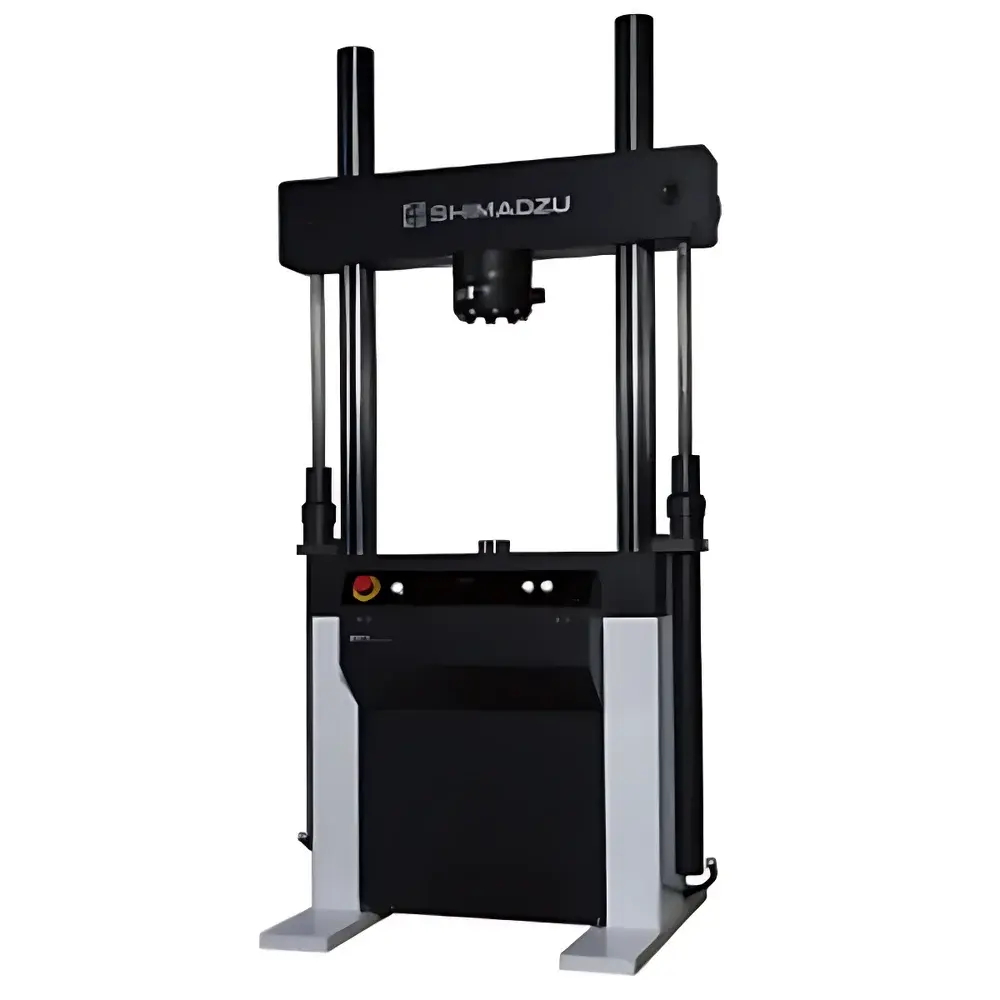
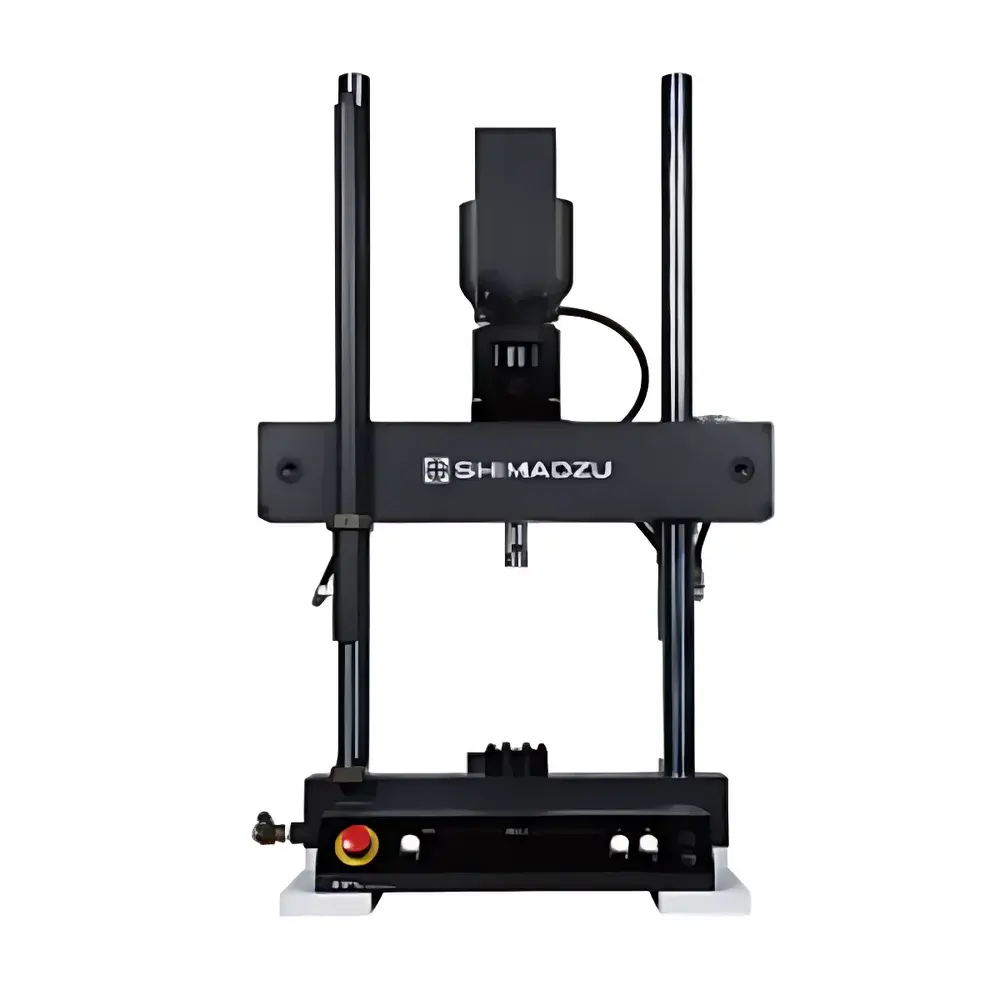
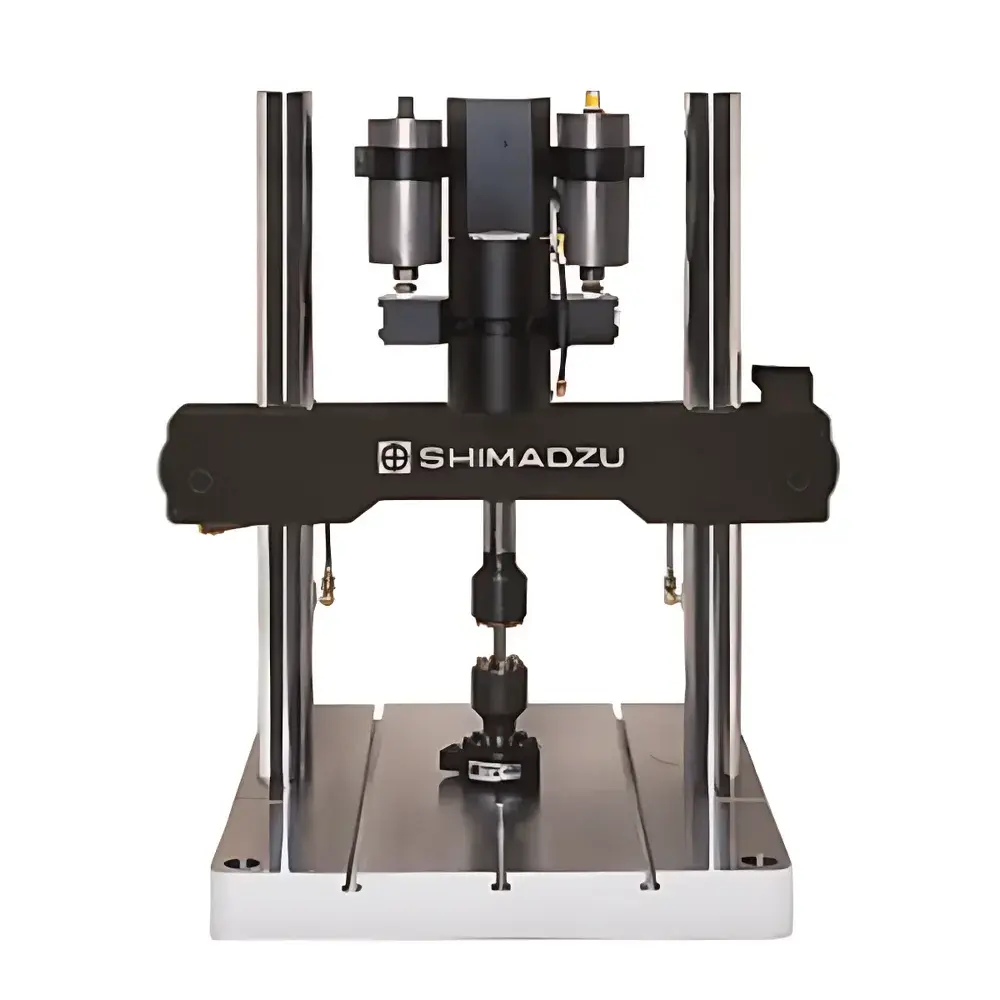
Shimadzu EHF-E/U/L Series Electro-Hydraulic Servo Fatigue Testing Systems
| Brand | Shimadzu |
|---|---|
| Origin | Japan |
| Manufacturer Type | Original Equipment Manufacturer (OEM) |
| Product Category | Imported |
| Model | EHF-E / EHF-U / EHF-L |
| Instrument Type | Electro-Hydraulic Servo Fatigue Testing Machine |
| Maximum Test Load | 500 kN |
| Load Capacity Options | EHF-L: 5–20 kN |
| EHF-E & EHF-U | 50–500 kN |
| Piston Stroke | ±25 mm / ±50 mm |
| Load Accuracy | ±0.5% of displayed value |
| Actuation Principle | Closed-loop electro-hydraulic servo control with high-bandwidth servo valves |
| Frame Stiffness | High-rigidity, four-column monolithic frame design |
| Energy Optimization | Optional Energy Control Unit (ECU) for adaptive hydraulic power modulation |
Overview
The Shimadzu EHF-E/U/L Series Electro-Hydraulic Servo Fatigue Testing Systems are precision-engineered platforms designed for high-fidelity dynamic mechanical characterization under cyclic loading conditions. Based on Couette-type hydraulic servo actuation and closed-loop digital control architecture, these systems reproduce user-defined waveforms—including sine, triangle, square, random, and block-loading profiles—with exceptional fidelity across a broad frequency spectrum (typically 0.001 Hz to 100 Hz, dependent on load capacity and specimen compliance). The core actuation principle relies on proportional servo valves regulating pressurized hydraulic fluid flow to a double-acting piston cylinder, enabling real-time synchronization of force, displacement, and strain signals. Engineered for structural integrity and thermal stability, the monolithic four-column frame minimizes parasitic bending moments—critical for maintaining axial alignment during long-duration fatigue tests per ASTM E466, ISO 1099, and ASTM E606 standards. Each system integrates a dedicated hydraulic power unit (HPU) with pressure regulation, filtration, and temperature stabilization subsystems to ensure consistent fluid viscosity and valve responsiveness over extended test cycles.
Key Features
- High-rigidity, preloaded four-column frame structure engineered to suppress lateral deflection and maintain coaxial loading alignment—essential for crack propagation studies and R-curve determination.
- Electro-hydraulic servo actuators with wide dynamic range: capable of stable operation from quasi-static creep testing (10−4 mm/s) to high-speed impact simulation (up to 100 mm/s), enabled by high-bandwidth (≥300 Hz) servo valves and low-latency digital control firmware.
- Load measurement accuracy of ±0.5% of full-scale reading, traceable to NIST-traceable calibration protocols, with dual-range load cells standard across all EHF-E and EHF-U models.
- Programmable piston stroke options (±25 mm or ±50 mm) accommodate both high-strain polymer testing and low-displacement metallic fracture mechanics specimens (e.g., compact tension or three-point bend configurations).
- Optional Energy Control Unit (ECU): dynamically adjusts HPU motor speed and pump displacement in real time based on instantaneous demand, reducing standby power consumption by up to 70% and minimizing oil heating during idle periods—supporting ISO 50001 energy management compliance.
- Integrated safety architecture including emergency stop interlocks, pressure relief circuits, over-travel limit switches, and software-enforced operational boundaries aligned with ISO 13850 and IEC 61508 functional safety requirements.
Sample Compatibility & Compliance
The EHF series accommodates standardized and custom geometries per ASTM E399 (fracture toughness), ASTM E647 (fatigue crack growth), ISO 12106 (metallic materials—fatigue testing), and ISO 14577 (instrumented indentation). Specimen mounting supports threaded, clevis, and wedge-grip configurations with interchangeable jaw sets for metals, composites, elastomers, and thermoplastics. All systems comply with CE marking directives (Machinery Directive 2006/42/EC, EMC Directive 2014/30/EU) and meet electromagnetic compatibility requirements per EN 61326-1. For regulated environments—including pharmaceutical device validation and aerospace component qualification—the platform supports 21 CFR Part 11-compliant audit trails when paired with Shimadzu’s TRAPEZIUM X software and optional electronic signature modules.
Software & Data Management
TRAPEZIUM X is the native control and analysis suite, offering real-time waveform synthesis, closed-loop control mode switching (load/displacement/strain), and automated test sequencing. It provides built-in templates for S–N curve generation, ΔK–da/dN plotting, hysteresis loop analysis, and cycle counting per ASTM E1049. Raw data export is supported in ASCII, CSV, and HDF5 formats for third-party post-processing (e.g., MATLAB, Python SciPy, or MTS FlexTest-compatible toolchains). All test logs include metadata stamps (operator ID, calibration certificate ID, environmental conditions), supporting GLP/GMP documentation workflows. Remote monitoring via secure HTTPS API enables integration into centralized laboratory information management systems (LIMS).
Applications
These systems serve as primary instrumentation in R&D laboratories and certification centers for fatigue life prediction, damage tolerance assessment, and durability validation. Typical use cases include: high-cycle fatigue (HCF) evaluation of turbine blades and landing gear components; low-cycle fatigue (LCF) characterization of welded joints under thermo-mechanical loading; fatigue crack growth rate (FCGR) measurement in nuclear-grade stainless steels; viscoelastic fatigue behavior of carbon-fiber-reinforced polymers (CFRPs); and biomechanical endurance testing of orthopedic implants per ISO 14801 and ISO 7206-4. Universities and national metrology institutes deploy EHF systems for benchmarking constitutive models and validating finite element simulations under multiaxial loading.
FAQ
What distinguishes the EHF-E, EHF-U, and EHF-L model families?
EHF-L targets low-force, high-resolution applications (5–20 kN) such as polymer or thin-film fatigue; EHF-E emphasizes general-purpose mid-to-high capacity testing (50–500 kN) with enhanced thermal management; EHF-U is optimized for ultra-high stiffness requirements in fracture mechanics, featuring reinforced crossheads and reduced frame compliance.
Is hydraulic fluid conditioning included as standard?
Yes—each system includes a closed-loop hydraulic circuit with multi-stage filtration (β10 ≥ 1000), air elimination, and thermostatically controlled heat exchangers maintaining oil temperature within ±2 °C of setpoint.
Can the system perform combined tension-compression-torsion tests?
Standard configuration supports uniaxial loading only; biaxial or torsional capabilities require integration with Shimadzu’s optional multi-axis test modules (e.g., TMS-2000 series) and corresponding controller upgrades.
How is traceability maintained for calibration records?
Each load cell and displacement transducer ships with a factory calibration certificate referencing JCSS (Japan Calibration Service System) or UKAS-accredited reference standards, with recalibration intervals defined per ISO/IEC 17025 and documented in TRAPEZIUM X’s calibration log.
Does the ECU option affect test repeatability or control bandwidth?
No—ECU operates exclusively on the hydraulic power supply side and does not interfere with servo valve command signals or feedback loop dynamics; all performance specifications remain unchanged under ECU-enabled operation.



