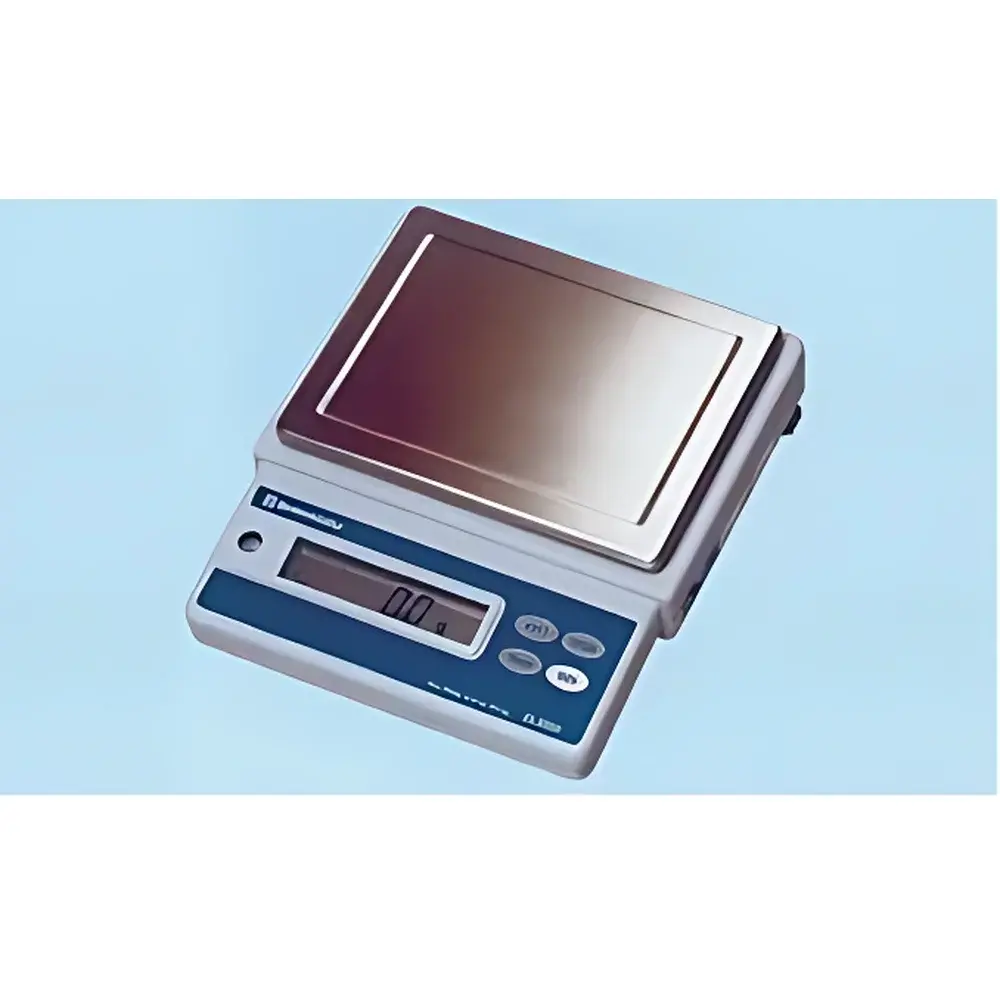
Shimadzu EL/ELB Series Portable Precision Balance
| Brand | Shimadzu |
|---|---|
| Origin | Japan |
| Product Line | EL (rechargeable battery/AC adapter) & ELB (alkaline battery/AC adapter) |
| Max Capacity | 120 g – 12 kg |
| Readability | 0.01 g – 1 g |
| Response Time | ≈1 s |
| Internal Resolution | 1/30,000 |
| Overload Protection | Integrated mechanical safeguard |
| Power Options | AC adapter (standard), rechargeable Li-ion battery (optional, EL series only), 6× AA alkaline batteries (ELB series, ~40 h) |
| Interface | RS-232C (IFB-102A, optional), printer port (EP-80 compatible), PC connectivity (with data transfer software) |
| Compliance | Designed for GLP/GMP-aligned workflows |
Overview
The Shimadzu EL and ELB Series portable precision balances are engineered for high-reproducibility mass measurement in dynamic laboratory, field, and quality control environments. Based on strain-gauge load cell technology, these balances deliver rapid stabilization (~1 second) and consistent repeatability across diverse operating conditions — including ambient temperature fluctuations and minor mechanical disturbances typical of mobile or benchtop use. Unlike electromagnetic force compensation (EMFC) balances, the EL/ELB series employs a robust, low-drift resistive sensor architecture optimized for durability, power efficiency, and cost-effective precision. With internal resolution up to 1/30,000 of full scale and readability options spanning 0.01 g to 1 g, the series bridges the performance gap between entry-level platforms and high-end analytical instruments — making it suitable for routine QC checks, inventory management, sample preparation, and field-based calibration verification.
Key Features
- Rapid Stabilization: Achieves stable readings in approximately one second, minimizing operator wait time and increasing throughput during repetitive weighing tasks.
- High Internal Resolution: 1/30,000 internal resolution ensures fine discrimination between closely spaced masses, supporting accurate differential and percentage measurements even at lower capacities.
- Dual Power Architecture: EL models support AC operation and optional integrated rechargeable lithium-ion battery (up to 12 hours continuous use); ELB models operate on standard AA alkaline cells (6 pcs, ~40 hours) plus AC adapter — enabling true off-grid deployment without compromise in stability.
- Mechanical Overload Protection: Patented mechanical stop mechanism prevents damage to the load cell from accidental overloading or impact on the weighing pan — extending service life and reducing recalibration frequency.
- Multi-Function Weighing Modes: Built-in applications include piece counting (PCS), percent weighing (%), and density determination (requires optional SMK-201 kit), eliminating the need for external calculation tools.
- Standard RS-232C & Printer Interface: Equipped with native serial communication port (IFB-102A optional) and dedicated printer interface for direct connection to EP-80 statistical printer — facilitating automated record generation compliant with basic GLP documentation requirements.
Sample Compatibility & Compliance
The EL/ELB series accommodates a wide range of sample types — from small vials and powders (using compact 10 mm pans on sub-600 g models) to bulk solids and packaged goods (via large 170 × 130 mm pans on higher-capacity units). All models feature stainless-steel pans and corrosion-resistant housing suitable for general chemical handling. While not certified for hazardous locations or intrinsically safe environments, the balances meet IEC 61010-1 safety standards for laboratory electrical equipment. For regulated environments, data output via RS-232C — when used with validated third-party software — supports traceability and basic 21 CFR Part 11 compliance (electronic signature and audit trail capabilities require external software validation). Optional accessories such as the ground-hook assembly (for below-bench suspension weighing) and protective display covers enhance operational flexibility and longevity.
Software & Data Management
The EL/ELB balances operate autonomously but integrate seamlessly into digital lab infrastructures. Raw weight data is transmitted in ASCII format via RS-232C using standard protocols (9600 bps, 8N1), compatible with LIMS, ELN, and custom SCADA systems. Shimadzu provides no proprietary data acquisition software; however, third-party tools (e.g., LabSolutions Link, Tera Term, or Python-based PySerial scripts) can be configured for real-time logging, statistical analysis, and PDF report generation. When paired with the EP-80 thermal printer, the balance automatically outputs timestamped records including gross/net/tare values, unit, and function mode — satisfying minimal documentation needs for ISO/IEC 17025 Annex A.5 or internal SOPs requiring printed evidence of calibration checks or raw material receipt.
Applications
- Pharmaceutical: Excipient dispensing, capsule weight checks, and batch reconciliation in non-sterile manufacturing areas.
- Food & Beverage: Portion control verification, ingredient batching, and shelf-life study sample tracking.
- Academic & Teaching Labs: Student experiments requiring portable, intuitive mass measurement with immediate feedback.
- Field Quality Audits: On-site supplier evaluations, warehouse cycle counts, and incoming inspection where mains power is unavailable.
- Materials Science: Density determination of polymers and composites (with SMK-201 kit), powder flow characterization support, and coating thickness estimation via mass-thickness correlation.
FAQ
What is the difference between EL and ELB models?
EL models support AC power and an optional built-in rechargeable lithium-ion battery; ELB models use AC power or six AA alkaline batteries — offering longer field runtime without charging infrastructure.
Can the EL/ELB series be used for density measurement?
Yes — when equipped with the optional SMK-201 density determination kit (not compatible with EL120/EL200/EL300 due to capacity constraints), the balance performs suspended-weight calculations per ASTM D792 and ISO 1183-1.
Is calibration traceable to national standards?
Shimadzu provides factory calibration certificates; users must perform periodic verification and adjustment using NIST-traceable weights appropriate for each model’s capacity and readability.
Does the balance support automatic tare or preset tare functions?
Yes — both manual tare and programmable preset tare values are supported, enabling rapid sequential weighing of multiple samples in fixed containers.
Are the RS-232C and printer interfaces enabled by default?
The printer interface is hardware-enabled and functional out-of-box; RS-232C requires optional IFB-102A interface module and proper cable termination — no firmware activation is needed.