
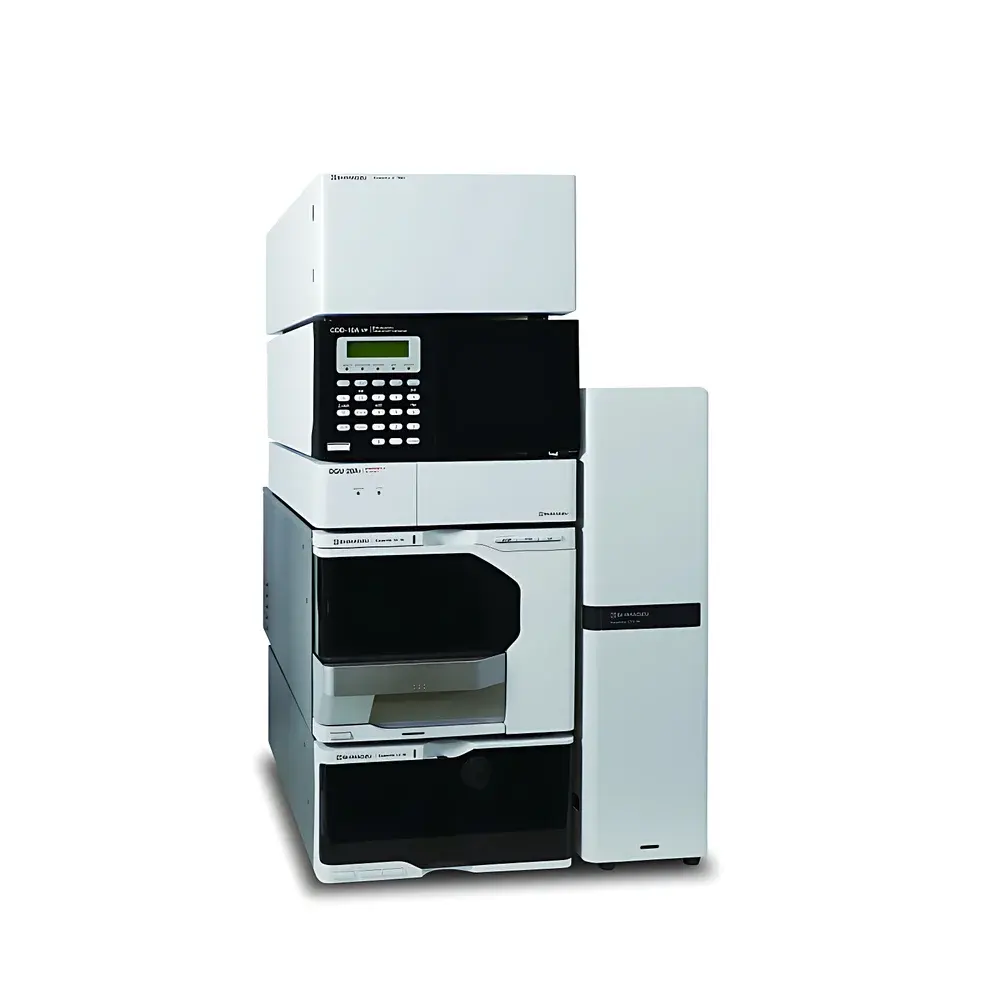
Shimadzu Essentia IC-16 Ion Chromatograph
| Brand | Shimadzu |
|---|---|
| Origin | Jiangsu, China |
| Manufacturer Type | Manufacturer |
| Origin Category | Domestic |
| Model | Essentia IC-16 |
| Instrument Type | Laboratory |
| Pump Pressure Rating | 0–36 MPa |
| Flow Rate Range | 0.001–10.00 mL/min |
| Eluent Flow Rate Range | 0.001–10.00 mL/min |
| Maximum Operating Pressure | 36 MPa |
| Column Oven Temperature Range | 30–85 °C |
| Temperature Reproducibility | Not specified |
| Eluent Concentration Range | Not specified |
Overview
The Shimadzu Essentia IC-16 Ion Chromatograph is a dedicated benchtop analytical system engineered for high-precision, routine anion and cation analysis in environmental, pharmaceutical, food, and industrial quality control laboratories. It operates on the principle of ion exchange chromatography, where ionic analytes are separated on a packed column containing ion-exchange resin as the stationary phase, eluted with aqueous electrolyte solutions (e.g., Na2CO3/NaHCO3 or methanesulfonic acid), and detected via suppressed conductivity detection. Central to its performance is the integrated automatic regenerative electrochemical membrane suppressor — eliminating the need for chemical regeneration reagents and enabling stable, low-background detection with enhanced signal-to-noise ratios. The system is fully compatible with Shimadzu’s LabSolutions Essentia platform, supporting method development, sequence execution, data acquisition, and report generation under a unified software architecture compliant with GLP and 21 CFR Part 11 requirements for audit trails and electronic signatures.
Key Features
- Inert LC-16i Isocratic Pump: Delivers flow accuracy ±0.1% RSD across the full range (0.001–10.00 mL/min) with pressure capability up to 36 MPa; constructed entirely from PEEK and ceramic components to ensure chemical inertness toward strong acids, bases, and organic modifiers.
- SIL-16i Inert Autosampler: Achieves injection precision <0.3% RSD and carryover <0.01% using a high-pressure needle-in-loop design; supports rapid cycle times (<10 s per injection) and full compatibility with both IC and reversed-phase LC mobile phases, including 100% acetonitrile or methanol.
- Electrolytic Regenerative Membrane Suppressor: Generates suppression current on-demand without external regenerant solutions; maintains consistent baseline stability over extended operation (>1000 injections) and reduces operational cost and waste disposal burden.
- Thermostatically Controlled Column Compartment: Precisely regulates temperature between 30–85 °C with ramping capability, ensuring retention time reproducibility and method robustness across seasonal or facility-wide environmental fluctuations.
- Modular Hardware Architecture: Designed for field-upgradability — supports optional UV/Vis absorbance detection, conductivity cell temperature control, and integration with fraction collectors or online dialysis modules.
Sample Compatibility & Compliance
The Essentia IC-16 accommodates a broad spectrum of aqueous samples, including drinking water, wastewater, biological fluids (serum, urine), food extracts, battery electrolytes, and semiconductor process chemicals. Its PEEK-wetted path and chemically resistant fluidic components enable direct injection of samples containing up to 25% organic solvent or pH 0–14 matrices without system degradation. Method validation aligns with ISO 14911 (water analysis), ASTM D4327 (anions in water), USP (conductivity of purified water), and EPA Methods 300.0, 300.1, and 317.0. All hardware and firmware comply with IEC 61000-6-3 (EMC) and IEC 61010-1 (safety), while software features full 21 CFR Part 11 compliance including user authentication, role-based access control, electronic signatures, and immutable audit trails.
Software & Data Management
IC Analysis Assist is a purpose-built module embedded within the LabSolutions Essentia workstation. It provides a task-oriented interface optimized for non-expert users: graphical batch table creation via drag-and-drop sample vial mapping, real-time status monitoring of autosampler tray position and injection progress, and one-click method launch with auto-configuration of pump gradient, detector settings, and suppressor current. Raw data are stored in vendor-neutral .cdf format (compatible with third-party processing tools), while quantitative reports include peak area/height, retention time, calibration curve statistics (R2, %RSD of standards), and customizable pass/fail criteria aligned with internal SOPs or regulatory thresholds. Data archiving supports network storage, NAS backup, and scheduled export to LIMS via ODBC or CSV protocols.
Applications
- Environmental monitoring: Quantification of F−, Cl−, NO2−, Br−, NO3−, PO43−, SO42−, and cations (Li+, Na+, NH4+, K+, Mg2+, Ca2+) in surface water, groundwater, and effluent streams.
- Pharmaceutical QC: Counterion profiling of APIs (e.g., chloride in amine hydrochlorides), residual acetate or sulfate in biologics formulations, and assay of excipients such as citrate or tartrate.
- Food & beverage safety: Detection of preservatives (benzoate, sorbate), nitrite in cured meats, iodide in dairy, and phosphate additives in soft drinks.
- Industrial process control: Monitoring of anionic impurities (Cl−, SO42−) in ultrapure water loops for semiconductor fabrication and analysis of corrosion inhibitors (molybdate, tungstate) in cooling tower fluids.
FAQ
Is the Essentia IC-16 suitable for regulated GMP/GLP environments?
Yes — the system meets core requirements for regulated labs, including electronic signature support, audit trail logging, method locking, and user permission tiers within LabSolutions Essentia.
Can the same autosampler be used interchangeably between IC and HPLC methods?
Yes — the SIL-16i is fully compatible with both ion chromatography and reversed-phase liquid chromatography due to its chemically inert flow path and pressure-rated design.
Does the suppressor require consumable regeneration cartridges or chemical reagents?
No — the electrochemical membrane suppressor operates without external regenerants; suppression current is generated internally via water electrolysis.
What column oven temperature stability can be expected during long-duration runs?
The column compartment maintains ±0.2 °C temperature control across the 30–85 °C operating range, verified per ASTM E2915 and supported by continuous thermal monitoring.
Is remote monitoring or unattended operation supported?
Yes — the system supports network-based instrument control, email alert notifications upon sequence completion or error events, and integration with enterprise scheduling systems via API-enabled LabSolutions interfaces.




