
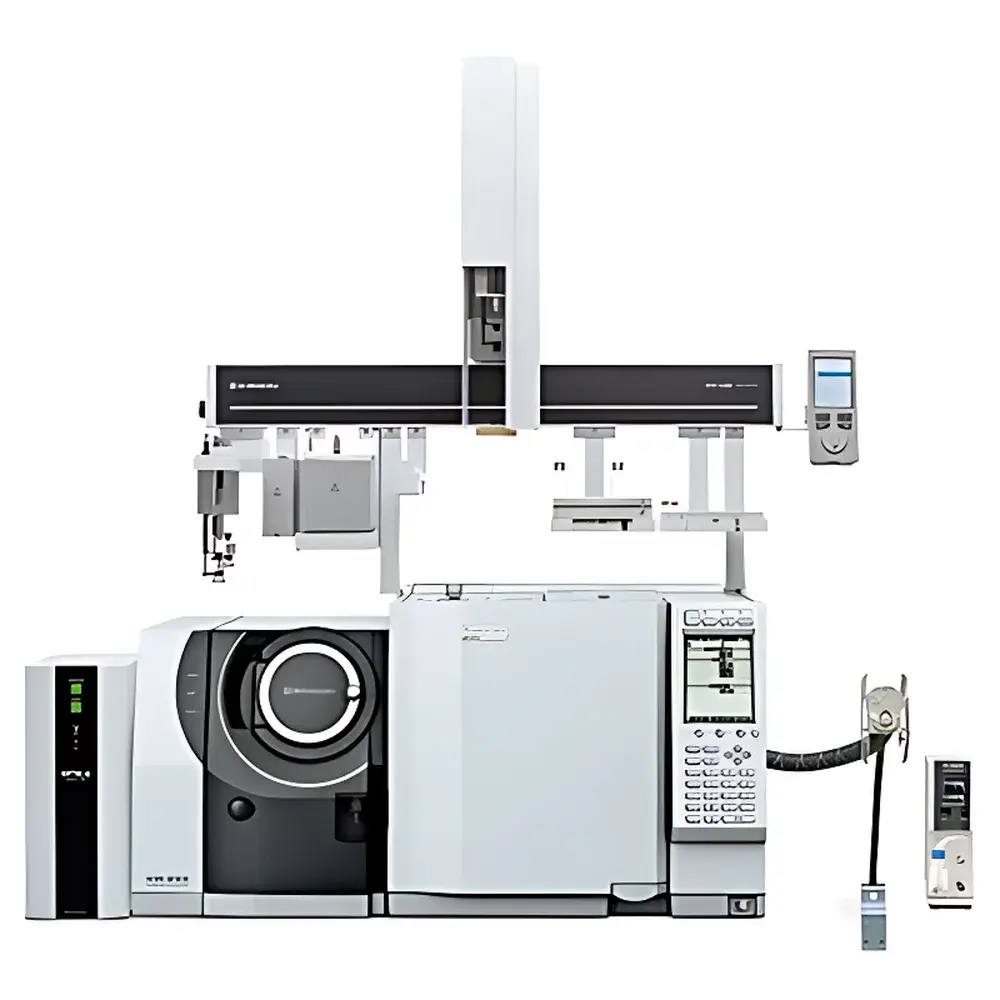
Shimadzu Off-Flavor Analyzer System (GCMS-QP2020/GCMS-TQ8040 with Dedicated Odor Database and Automated Sample Prep)
| Brand | Shimadzu |
|---|---|
| Origin | Japan |
| Manufacturer Type | Original Equipment Manufacturer (OEM) |
| Import Status | Imported |
| Model | Off-Flavor Analyzer |
| Instrument Type | Triple Quadrupole Mass Spectrometer (GC-MS/MS) |
| Mass Range | 2–1090 u |
| Resolution | Unit Mass Resolution |
| Sensitivity | >20,000:1 (S/N, using chlorobenzene, m/z 112) |
| Scan Speed | 20,000 u/s |
| Chromatographic Configuration | Multi-column switching platform (three polarities: DB-5ms, DB-WAX, InertCap Pure-WAX) |
Overview
The Shimadzu Off-Flavor Analyzer System is an integrated gas chromatography–triple quadrupole mass spectrometry (GC–MS/MS) platform engineered specifically for the objective, reproducible identification and semi-quantitative assessment of odor-active compounds at sensory-relevant concentrations. Unlike conventional GC–MS workflows that rely on generic spectral libraries and manual interpretation, this system embeds olfactory science into analytical chemistry by coupling high-sensitivity triple quadrupole detection with a curated, experimentally validated odor database. It operates on the principle of targeted multiple reaction monitoring (MRM), enabling selective detection of volatile organic compounds (VOCs) at or below their human odor threshold concentrations—critical for applications where trace-level off-flavors drive product rejection or regulatory concern. Designed for laboratories requiring compliance with ISO 11337 (odor analysis), ASTM E2869 (sensory-guided chemical analysis), and FDA-aligned data integrity standards, the system bridges the gap between sensory perception and instrumental quantification without dependence on human panelists.
Key Features
- Triple quadrupole GC–MS architecture (GCMS-QP2020 or GCMS-TQ8040) delivering robust selectivity and sub-part-per-trillion (ppt) sensitivity in MRM mode
- Dedicated off-flavor database containing over 1,200 odor-active compounds, each annotated with sensory descriptors (e.g., “catty”, “earthy”, “metallic”), odor threshold values (in air/water matrices), and retention indices across three column chemistries
- Automated method generation: software auto-generates GC temperature programs, MRM transitions, and dwell times based on compound class and matrix type
- Multi-polarity column switching capability—DB-5ms (non-polar), DB-WAX (polar), and InertCap Pure-WAX (highly inert polar)—enabling orthogonal separation and confirmatory identification without venting the vacuum system
- Integrated automated sample preparation module supporting headspace (HS), solid-phase microextraction (SPME), and purge-and-trap (P&T) protocols with programmable thermal desorption
- Real-time odor intensity prediction algorithm correlating peak area ratios to published odor activity values (OAVs)
Sample Compatibility & Compliance
The system accommodates complex, low-volatility, and thermally labile matrices including beverages (beer, wine, dairy), food packaging leachates, wastewater effluents, indoor air samples, and forensic evidence swabs. All hardware and software components comply with ISO/IEC 17025:2017 requirements for testing laboratories. Data acquisition and processing support 21 CFR Part 11-compliant audit trails, electronic signatures, and role-based access control. The odor database is maintained per GLP principles, with version-controlled updates traceable to peer-reviewed literature (e.g., Flavornet, Leffingwell & Associates, and peer-reviewed publications in Food Chemistry and Journal of Agricultural and Food Chemistry). Method validation documentation aligns with ICH Q2(R2) guidelines for specificity, linearity, LOD/LOQ, and precision.
Software & Data Management
Controlled via Shimadzu’s LabSolutions Insight software, the platform provides unified workflow management—from method setup and instrument control to odor-centric reporting. The software includes embedded retention time alignment algorithms for cross-column comparison, automatic peak deconvolution for co-eluting odorants, and customizable report templates showing compound name, odor descriptor, threshold concentration, measured concentration, OAV, and confidence score. Raw data files (.qgd) are stored in vendor-neutral formats compliant with ASTM E1947 for long-term archival. Backup and restore functions meet ISO 27001 information security standards, and optional integration with LIMS systems is supported via ASTM E1482-compliant APIs.
Applications
- Food & beverage quality assurance: Detection of geosmin in bottled water, 2-methylisoborneol (MIB) in aquaculture products, trans-2-nonenal in aged beer, and hexanal in oxidized oils
- Environmental monitoring: Identification of dimethyl sulfide (DMS), indole, and skatole in landfill leachate and wastewater treatment plant emissions
- Packaging migration studies: Screening for aldehydes, lactones, and plasticizer residuals migrating into food simulants
- Pharmaceutical stability testing: Monitoring sulfur-containing volatiles in lyophilized formulations
- Forensic odor profiling: Characterization of decomposition VOCs in clandestine burial site investigations
FAQ
What distinguishes the Off-Flavor Analyzer from standard GC–MS systems?
It integrates a purpose-built odor database with automated MRM method generation and multi-column chromatographic flexibility—eliminating reliance on subjective sensory panels while maintaining trace-level detectability aligned with human olfaction thresholds.
Can the system quantify odor intensity—not just compound concentration?
Yes. Using odor activity values (OAV = measured concentration / odor threshold), the software calculates relative odor impact and flags compounds exceeding perceptual relevance thresholds.
Is method validation support included?
Yes. Pre-validated SOPs, system suitability test protocols, and uncertainty estimation tools are provided for ISO 17025 and FDA audit readiness.
How is database update handled?
Annual database subscriptions include new compounds, revised thresholds, and expanded sensory annotations—each update accompanied by technical notes citing primary literature sources and experimental conditions.
Does the system support untargeted screening alongside targeted odor analysis?
While optimized for targeted MRM, full-scan and SIM modes are fully accessible; however, untargeted workflows require separate method configuration and are not governed by the odor database logic.




