
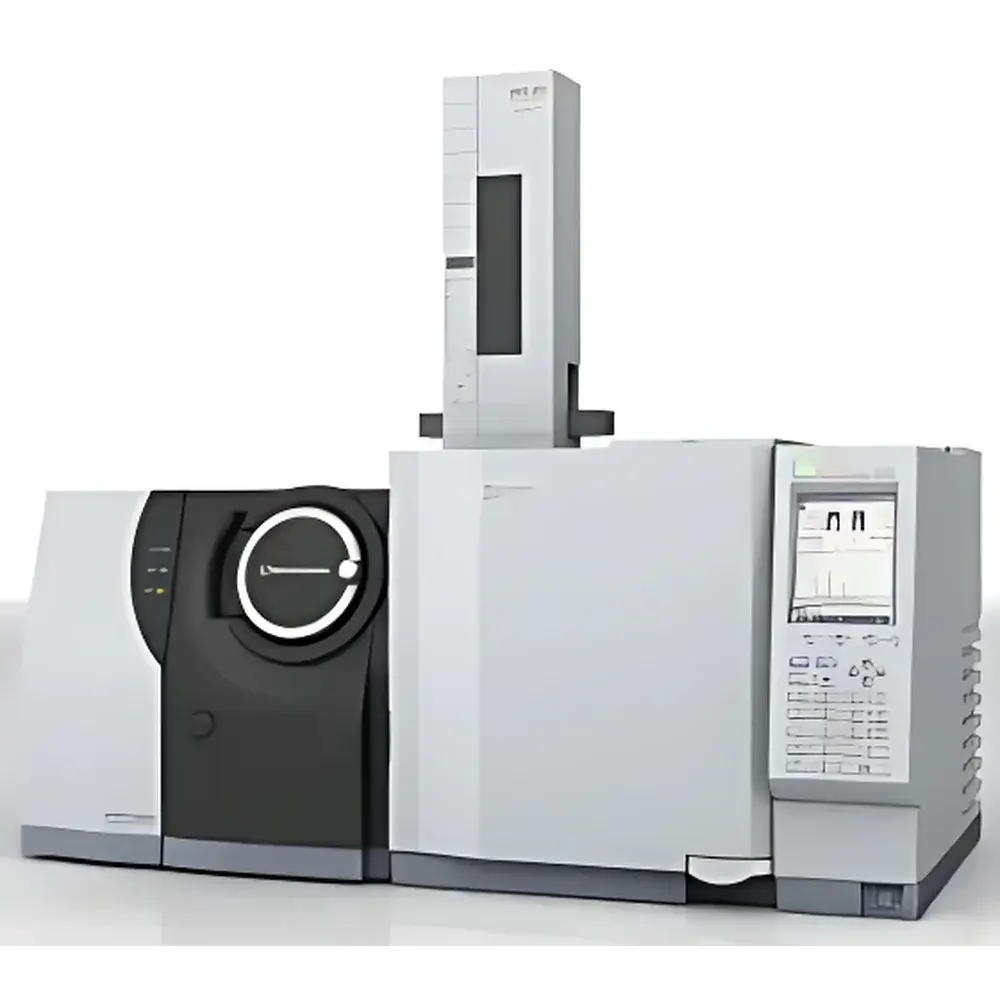
Shimadzu GCMS-TQ8040X Triple Quadrupole Gas Chromatography-Mass Spectrometer
| Brand | Shimadzu |
|---|---|
| Origin | Japan |
| Manufacturer Type | Original Equipment Manufacturer (OEM) |
| Import Status | Imported Instrument |
| Model | GCMS-TQ8040X |
| Instrument Type | Triple Quadrupole Mass Spectrometer |
| GC Configuration | Conventional Capillary Gas Chromatograph |
| MRM Channel Capacity | Up to 32,768 per run |
| Ion Source | Patented High-Efficiency Ion Source |
| Collision Cell | Optimized RF-Only Quadrupole Collision Cell |
| Scan Modes | Simultaneous Scan and MRM Acquisition |
| Software Platform | GCMSsolution with Smart MRM Automation |
Overview
The Shimadzu GCMS-TQ8040X is a high-performance triple quadrupole gas chromatography–mass spectrometry (GC-MS/MS) system engineered for trace-level quantitative analysis in regulated and research-intensive laboratories. It operates on the fundamental principle of tandem mass spectrometry: analytes eluting from a capillary gas chromatograph are ionized via electron ionization (EI), subjected to precursor ion selection in Q1, collision-induced dissociation (CID) in a pressurized RF-only quadrupole collision cell (Q2), and product ion detection in Q3. This configuration delivers exceptional selectivity, specificity, and robustness—particularly critical for complex matrices such as environmental extracts, food residues, clinical biosamples, and forensic evidence. Designed and manufactured in Kyoto, Japan, the GCMS-TQ8040X integrates hardware precision with algorithm-driven workflow optimization to meet the evolving demands of high-throughput targeted quantitation under GLP, ISO/IEC 17025, and FDA 21 CFR Part 11–compliant environments.
Key Features
- Smart MRM™ automation engine: Enables fully automated method development—including retention time alignment, optimal precursor/product ion selection, and collision energy optimization—based on compound databases or user-defined libraries.
- High-capacity MRM acquisition: Supports up to 32,768 MRM transitions per analytical run without compromising dwell time or sensitivity, facilitating comprehensive multi-residue or multi-analyte panels in a single injection.
- Patented high-efficiency ion source: Features optimized electron beam geometry and heated transfer line design to maximize ion transmission efficiency across a wide dynamic range (sub-pg to ng levels), minimizing signal saturation and carryover.
- Advanced Scan/MRM simultaneous acquisition: Allows concurrent full-scan MS data collection (for library matching and unknown screening) alongside high-duty-cycle MRM quantification—ensuring both identification confidence and quantitative rigor in one analysis.
- ASSP (Advanced Scanning Speed Protocol): Dynamically adjusts scan speed and dwell allocation based on peak width and expected elution profile, preserving chromatographic fidelity while maintaining quantitative precision.
- Rugged vacuum architecture: Dual-stage turbomolecular pumping system with active pressure monitoring ensures stable operation over extended sequences, reducing downtime and recalibration frequency.
Sample Compatibility & Compliance
The GCMS-TQ8040X accommodates standard 0.25–0.53 mm ID fused-silica capillary columns and interfaces seamlessly with common autosamplers (e.g., AOC-20i/s, PAL RTC). It supports derivatized and underivatized volatile and semi-volatile compounds—including pesticides, PAHs, PCBs, steroids, alkaloids, and legacy pollutants—with demonstrated compliance to ASTM D5847, EPA Methods 525.3/8270/1613, ISO 17025 method validation requirements, and EU SANTE/11312/2021 residue analysis guidelines. All instrument control, data acquisition, and report generation adhere to ALCOA+ principles; audit trail, electronic signatures, and secure user role management are natively embedded within GCMSsolution software to support 21 CFR Part 11 compliance.
Software & Data Management
GCMSsolution v5.1 or later serves as the unified platform for instrument control, method building, real-time monitoring, and post-run processing. The Smart MRM module leverages compound-specific fragmentation patterns and retention index prediction algorithms to auto-generate validated MRM methods—reducing manual optimization by >70% compared to conventional workflows. Raw data files (.qgd) are stored in a structured, timestamped hierarchy with SHA-256 checksum integrity verification. Integrated QuantBrowser enables batch processing, matrix-matched calibration curve fitting (linear, quadratic, weighted), LOQ/LOD estimation per ICH Q2(R2), and customizable reporting templates compliant with LIMS export standards (e.g., ASTM E1912, ANSI/NIST IR 6771).
Applications
- Multi-residue pesticide analysis in fruits, vegetables, and cereals per EU Maximum Residue Levels (MRLs)
- Endocrine-disrupting compound profiling in wastewater and surface water
- Pharmaceutical impurity identification and quantitation in stability studies
- Forensic toxicology screening for controlled substances and metabolites
- Veterinary drug residue monitoring in meat and dairy products
- Environmental persistent organic pollutant (POP) surveillance in soil and sediment samples
FAQ
What regulatory standards does the GCMS-TQ8040X support for method validation?
It complies with ICH Q2(R2), USP <1225>, and ISO/IEC 17025 requirements for accuracy, precision, linearity, LOD/LOQ, and robustness testing.
Can the system perform untargeted screening alongside targeted quantitation?
Yes—via simultaneous Scan/MRM acquisition mode, enabling retrospective analysis of full-scan data for unknown identification while retaining validated MRM results.
Is remote monitoring and troubleshooting supported?
GCMSsolution includes secure TLS-encrypted remote access capability for real-time diagnostics, log review, and collaborative method support—subject to network policy and firewall configuration.
How is data integrity ensured during long-term deployment?
All raw and processed data are write-once, read-many (WORM) archived with immutable timestamps, cryptographic hashing, and configurable retention policies aligned with 21 CFR Part 11 Subpart B.
Does the system integrate with laboratory information management systems (LIMS)?
Yes—through standardized ODBC/JDBC drivers and XML-based result export modules compatible with major LIMS platforms including Thermo Fisher SampleManager, LabVantage, and STARLIMS.




