
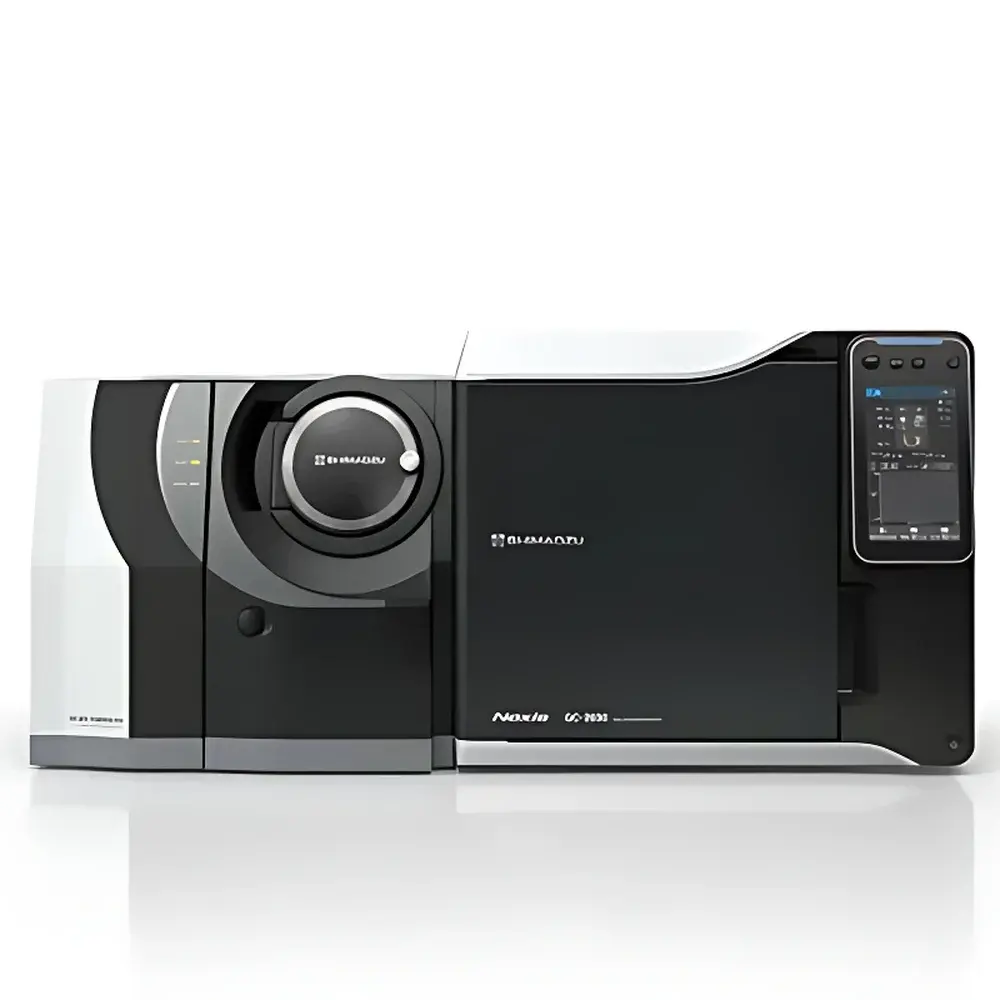
Shimadzu GCMS-TQ8050 NX Triple Quadrupole Gas Chromatography Mass Spectrometer
| Brand | Shimadzu |
|---|---|
| Origin | Japan |
| Manufacturer Type | Original Equipment Manufacturer (OEM) |
| Import Status | Imported |
| Model | GCMS-TQ8050 NX |
| Instrument Type | Triple Quadrupole Mass Spectrometer |
| GC Configuration | Conventional Capillary Gas Chromatograph Coupling |
| Mass Range | 2–1090 m/z |
| Resolution | Unit Mass Resolution |
| Sensitivity | >20,000:1 (Signal-to-Noise Ratio, S/N, for 1 pg OFN in Scan Mode) |
| Scan Speed | 20,000 u/s |
Overview
The Shimadzu GCMS-TQ8050 NX is a high-performance triple quadrupole gas chromatography mass spectrometer engineered for ultra-trace quantitative analysis of volatile and semi-volatile organic compounds. Operating on the principle of tandem mass spectrometry (MS/MS), it employs three quadrupole mass filters—Q1 (mass selection), q2 (collision cell), and Q3 (mass analysis)—to enable highly selective precursor ion → product ion transitions. This architecture delivers exceptional specificity in complex matrices, effectively suppressing chemical noise and minimizing interferences from co-eluting compounds. Designed for laboratories requiring regulatory-grade data integrity, the system supports rigorous analytical workflows in compliance with ISO/IEC 17025, USP , and FDA 21 CFR Part 11 when configured with audit-trail-enabled software and electronic signature modules.
Key Features
- Ultra-high sensitivity detection: Achieves attogram-level instrument detection limits (IDL) for key analytes (e.g., dioxins, PCBs, pesticides) through an enhanced gain electron multiplier detector and full-time triple-noise suppression technology—including source shielding, optimized ion optics, and low-noise electronics.
- Robust ion source architecture: Incorporates a high-brightness ion source with integrated shield plate (Shield Technology) to minimize surface adsorption and reduce contamination buildup, extending maintenance intervals and improving long-term signal stability.
- Advanced vacuum system: Equipped with a high-capacity, oil-free turbo-molecular pump assembly delivering rapid pump-down times and stable operating pressure (<5 × 10⁻⁶ Pa), essential for sustained MS/MS performance across extended acquisition sequences.
- High-speed scanning capability: Supports up to 20,000 u/s scan speed without sacrificing sensitivity or mass accuracy—enabling multi-analyte quantitation across narrow GC peaks with high temporal resolution.
- Durable hardware design: Engineered for continuous operation in QC and research environments; features modular components, field-replaceable ion sources, and diagnostic self-check routines to maximize uptime and reduce total cost of ownership.
Sample Compatibility & Compliance
The GCMS-TQ8050 NX is compatible with standard capillary GC columns (e.g., 15–60 m × 0.25 mm ID, 0.1–1.0 µm film thickness) and accepts split/splitless, PTV, and direct injection interfaces. It supports derivatization-compatible workflows for polar or thermally labile compounds. The system complies with international standards including ASTM D5845 (dioxin analysis), EPA Methods 1613/8270, and ISO 18856 for environmental monitoring. When operated with GCMS Insight software under validated conditions, it meets GLP/GMP requirements for regulated bioanalysis and residue testing in food, pharmaceutical, and clinical toxicology applications.
Software & Data Management
GCMS Insight is a fully integrated, workflow-driven software platform supporting method development, acquisition control, library searching (NIST, Wiley, custom libraries), quantitative processing (internal standard, isotope dilution), and report generation. It includes automated peak integration algorithms compliant with ICH Q2(R2) guidelines, batch processing with customizable QC flagging, and secure user access levels with full audit trail logging. Data files are stored in vendor-neutral .cdf format, enabling interoperability with third-party LIMS and statistical analysis tools. Optional 21 CFR Part 11 compliance packages provide electronic signatures, role-based permissions, and immutable record retention.
Applications
The GCMS-TQ8050 NX is routinely deployed in regulatory and research laboratories for targeted quantification of trace-level contaminants and biomarkers. Key application areas include: pesticide residue screening in food and agricultural commodities; persistent organic pollutant (POP) analysis—including dioxins, furans, and brominated flame retardants—in soil, sediment, and biota; forensic toxicology screening for drugs of abuse and metabolites; endocrine disruptor profiling in water and wastewater; impurity identification and quantification in synthetic intermediates; and discovery-phase metabolomics using stable-isotope-labeled internal standards. Its selectivity enables reliable detection of structurally similar isomers (e.g., 2,3,7,8-TCDD vs. non-toxic congeners) without prior chromatographic separation.
FAQ
What is the typical maintenance interval for the ion source?
With Shield Technology and routine bake-out protocols, the ion source typically requires cleaning every 2–3 months under continuous operation at 8-hour shifts.
Can the system be upgraded to support GC×GC coupling?
Yes—the GCMS-TQ8050 NX supports comprehensive two-dimensional GC interfacing via optional modulator control modules and synchronized acquisition firmware.
Is method transfer possible from older Shimadzu GC-MS/MS platforms?
GCMS Insight provides backward-compatible method import functions for GCMS-TQ8030 and GCMS-TQ8040 systems, preserving transition lists, dwell times, and calibration curves.
Does the system support isotopic ratio measurements?
While optimized for quantitative SRM/MRM, the GCMS-TQ8050 NX does not provide high-precision isotope ratio (IR-MS) capabilities; such analyses require magnetic sector or Orbitrap-based instrumentation.
What vacuum pump options are available?
The standard configuration includes a dual-stage oil-free turbo-molecular pump; optional helium-compatible pumping systems are available for specialized carrier gas applications.
Related Products





