
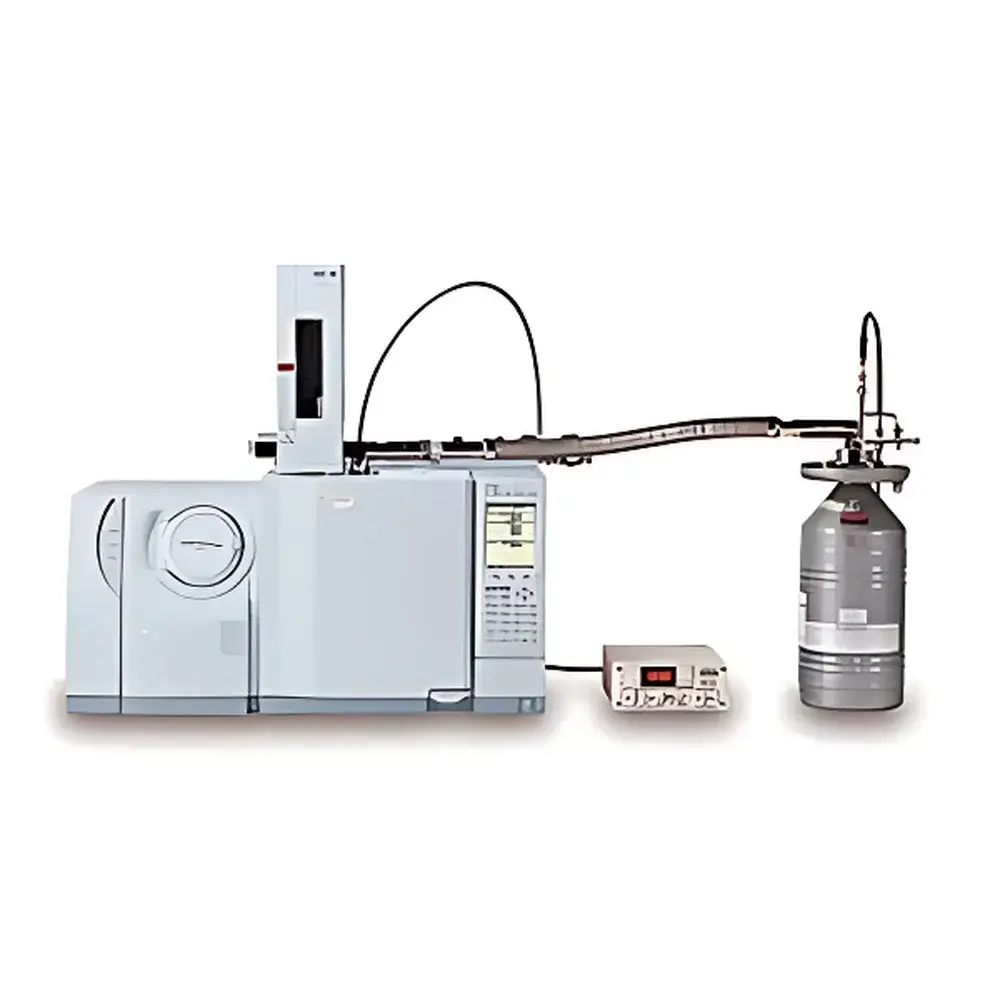
Shimadzu GC×GC-qMS Comprehensive Two-Dimensional Gas Chromatography System
| Brand | Shimadzu |
|---|---|
| Origin | Japan |
| Manufacturer Type | Original Equipment Manufacturer (OEM) |
| Origin Category | Imported |
| Model | GC×GC-qMS |
| Price Range | USD 135,000 – 205,000 (FOB Japan) |
| Application Scope | General-Purpose Analytical Laboratory |
Overview
The Shimadzu GC×GC-qMS system is a high-performance comprehensive two-dimensional gas chromatography platform coupled with quadrupole mass spectrometry. It implements the fundamental principle of heart-cutting modulation-free orthogonal separation: analytes eluting from a primary (1D) non-polar column are periodically trapped, focused, and reinjected onto a secondary (2D) polar column using a cryogenic or thermal modulator—enabling enhanced peak capacity, improved sensitivity, and superior resolution of co-eluting compounds. Unlike conventional one-dimensional GC or GC-MS, which rely predominantly on volatility-based separation, GC×GC exploits orthogonal selectivity—combining differences in boiling point (1D) and polarity (2D)—to resolve structurally similar compounds within highly complex matrices. This architecture is especially critical for laboratories engaged in untargeted profiling, trace-level contaminant identification, and compositional fingerprinting where chromatographic overlap severely compromises detection confidence and quantitation accuracy.
Key Features
- Orthogonal column configuration: Standard setup employs a 30 m × 0.25 mm ID × 0.25 µm df non-polar 1D column (e.g., DB-5ms) paired with a 1–2 m × 0.10 mm ID × 0.10 µm df polar 2D column (e.g., DB-17ms), optimized for maximum peak capacity (>1,000 peaks per run)
- Integrated thermal modulator (Zoex ZX-2): Delivers precise, reproducible modulation cycles (typically 2–10 s) with minimal baseline disturbance and no consumables—compatible with both split/splitless and direct injection modes
- Quadrupole mass spectrometer detector: Equipped with electron ionization (EI) source, unit-mass resolution, and scan/sim acquisition modes; supports spectral library matching (NIST, Wiley) and deconvolution of overlapping MS signals
- Modulation-synchronized data acquisition: Ensures temporal alignment between modulation events and MS duty cycle to preserve second-dimension peak shape integrity and retention time reproducibility (RSD < 0.5% across 24 h)
- Rugged, temperature-stable oven design: Supports ramp rates up to 120 °C/min and operating range from –20 °C to 450 °C—critical for method robustness in petroleum and environmental applications
Sample Compatibility & Compliance
The GC×GC-qMS system accommodates liquid, solid (via thermal desorption or solvent extraction), and gaseous samples following standard EPA, ASTM, and ISO preparation protocols (e.g., EPA Method 8270D for semivolatiles, ASTM D7214 for diesel hydrocarbon typing). It complies with GLP/GMP data integrity requirements when operated with audit-trail-enabled software configurations. All hardware components—including modulator control electronics, GC oven firmware, and MS acquisition modules—meet IEC 61000-4 electromagnetic compatibility standards and UL/CSA safety certifications. The system supports 21 CFR Part 11-compliant user access controls, electronic signatures, and raw data archiving when deployed with validated LIMS integration.
Software & Data Management
Data acquisition and instrument control are managed via Shimadzu’s GCMSsolution v5.x platform, supporting full method development, sequence automation, and real-time monitoring of modulation status and MS tuning parameters. Raw .qgd files are natively compatible with Zoex GC Image v2.8+, a dedicated GC×GC visualization and analysis environment. GC Image enables automated peak detection, structured component grouping (e.g., alkanes, PAHs, oxygenates), retention time correlation mapping, and export of quantitative reports compliant with ISO/IEC 17025 reporting templates. Batch processing, spectral deconvolution, and retention index calibration (using n-alkane standards) are fully scriptable. All processed results—including 2D contour plots, peak tables, and group statistics—are stored in vendor-neutral HDF5 format for long-term archival and third-party reanalysis.
Applications
This system is routinely deployed in food authenticity testing (e.g., olive oil adulteration, spice origin tracing), flavor & fragrance profiling (terpene/isomer differentiation), petrochemical characterization (diesel aromaticity indexing, naphtha cut analysis), environmental forensics (PCB congener resolution, microplastic pyrolyzate fingerprinting), and natural product discovery (plant metabolome deconvolution). Its ability to resolve >500 components in a single diesel sample—grouped by ring count (e.g., mono-, di-, tri-aromatics) and carbon number—demonstrates analytical power unattainable with 1D-GC-MS. Laboratories performing regulatory compliance testing under EU REACH, US FDA Food Safety Modernization Act (FSMA), or ISO 17025-accredited methods report measurable reductions in false-negative rates and improved limit-of-quantitation (LOQ) for low-abundance biomarkers.
FAQ
What is the minimum modulation period supported by the ZX-2 thermal modulator?
The Zoex ZX-2 supports modulation periods from 1.5 s to 15 s, with optimal performance typically observed between 2–6 s depending on 2D column dimensions and carrier gas velocity.
Can GCMSsolution directly process GC×GC data without GC Image?
No—GCMSsolution acquires and stores raw modulated data but does not generate or interpret 2D contour plots; GC Image is required for peak finding, group classification, and structured reporting.
Is cryogenic modulation supported on this Shimadzu platform?
This configuration uses thermal modulation exclusively; cryogenic systems require separate hardware integration and are not part of the standard GC×GC-qMS bundle.
How is retention time stability maintained across long GC×GC runs?
Stability is ensured through oven temperature uniformity control (< ±0.1 °C), pressure-programmed carrier gas flow, and internal retention index calibration using injected alkane standards before and after each sequence.
Does the system support automated method optimization for unknown samples?
Yes—GCMSsolution includes retention time prediction tools and column selection wizards; GC Image offers unsupervised clustering (e.g., hierarchical agglomerative) to guide method refinement based on sample class similarity.





