
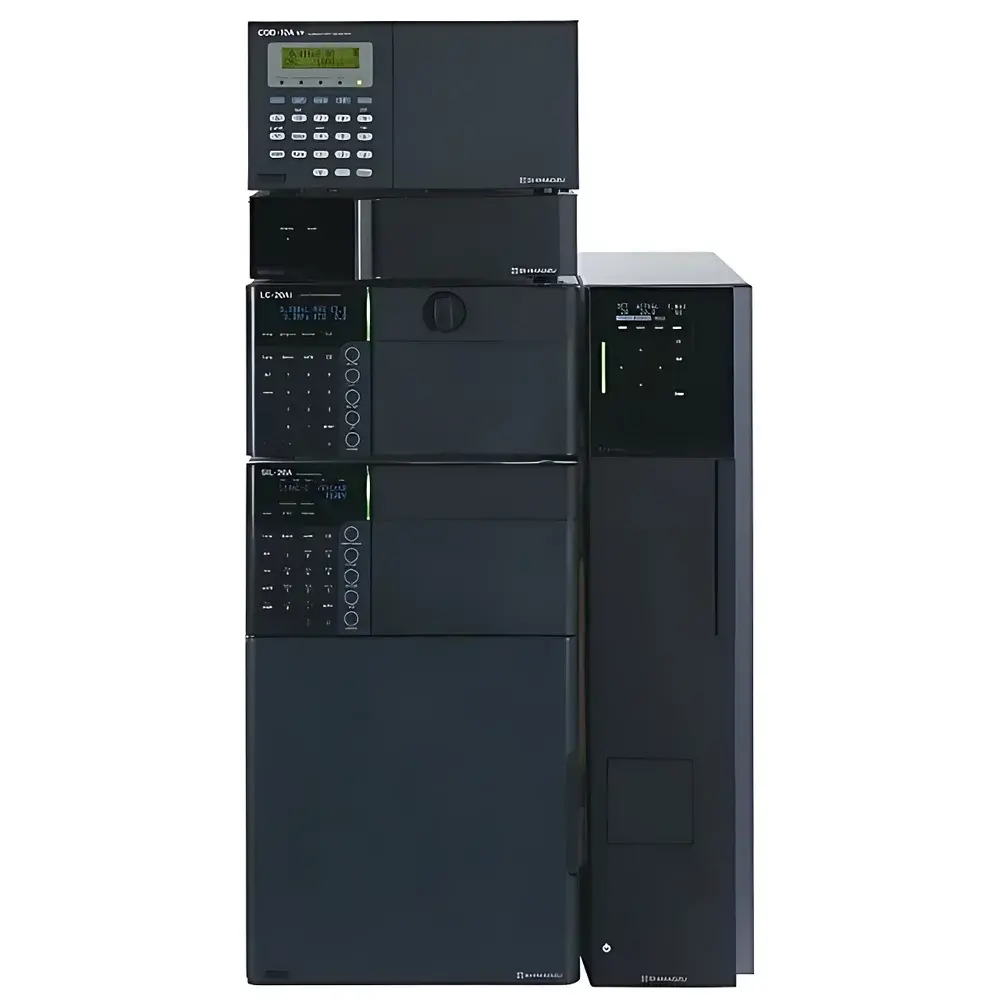
Shimadzu HIC-ESP Ion Chromatograph
| Brand | Shimadzu |
|---|---|
| Origin | Japan |
| Manufacturer Type | Original Equipment Manufacturer (OEM) |
| Product Origin | Imported |
| Model | HIC-ESP |
| Instrument Type | Laboratory Benchtop System |
| Pump Maximum Pressure | 40 MPa |
| Flow Rate Range | 0.001–10.000 mL/min |
| Eluent Flow Rate Range | 0.001–10.000 mL/min |
| Maximum Operating Pressure | 30 MPa |
| Column Oven Temperature Range | 20–85 °C |
| Temperature Reproducibility | ±0.1 °C |
| Eluent Concentration Range | 0.1–100 mM |
Overview
The Shimadzu HIC-ESP is a high-performance, benchtop ion chromatograph engineered for precise, reproducible, and environmentally sustainable anion analysis in regulated and research laboratory environments. It operates on the principle of suppressed conductivity detection following ion-exchange separation—utilizing high-efficiency analytical columns coupled with Shimadzu’s proprietary electrochemical suppression technology. Unlike conventional chemical suppression systems requiring external regenerants, the HIC-ESP integrates an electrolytically regenerated suppressor (ICDS-40A), enabling continuous on-line suppression without consumable acids or bases. This architecture eliminates carryover risk, reduces maintenance intervals, and ensures baseline stability across extended run sequences—critical for compliance-driven workflows in environmental monitoring, pharmaceutical quality control, food safety testing, and industrial chemical R&D.
Key Features
- Electrolytic Suppressor ICDS-40A: Features a low-volume, high-efficiency membrane design that minimizes band broadening—particularly beneficial for early-eluting anions (e.g., F⁻, Cl⁻, NO₂⁻) and improves resolution from the water dip. Suppression and regeneration occur simultaneously via electrodialysis, eliminating need for hazardous reagents such as sulfuric acid.
- Ultra-Low Carryover Architecture: Inherits Shimadzu’s proven HPLC-grade fluidic design—optimized injection valve geometry, inert flow paths, and pressure-balanced sample loop actuation—to achieve <0.01% carryover and sub-1% RSD for injection volume accuracy (down to 10 µL).
- High-Stability Fluid Delivery: Dual-piston, pulse-free pump system delivers flow precision ≤0.1% RSD over full range (0.001–10.000 mL/min) at pressures up to 30 MPa; compatible with both low- and high-capacity anion exchange columns.
- Compact Footprint: Entire system width measures only 420 mm—designed for integration into space-constrained analytical laboratories without compromising thermal or mechanical stability.
- Thermostatically Controlled Column Compartment: Maintains column oven temperature between 20–85 °C with ±0.1 °C reproducibility—ensuring retention time stability and method transfer fidelity across instruments and labs.
Sample Compatibility & Compliance
The HIC-ESP supports aqueous samples containing common inorganic anions (F⁻, Cl⁻, NO₂⁻, Br⁻, NO₃⁻, PO₄³⁻, SO₄²⁻), organic acids (acetate, formate, oxalate), and low-molecular-weight amines. It accommodates standard 4-mm and 2-mm ID analytical columns, including Shimadzu’s IC-YM series and third-party columns compliant with ASTM D4327 and ISO 14911. The system meets GLP/GMP documentation requirements through audit-trail-enabled software, electronic signatures per FDA 21 CFR Part 11, and instrument qualification support packages (IQ/OQ/PQ templates available upon request).
Software & Data Management
Controlled exclusively via Shimadzu LabSolutions IC software—a unified platform supporting method development, acquisition, quantitation, and reporting. Browser-based workflow allows real-time peak integration, calibration curve generation (linear, quadratic, weighted), limit-of-detection calculation, and multi-level report templating—including single-sample reports, batch summaries, and regulatory-compliant PDF exports with embedded metadata (acquisition time, operator ID, instrument serial number, version logs). All raw data are stored in vendor-neutral .cdf format, ensuring long-term readability and third-party software interoperability.
Applications
- Environmental: Quantification of anions in drinking water, wastewater, rainwater, and soil extracts per EPA Methods 300.0, 300.1, and ISO 10304-1.
- Pharmaceutical: Counter-ion profiling in APIs, residual chloride testing in injectables, and excipient purity verification aligned with USP and ICH Q5C.
- Food & Beverage: Nitrate/nitrite in cured meats, sulfate in wine, iodide in dairy, and phosphate additives in processed foods—validated against AOAC 993.22 and EN 15283-1.
- Chemical Manufacturing: Quality assurance of catalysts, battery electrolytes, and semiconductor process chemicals where trace halide contamination must be monitored below 10 ppb.
FAQ
Does the HIC-ESP support gradient elution?
Yes—the dual-pump configuration enables binary or ternary gradient elution using compatible eluents (e.g., NaOH/KOH, carbonate/bicarbonate, methanesulfonic acid), programmable via LabSolutions IC.
Is the ICDS-40A suppressor compatible with cation analysis?
No—the ICDS-40A is optimized for anion mode only; cation analysis requires the optional CSRS-300 suppressor and corresponding cation-exchange columns.
Can the system be integrated into a LIMS environment?
Yes—LabSolutions IC supports ASTM E1384-compliant data export (CSV, XML, .cdf) and optional OPC UA interface for bidirectional communication with major LIMS platforms.
What validation documentation is provided with the instrument?
Factory-installed IQ/OQ protocols, electronic calibration certificates traceable to NIST standards, and a comprehensive user manual including performance verification procedures per ISO/IEC 17025 Annex A.3.
Is remote monitoring supported?
Yes—via secure HTTPS access to LabSolutions Web Console, enabling real-time status checks, method queue management, and alarm notifications without local client installation.






