
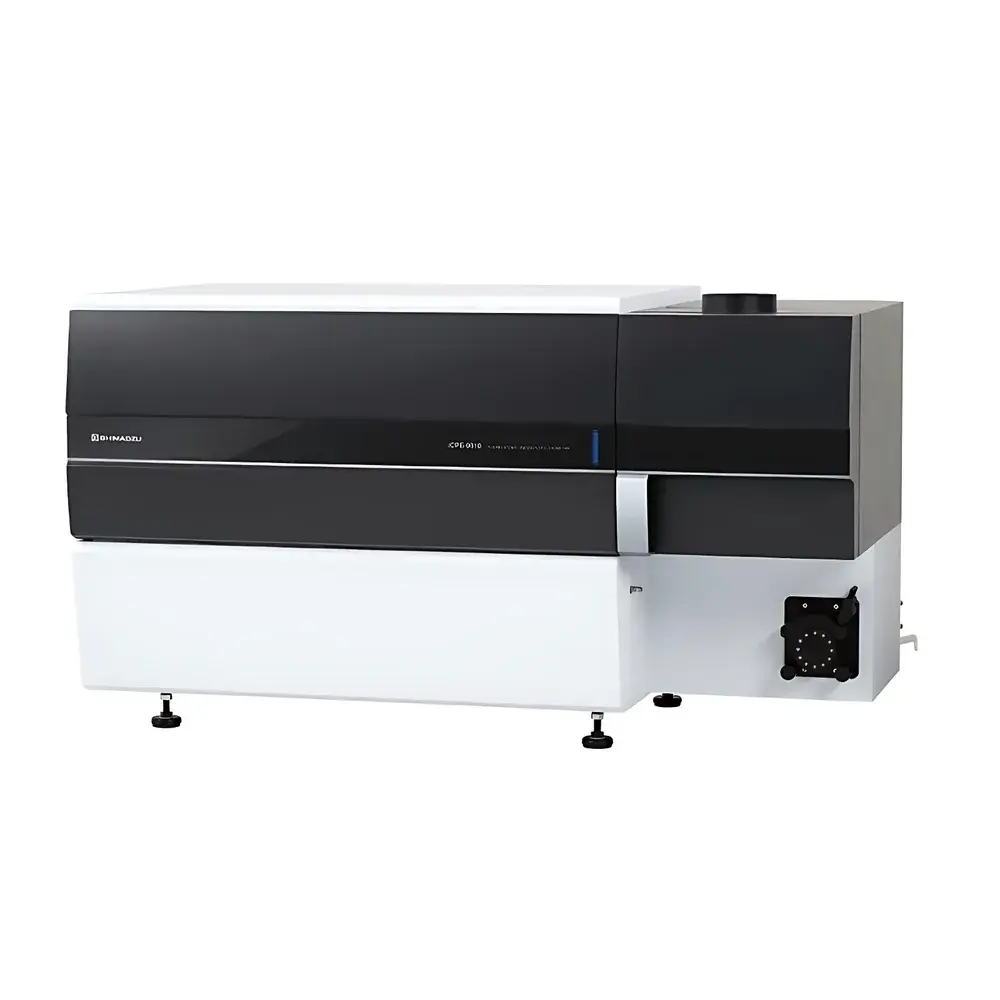
Shimadzu ICPE-9800 Full-Spectrum Direct-Reading Inductively Coupled Plasma Optical Emission Spectrometer
| Brand | Shimadzu |
|---|---|
| Origin | Japan |
| Manufacturer Type | Original Equipment Manufacturer (OEM) |
| Product Origin | Imported |
| Model | ICPE-9800 |
| Instrument Type | Full-Spectrum Direct-Reading ICP-OES |
| Argon Purity Requirement | ≥99.95% |
| Minimum Argon Flow (Eco Mode) | 5 L/min |
| UV Spectral Range | 165–190 nm |
| Optical System | Two-Dimensional Cross-Dispersion with Sealed Vacuum Chamber |
| Detector | High-Resolution Megapixel CCD |
| Torch Configuration | Vertical Dual-View Design |
| Software Platform | ICPESolution v3.x with Automatic Interference-Free Wavelength Selection |
Overview
The Shimadzu ICPE-9800 is a full-spectrum direct-reading inductively coupled plasma optical emission spectrometer (ICP-OES) engineered for high-throughput, multi-element trace metal analysis in environmental, pharmaceutical, geological, and industrial quality control laboratories. It operates on the fundamental principle of atomic emission spectroscopy: liquid samples are nebulized into an argon plasma at ~6,000–10,000 K, where constituent elements are atomized and electronically excited; upon relaxation, they emit characteristic photons across the UV–visible spectrum. The ICPE-9800 captures the entire emission spectrum simultaneously using a two-dimensional cross-dispersion optical architecture and a sealed, thermally stabilized vacuum spectrometer chamber—enabling quantitative detection from 165 nm to over 800 nm without mechanical scanning or wavelength reconfiguration.
Key Features
- Vacuum-Optimized Deep-UV Detection: A hermetically sealed, temperature-controlled vacuum optical chamber eliminates atmospheric absorption (O2, H2O), enabling robust, low-noise measurement of critical deep-UV spectral lines—including Al 167.08 nm, As 189.04 nm, B 182.6 nm, P 178.2 nm, Pb 168.37 nm, Sn 189.99 nm, I 178.27 nm, Br 179.35 nm, and S 180.73 nm—without purging or external vacuum pumps.
- Argon-Efficient Plasma Operation: Designed to operate stably with standard-grade argon (≥99.95% purity), eliminating dependency on ultra-high-purity (99.999%) gas. Combined with a proprietary miniaturized torch geometry and Eco Mode (5 L/min standby flow), total argon consumption is reduced by up to 70% versus conventional ICP-OES systems—lowering operational cost and environmental footprint without compromising plasma stability or sensitivity.
- Vertical Dual-View Torch Architecture: A robust, vertically oriented torch minimizes carbon deposition and salt buildup, extending torch lifetime and reducing routine maintenance intervals. This design also improves matrix tolerance for high-TDS and organic solvent samples compared to horizontal configurations.
- Full-Spectrum Simultaneous Acquisition: Equipped with a megapixel, back-thinned CCD detector and two-dimensional cross-dispersive optics, the ICPE-9800 records the complete emission spectrum in a single exposure. Post-acquisition, users may retrospectively quantify additional elements or re-evaluate alternative analytical wavelengths—no re-run required.
- Thermal Stability Engineering: The optical bench and vacuum chamber are maintained at constant temperature (±0.1 °C) via active Peltier cooling and thermal shielding, ensuring long-term wavelength calibration stability (<0.2 pm/h drift) and reproducible intensity response across multi-day campaigns.
Sample Compatibility & Compliance
The ICPE-9800 supports aqueous solutions, diluted acids (HNO3, HCl, HF up to 5%), and organic matrices (e.g., kerosene, MIBK) when paired with appropriate sample introduction accessories (e.g., microconcentric nebulizer, chilled spray chamber). It complies with ASTM D1976 (trace metals in water), ISO 11885 (water quality—determination of selected elements by ICP-OES), USP / (elemental impurities in pharmaceuticals), and EPA Methods 200.7 and 6010D. Data integrity features—including electronic signatures, audit trails, and user-access-level controls—support compliance with FDA 21 CFR Part 11 and GLP/GMP documentation requirements.
Software & Data Management
ICPESolution software (v3.x) provides a unified platform for instrument control, method development, calibration, and reporting. Its intelligent wavelength selection engine automatically identifies interference-free emission lines based on user-defined matrices and co-existing elements, referencing NIST-certified spectral databases. All raw spectral data (intensity vs. pixel) are stored in vendor-neutral HDF5 format. The software supports automated QC checks (drift correction, internal standard ratio monitoring), batch processing of 100+ samples, and export to LIMS via ASTM E1384-compliant XML or CSV. Audit logs record every parameter change, calibration event, and report generation with timestamp and operator ID.
Applications
The ICPE-9800 delivers reliable quantification across diverse use cases: regulatory testing of heavy metals (As, Cd, Cr, Pb, Hg) in drinking water per WHO/EPA limits; elemental impurity screening in active pharmaceutical ingredients (APIs) per ICH Q3D; alloy composition verification in aerospace and automotive supply chains; nutrient and contaminant profiling in soil and plant digests (ISO 11047); and catalyst residue analysis in petrochemical process streams. Its deep-UV capability is particularly valuable for sulfur speciation in low-sulfur fuels and boron monitoring in nuclear-grade coolants.
FAQ
Does the ICPE-9800 require liquid nitrogen or external vacuum pumps for UV operation?
No. Its sealed, actively temperature-stabilized vacuum chamber maintains <1 Pa pressure indefinitely without consumables or auxiliary hardware.
Can I analyze high-salt samples without frequent torch cleaning?
Yes. The vertical torch design, combined with optional desolvation and high-efficiency nebulizers, significantly reduces salt deposition—typical maintenance intervals exceed 100 hours for 3% NaCl matrix.
Is post-acquisition reprocessing of spectral data compliant with 21 CFR Part 11?
Yes. All reprocessed results generate new, time-stamped audit trail entries with operator attribution and original raw data linkage.
What calibration standards are supported?
Multi-element mixed standards (up to 30 elements), single-element standards, and certified reference materials (CRMs) such as NIST SRM 1640a (trace elements in natural water) and ERM®-CA401 (soil extract).
How does Eco Mode affect detection limits?
Eco Mode (5 L/min) is intended for standby/idle periods. Analytical performance—including DLs for As (0.008 µg/L) and Pb (0.003 µg/L)—is validated under standard operating conditions (12–15 L/min plasma + 0.8 L/min nebulizer flow).





