
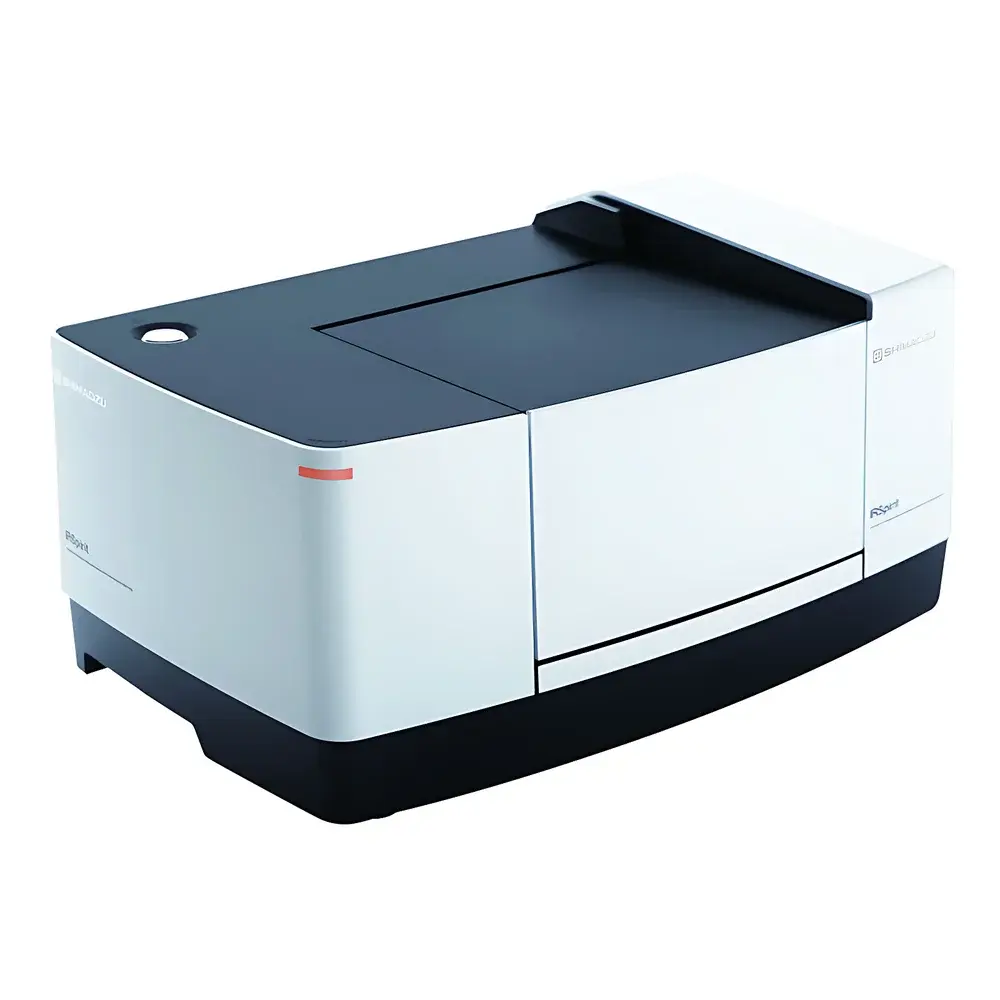
Shimadzu IRSpirit Fourier Transform Infrared (FTIR) Spectrometer
| Brand | Shimadzu |
|---|---|
| Origin | Japan |
| Manufacturer | Shimadzu Corporation |
| Instrument Type | Laboratory FTIR Spectrometer |
| Wavenumber Range | 7800–350 cm⁻¹ |
| Resolution | 0.9 cm⁻¹ |
| Scan Speed | 45 scans/min (at 4 cm⁻¹ resolution) |
| Signal-to-Noise Ratio | 30,000:1 |
| Form Factor | Compact, Dual-Orientational (Horizontal/Vertical Placement) |
| Sample Compartment | Large-volume chamber compatible with Shimadzu and third-party FTIR accessories |
| Software | IR Pilot with 23 preconfigured application workflows, qualitative identification module, and pass/fail foreign material analysis module |
Overview
The Shimadzu IRSpirit is a compact, high-performance Fourier Transform Infrared (FTIR) spectrometer engineered for rigorous laboratory-based chemical identification, material verification, and contaminant screening. Utilizing Michelson interferometry with a permanently aligned, dynamically stabilized optical bench, the IRSpirit delivers high spectral fidelity and long-term measurement reproducibility without routine realignment. Its core architecture adheres to the fundamental principles of FTIR spectroscopy—measuring infrared absorption as a function of wavenumber via Fourier transformation of the interferogram—enabling precise molecular fingerprinting across organic, inorganic, polymeric, and pharmaceutical samples. Designed for operational flexibility, the instrument supports both horizontal and vertical orientation, minimizing spatial footprint in constrained lab environments while maintaining full optical performance. The large-volume sample compartment—unusually spacious for an instrument of its class—facilitates direct integration of standard Shimadzu accessories (e.g., ATR, transmission cells, reflection stages) and widely adopted third-party modules, eliminating compatibility bottlenecks in method transfer or multi-technique workflows.
Key Features
- Compact dual-orientation design (horizontal or vertical placement) optimized for space-constrained laboratories, cleanrooms, and quality control stations.
- Dynamically stabilized Michelson interferometer with sealed, inert-gas-purged optics—ensuring consistent alignment and minimal drift under variable ambient conditions.
- Extended wavenumber range (7800–350 cm⁻¹) covering mid-IR fundamentals and overtones, suitable for functional group analysis, polymer characterization, and residual solvent detection.
- High signal-to-noise ratio (30,000:1 at 4 cm⁻¹, 1-minute scan) enabling reliable detection of trace components and low-absorbance features in heterogeneous or thin-film samples.
- Real-time instrument status monitoring via embedded diagnostics—including source intensity, detector response, mirror velocity, and purge gas integrity—supporting proactive maintenance and GLP-compliant operation.
- Integrated anti-theft and anti-drop mechanical locks, plus humidity-resistant housing design validated for continuous operation in environments up to 80% RH (non-condensing).
Sample Compatibility & Compliance
The IRSpirit accommodates diverse sample forms—including solids (KBr pellets, ATR crystals), liquids (sealed cells, film substrates), and gases (gas cells with pathlength control)—without hardware modification. Its open-access sample chamber accepts standard 13 mm and 25 mm diameter accessories, ensuring seamless transition from R&D to QC protocols. The system complies with key regulatory frameworks governing analytical instrumentation: it supports audit-trail-enabled data handling per FDA 21 CFR Part 11 when deployed with validated IR Pilot configurations; meets ISO/IEC 17025 requirements for test method validation through documented calibration traceability (NIST-traceable polystyrene film standard included); and aligns with USP and EP 2.2.24 guidelines for IR identity testing in pharmaceutical manufacturing. All firmware and optical calibration routines are factory-certified and user-verifiable.
Software & Data Management
IR Pilot software serves as the integrated control and analysis environment, featuring 23 pre-validated application workflows—from polymer identification and excipient verification to lubricant residue screening and counterfeit drug detection. Each workflow enforces standardized acquisition parameters, spectral preprocessing (baseline correction, normalization, derivative smoothing), and decision logic—reducing operator-dependent variability. The built-in qualitative identification engine performs library search against the Shimadzu IR spectral database (≥15,000 compounds) using Hit Quality Index (HQI) scoring and customizable match thresholds. For regulated environments, IR Pilot supports electronic signatures, user role-based access control, and immutable audit trails for all spectral acquisitions, processing steps, and report generations. Raw interferograms and processed spectra are stored in vendor-neutral JCAMP-DX format, ensuring long-term archival integrity and cross-platform interoperability.
Applications
- Pharmaceutical QC: Identity confirmation of active pharmaceutical ingredients (APIs), excipients, and packaging materials per USP monographs.
- Materials Science: Polymer classification (e.g., PE vs. PP vs. PET), additive quantification, and degradation product profiling.
- Forensics & Failure Analysis: Rapid identification of unknown particulates, fibers, adhesives, and contaminants in electronics, automotive, and aerospace components.
- Academic Research: Teaching spectral interpretation, reaction monitoring, and surface chemistry studies using reflection or transmission modes.
- Environmental Testing: Detection of microplastics in water filters, hydrocarbon residues in soil extracts, and functionalized carbon nanomaterials.
FAQ
Is the IRSpirit compliant with FDA 21 CFR Part 11 for electronic records and signatures?
Yes—when configured with IR Pilot’s validated security settings, including user authentication, audit trail logging, and electronic signature capture, the system meets Part 11 requirements for regulated laboratories.
Can I use non-Shimadzu ATR accessories with the IRSpirit?
Yes—the instrument’s mechanical and optical interface conforms to ISO 17025-aligned mounting standards, supporting most commercially available diamond, ZnSe, and Ge ATR crystals with standard kinematic coupling.
What maintenance is required to sustain optimal spectral performance?
Routine maintenance is limited to periodic desiccant replacement (every 6–12 months depending on ambient humidity) and annual verification using the included NIST-traceable polystyrene reference film; no optical realignment is necessary under normal operating conditions.
Does the IRSpirit support automated sampling?
While the base configuration is manually operated, optional motorized sample changers and autosampler interfaces (e.g., Shimadzu QATR-FTIR module) are available for unattended batch analysis in high-throughput environments.
How does the dual-orientation capability affect optical alignment or spectral accuracy?
Optical performance is invariant across orientations—the interferometer and detector are rigidly mounted on a single monolithic baseplate, eliminating gravity-induced misalignment; all factory calibrations remain valid regardless of installation geometry.







