
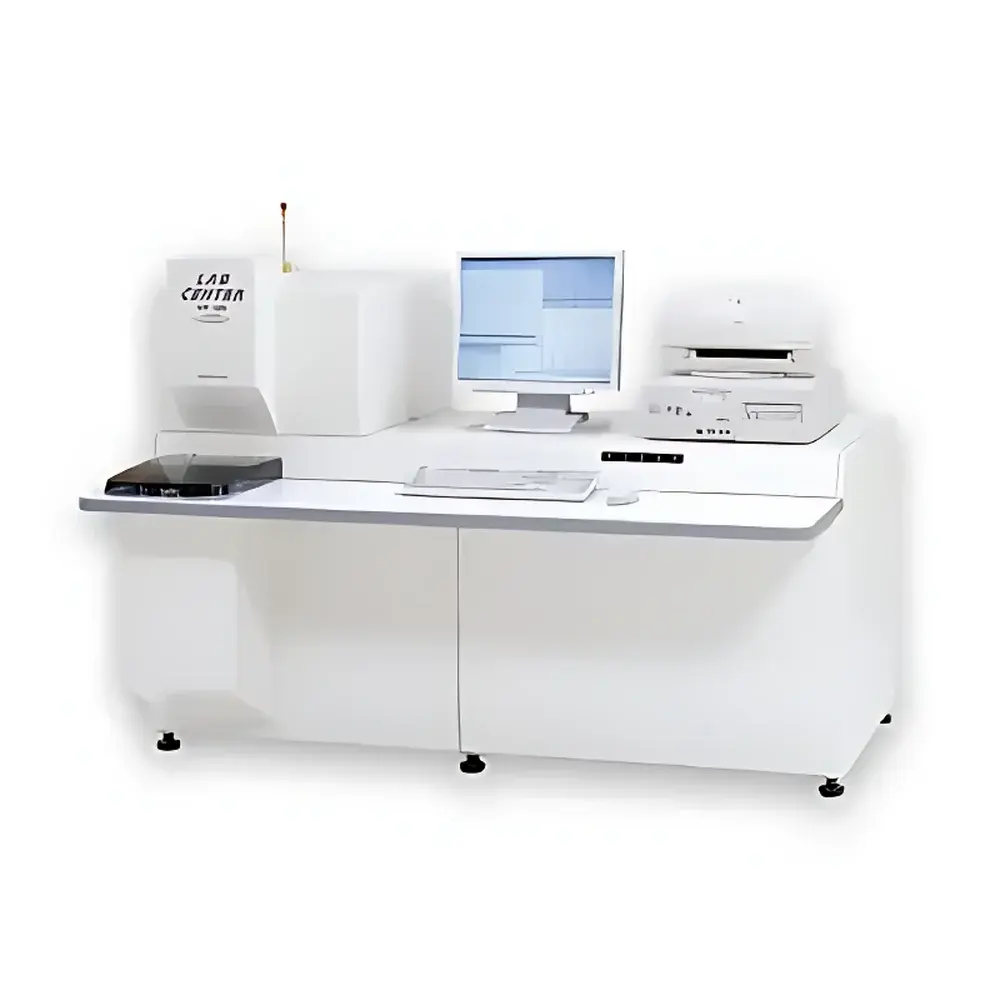
Shimadzu LAB CENTER XRF-1800 Wavelength Dispersive X-Ray Fluorescence Spectrometer
| Brand | Shimadzu |
|---|---|
| Origin | Japan |
| Manufacturer Type | Original Equipment Manufacturer (OEM) |
| Product Origin | Imported |
| Model | LAB CENTER XRF-1800 |
| Pricing | Available Upon Request |
Overview
The Shimadzu LAB CENTER XRF-1800 is a high-performance wavelength dispersive X-ray fluorescence (WDXRF) spectrometer engineered for precision elemental analysis across solid, powdered, and liquid sample matrices. Unlike energy dispersive (EDXRF) systems, the XRF-1800 employs Bragg diffraction from precisely aligned analyzing crystals to isolate characteristic X-ray lines with superior spectral resolution—enabling accurate separation of overlapping peaks (e.g., V Kβ / Cr Kα, S Kα / Pb Mα, or rare earth L-lines). This physical principle ensures exceptional detection limits (sub-ppm for many elements), high inter-laboratory reproducibility, and long-term stability required in regulated environments such as ISO/IEC 17025-accredited testing labs, metallurgical QA/QC departments, and geological survey laboratories.
Key Features
- High-power 4 kW Rhodium-target X-ray tube with thin-window design for enhanced low-Z element excitation (down to oxygen, 8O; beryllium and nitrogen available as optional upgrades)
- Modular optical bench with 10 interchangeable analyzing crystals (e.g., LiF(200), PET, TAP, Ge(111)) supporting comprehensive elemental coverage from 4Be to 92U
- Five selectable collimator slits and integrated high-order line profiling capability for improved peak deconvolution and matrix effect correction
- Ultra-fast goniometer rotation at up to 300°/min, reducing full-spectrum acquisition time without compromising counting statistics
- Micro-spot analysis mode with 500 µm beam diameter for localized compositional mapping and inclusion analysis
- High-resolution elemental imaging function with 250 µm spatial resolution, enabling qualitative distribution visualization and semi-quantitative area scans
Sample Compatibility & Compliance
The XRF-1800 accommodates a broad range of sample forms—including pressed pellets, fused beads, polished metal sections, thin films, and homogenized liquids—without requiring extensive calibration standards. Its fundamental parameters (FP) quantification engine eliminates dependence on empirical calibration curves, delivering traceable results directly from first-principles physics models. The system complies with ASTM E1361 (Standard Guide for Quantitative Analysis by WDXRF), ISO 22036 (Soil quality — X-ray fluorescence spectrometry), and supports audit-ready data handling per FDA 21 CFR Part 11 requirements when paired with Shimadzu’s certified LabSolutions XRF software suite. All hardware components meet IEC 61000-6-3 (EMC) and IEC 61010-1 (safety) standards.
Software & Data Management
LabSolutions XRF provides an intuitive, workflow-driven interface for method development, automated sequence execution, and multi-layered reporting. It includes embedded FP-based quantification algorithms with optional matrix correction modules (e.g., alpha coefficients, absorption-enhancement modeling), spectral library search for unknown phase identification, and customizable report templates compliant with GLP/GMP documentation practices. Raw spectral data, instrument logs, and user audit trails are stored in secure, timestamped archives with role-based access control. Export formats include CSV, PDF, XML, and ASTM E1357-compliant .xrf files for third-party data interchange.
Applications
- Geochemical exploration and ore grade verification (SiO₂, Al₂O₃, Fe, Cu, Zn, REEs)
- High-purity metal certification (Al, Ti, Ni alloys; impurity quantification down to 0.1 ppm)
- Cement and clinker composition control per ASTM C114 and EN 196-2
- RoHS/WEEE screening of bromine, chlorine, lead, mercury, cadmium, and chromium in electronics and polymers
- Archaeometric provenance studies via trace-element fingerprinting of ceramics and glass
- Environmental soil and sediment analysis for heavy metals and nutrient elements
FAQ
Does the XRF-1800 support regulatory compliance for pharmaceutical raw material testing?
Yes—when configured with certified reference materials and operated under validated SOPs, it meets USP , EP 2.4.14, and ICH Q2(R2) guidelines for elemental impurities in drug substances.
Can the system analyze light elements below sodium (Na)?
Standard configuration covers oxygen (O, Z=8); beryllium (Be, Z=4) and nitrogen (N, Z=7) require vacuum/purged optics and specialized crystals—available as factory-installed options.
Is remote operation and data review supported?
LabSolutions XRF supports secure client-server deployment over LAN/WAN, enabling real-time monitoring, method sharing, and centralized database management across multi-site laboratories.
What maintenance intervals are recommended for the X-ray tube and analyzer crystals?
The Rh-target tube has a rated lifetime of ≥20,000 hours under typical operating conditions; crystal alignment verification is recommended annually or after mechanical shock events.
How does the 250 µm imaging function differ from conventional mapping?
Unlike step-scan raster mapping, this feature acquires simultaneous multi-element intensity distributions at fixed geometry, providing rapid qualitative overview prior to targeted quantitative point analysis.
Related Products





