
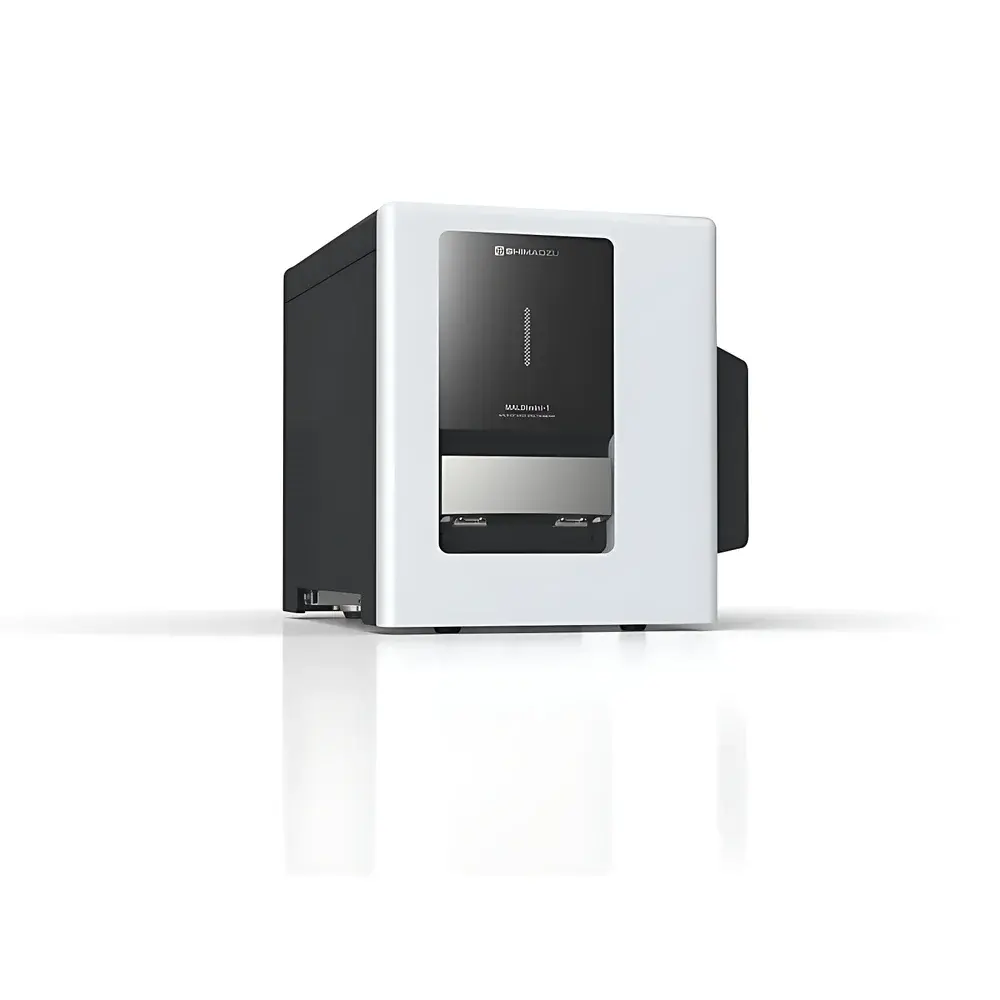
Shimadzu MALDImini-1 Digital Ion Trap Mass Spectrometer
| Brand | Shimadzu |
|---|---|
| Origin | Japan |
| Manufacturer Type | Original Equipment Manufacturer (OEM) |
| Import Status | Imported |
| Model | MALDImini-1 |
| Instrument Type | Ion Trap–Time-of-Flight (IT-TOF) Hybrid |
| Resolution | >4000 (FWHM at m/z 500) |
| Sensitivity | Low-femtomole (fmol) level for peptides and small molecules |
| Stability | High long-term signal stability under continuous operation |
| Acquisition Rate | 0.6 spectra/s |
| Mass Accuracy | ±200 ppm (external calibration, typical for MALDI-MS in linear mode) |
Overview
The Shimadzu MALDImini-1 is a compact, benchtop hybrid mass spectrometer integrating Matrix-Assisted Laser Desorption/Ionization (MALDI) ionization with a proprietary Digital Ion Trap (DIT) and orthogonal time-of-flight (TOF) detection architecture. Unlike conventional 3D quadrupole ion traps or large-scale TOF systems, the MALDImini-1 employs a novel rectangular-wave RF-driven digital ion trap—engineered to confine, isolate, and sequentially fragment ions with high duty cycle and minimal space requirements. Its core innovation lies in the physical miniaturization of the ion optics and vacuum architecture without compromising analytical capability: the instrument achieves a mass range up to m/z 70,000, supports up to MS⁴ fragmentation for structural elucidation, and maintains robust performance across diverse biomolecular classes—including intact proteins, glycans, oligonucleotides, and synthetic polymers.
Key Features
- Ultra-compact footprint: Dimensions equivalent to A3 paper (297 × 420 mm); total weight 25 kg—designed for standard laboratory benches without dedicated floor space or external vacuum infrastructure.
- Integrated turbomolecular pumping system: Fully self-contained vacuum architecture enables rapid pump-down (<5 minutes from ambient to operational pressure) after sample insertion—eliminating dependency on central vacuum lines or external roughing pumps.
- Digital Ion Trap (DIT) technology: Utilizes digitally synthesized rectangular RF waveforms for precise ion confinement and ejection control, enabling high trapping efficiency, improved mass-selective isolation, and enhanced MSn reproducibility compared to analog sinusoidal traps.
- Optimized orthogonal MALDI ion optics: Laser beam incidence is perpendicular to the sample plate; post-ionization ion trajectory includes a 90° electrostatic deflection to maximize transmission into the DIT while minimizing neutral background and spatial dispersion.
- Sub-microliter sample compatibility: Supports analysis of ≤0.5 µL dried-droplet or thin-layer preparations—ideal for precious clinical, single-cell, or micro-extracted samples where material conservation is critical.
- Hybrid IT-TOF acquisition: Combines the structural interrogation power of multi-stage ion trap fragmentation with the extended mass range and high transmission of orthogonal TOF detection—delivering both sequence-level detail and broad m/z coverage in a single platform.
Sample Compatibility & Compliance
The MALDImini-1 is validated for direct analysis of peptides, post-translationally modified proteins, oligosaccharides, lipid species, and synthetic macromolecules without prior chromatographic separation. Sample preparation follows standard MALDI protocols using α-cyano-4-hydroxycinnamic acid (CHCA), sinapinic acid (SA), or 2,5-dihydroxybenzoic acid (DHB) matrices. The system complies with ISO/IEC 17025:2017 requirements for testing laboratories and supports audit-ready data handling per FDA 21 CFR Part 11 when operated with Shimadzu’s LabSolutions LCMS software suite. Instrument qualification documentation—including Installation Qualification (IQ), Operational Qualification (OQ), and Performance Qualification (PQ)—is provided for GxP-regulated environments (e.g., biopharmaceutical QC, clinical proteomics).
Software & Data Management
Controlled via Shimadzu LabSolutions LCMS v5.9 or later, the MALDImini-1 supports automated calibration, real-time spectral averaging, peak deconvolution, and database-assisted identification (using NIST, UniProt, or custom libraries). All raw data files (.qgd format) are stored with embedded metadata—including laser fluence, delay time, detector gain, and calibration parameters—ensuring full traceability. Software features include GLP-compliant electronic signatures, user-access role management, and secure audit trails for all acquisition, processing, and export events. Data export options include mzML, .mzXML, and ASCII formats compatible with third-party bioinformatics pipelines (e.g., MaxQuant, Proteome Discoverer, GlycoWorkbench).
Applications
- High-throughput peptide mass fingerprinting (PMF) for protein identification in gel-based and solution-phase proteomics.
- Top-down and middle-down characterization of monoclonal antibody variants, including oxidation, deamidation, and glycosylation site mapping.
- Structural analysis of N- and O-linked glycans released from therapeutic glycoproteins—enabling batch-to-batch comparability assessments.
- Rapid profiling of synthetic polymers and dendrimers via end-group analysis and repeat-unit confirmation.
- Direct tissue imaging (MALDI-IMS) when coupled with compatible raster-scanning stages and matrix sprayers—supporting spatial metabolomics and lipidomics workflows.
- Quality control of oligonucleotide therapeutics (ASOs, siRNAs), including purity assessment, truncation detection, and modification verification.
FAQ
What is the maximum achievable mass range in MALDI-TOF mode?
The instrument delivers reliable detection up to m/z 70,000 in linear TOF mode, with resolution >4000 maintained across the full range under standard operating conditions.
Can the MALDImini-1 perform quantitative analysis?
Yes—when used with internal standards and optimized calibration curves, it supports semi-quantitative relative quantitation (e.g., fold-change in PTM abundance) and absolute quantitation down to low-fmol levels for well-characterized analytes.
Is external calibration required before each run?
No—internal calibration using a dual-point calibrant (e.g., angiotensin II + ACTH clip) provides stable mass accuracy within ±200 ppm over 8-hour continuous operation.
Does the system support collision-induced dissociation (CID) and other activation methods?
Yes—CID is implemented in the DIT cell using helium as the collision gas; supplemental activation techniques such as infrared multiphoton dissociation (IRMPD) are not supported in this configuration.
What maintenance intervals are recommended for the integrated vacuum system?
The turbomolecular pump requires annual inspection and bearing replacement every 15,000 hours of operation; the ion source optics are cleaned quarterly in high-throughput labs, or as indicated by signal drift exceeding ±10% RSD over 24 h.






