
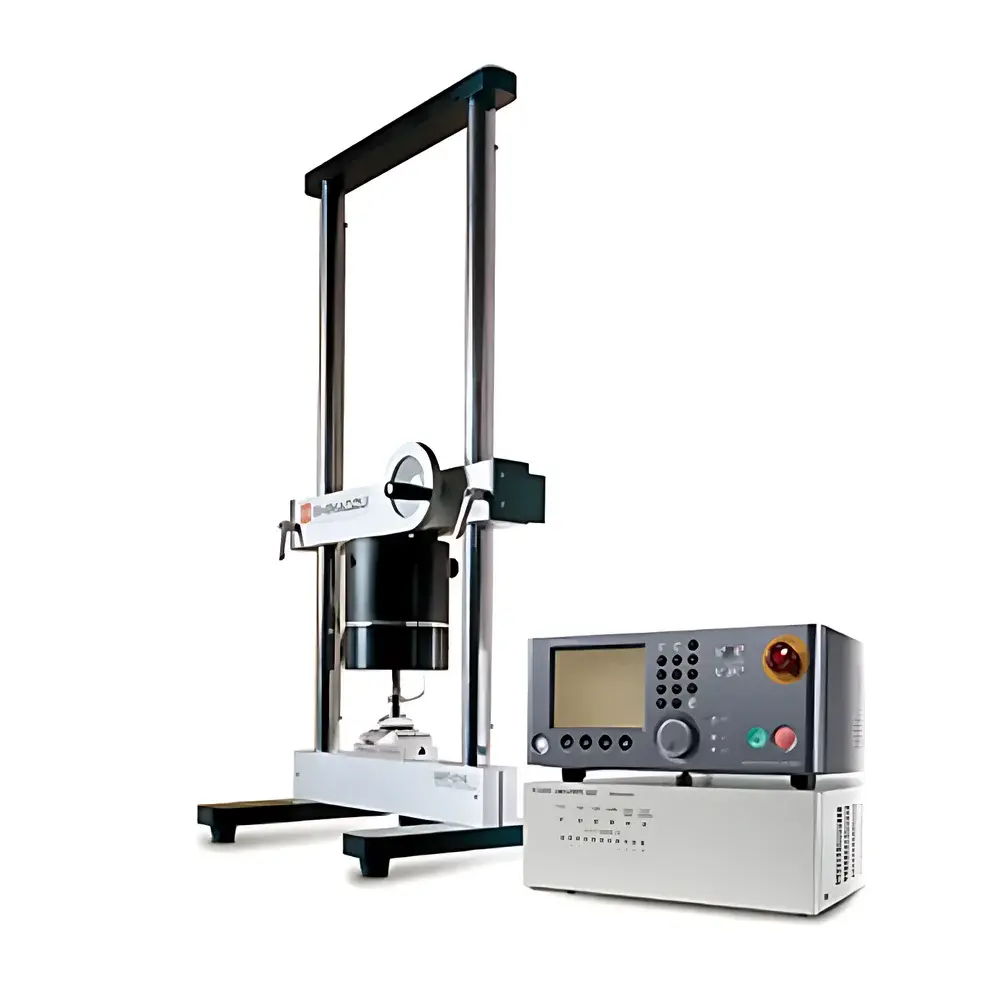
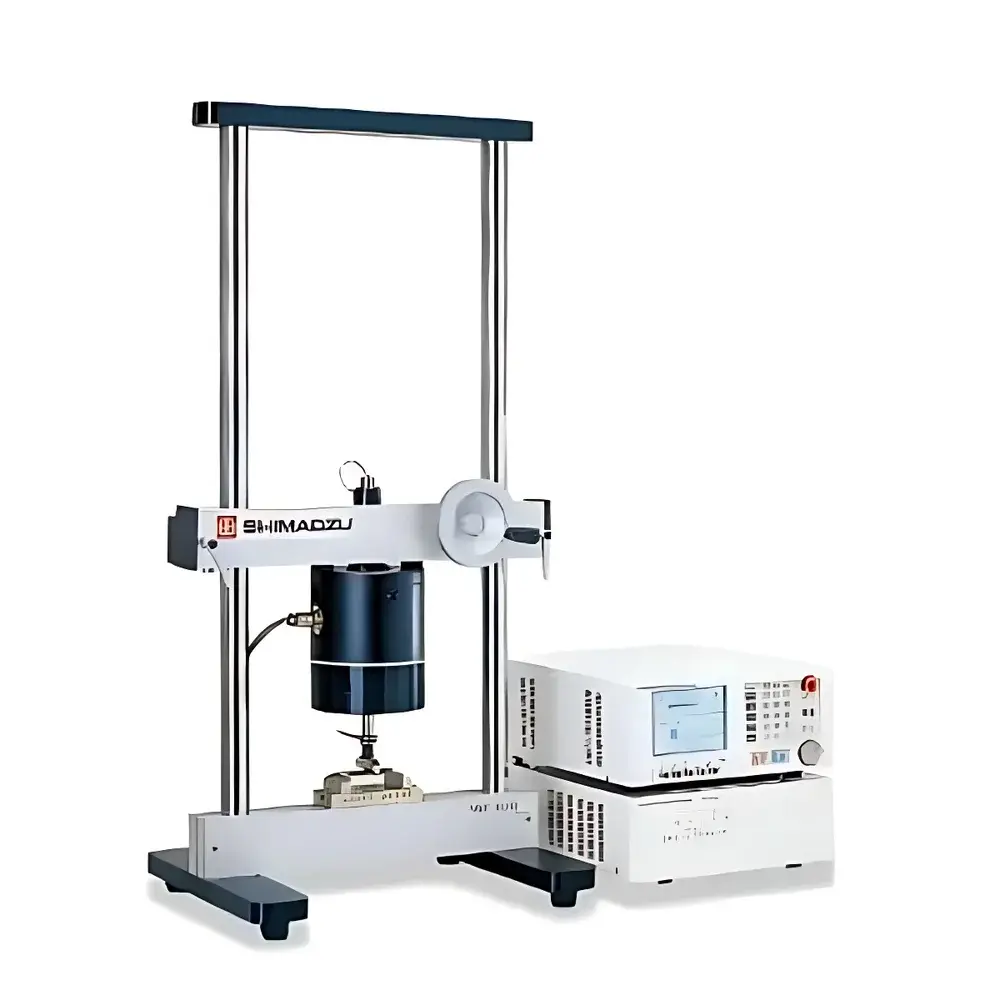
Shimadzu MMT Series Electromagnetic Dynamic Micro-Fatigue Testing System
| Brand | Shimadzu |
|---|---|
| Origin | Japan |
| Manufacturer Type | Original Equipment Manufacturer (OEM) |
| Product Origin | Imported |
| Model | MMT Series |
| Quotation | Upon Request |
| Instrument Category | Specialized Electromagnetic Fatigue Testing Machine |
| Maximum Test Force | ±500 N |
| Frequency Range | 60–100 Hz |
| Host Weight | 80–150 kg |
| Load Capacity Options | ±10 N, ±100 N, ±250 N, ±500 N |
| Piston Stroke | ±2 mm / ±10 mm |
| Load Accuracy | ±0.5% of displayed value |
| Force Resolution | 0.01 N |
| Displacement Resolution | ±0.125 µm |
| Control Architecture | Dual-degree-of-freedom PID control with 24-bit DAC/ADC resolution |
Overview
The Shimadzu MMT Series is an electromagnetic dynamic micro-fatigue testing system engineered for high-precision mechanical characterization of miniature specimens and micro-scale components under cyclic loading conditions. Unlike hydraulic or servo-motor-driven fatigue testers, the MMT employs a high-bandwidth electromagnetic actuator—capable of sub-millisecond response times—to deliver controlled sinusoidal, trapezoidal, or arbitrary waveforms at frequencies ranging from 60 Hz to 100 Hz. This architecture enables true high-cycle fatigue (HCF) evaluation in the ultrasonic-to-audio frequency range, making it uniquely suited for assessing the durability of MEMS devices, thin-film interconnects, solder joints (including lead-free Sn-Ag-Cu alloys), biomedical micro-implants, and microelectronic packaging structures. The system operates on the principle of Lorentz-force actuation, where current through a voice-coil coil within a permanent magnetic field generates proportional axial force—ensuring linearity, repeatability, and minimal hysteresis across its full dynamic range.
Key Features
- Wide dual-mode load range: Seamless transition between quasi-static (down to ±10 mN) and dynamic fatigue regimes (up to ±500 N), eliminating the need for multiple test frames.
- Ultra-high-resolution closed-loop control: 24-bit digital signal processing enables real-time feedback with force resolution of 0.01 N and displacement resolution of ±0.125 µm—critical for detecting early-stage crack nucleation in micron-thick films or brittle ceramics.
- Electromagnetic actuation advantages: No hydraulic fluid, no gear backlash, no thermal drift from motor windings; results in lower acoustic noise (<65 dB(A)), reduced cooling demand, and enhanced long-term stability during extended test campaigns.
- Compact monolithic frame design: Optimized stiffness-to-weight ratio (80–150 kg depending on configuration) supports tabletop integration in cleanroom environments or vibration-isolated optical benches without requiring floor anchoring.
- Dual-degree-of-freedom PID architecture: Independent tuning of force and displacement loops ensures robust tracking performance even under rapidly changing load-displacement phase relationships—essential for out-of-phase testing of viscoelastic polymers or piezoelectric actuators.
Sample Compatibility & Compliance
The MMT Series accommodates specimens as small as 0.5 mm × 0.5 mm × 0.1 mm (e.g., MEMS cantilevers) up to standard miniaturized tensile bars (3 mm gauge length). Custom fixturing—including wedge-grip, pin-loaded shear, and four-point bending configurations—is available per ASTM E466, ISO 1099, and JIS Z 2275 standards. All firmware and controller firmware are validated for GLP/GMP-aligned laboratories; audit trails, electronic signatures, and user-access-level management comply with FDA 21 CFR Part 11 requirements when used with Shimadzu’s TruTest™ software suite. Data integrity is maintained via timestamped binary logging with checksum verification and optional network-based backup to NAS or LIMS-integrated storage.
Software & Data Management
Control and analysis are executed via Shimadzu’s TruTest™ v5.x platform—a Windows-based application supporting real-time waveform synthesis, spectral analysis (FFT-based frequency domain monitoring), S–N curve generation, and Paris law parameter extraction. The software includes built-in modules for thermomechanical coupling simulation (optional thermal chamber interface), cycle counting per ASTM E1049, and automated pass/fail logic based on user-defined thresholds (e.g., stiffness degradation >5%, displacement drift >1 µm/cycle). Raw data export adheres to ASTM E1434-compliant HDF5 format, ensuring interoperability with MATLAB, Python (via h5py), and third-party statistical process control (SPC) tools. Remote operation and multi-user role assignment (Administrator, Operator, Reviewer) support centralized QA/QC workflows in contract testing labs.
Applications
- Fatigue life assessment of lead-free solder joints (Sn–Ag–Cu, Sn–Bi) under thermal–mechanical cycling conditions.
- Mechanical reliability testing of flexible printed circuit boards (FPCBs) and ultra-thin copper foils (<12 µm).
- Cyclic deformation behavior of hydrogels, electrospun nanofibers, and tissue-engineered scaffolds under physiological strain rates.
- High-frequency endurance validation of piezoelectric micro-positioning stages and RF-MEMS switches.
- Crack propagation kinetics in thin-film barrier layers (e.g., Al₂O₃ ALD coatings on OLED substrates) under resonant loading.
- Interfacial adhesion fatigue in multilayer semiconductor packages subjected to board-level drop impact simulations.
FAQ
What distinguishes the MMT Series from conventional servo-hydraulic fatigue testers?
The MMT eliminates fluid compressibility, seal friction, and thermal inertia inherent in hydraulic systems—enabling higher fidelity waveform reproduction above 50 Hz and superior low-force accuracy below 1 N.
Can the MMT perform tests compliant with ISO 1099 or ASTM E466?
Yes—standard configurations include calibrated load cells traceable to NMIJ (Japan), with documentation supporting ISO/IEC 17025-accredited calibration intervals and test report templates aligned with both standards.
Is thermal environmental control supported?
Optional integration with Shimadzu’s TEC-1000 temperature chamber (−40°C to +150°C, ±0.5°C uniformity) enables thermomechanical fatigue (TMF) protocols with synchronized thermal ramping and mechanical cycling.
How is data integrity ensured during long-duration fatigue runs (e.g., >10⁷ cycles)?
TruTest™ implements cyclic buffer management with automatic disk write throttling, CRC-32 error checking on every data packet, and configurable auto-recovery checkpoints to prevent data loss during unexpected power interruption.
Does the system support custom waveform programming beyond sine/triangle?
Yes—user-defined waveforms (CSV or MATLAB-generated) can be imported and executed at full bandwidth, including transient overloads, dwell periods, and amplitude-modulated sequences for accelerated life modeling.



