
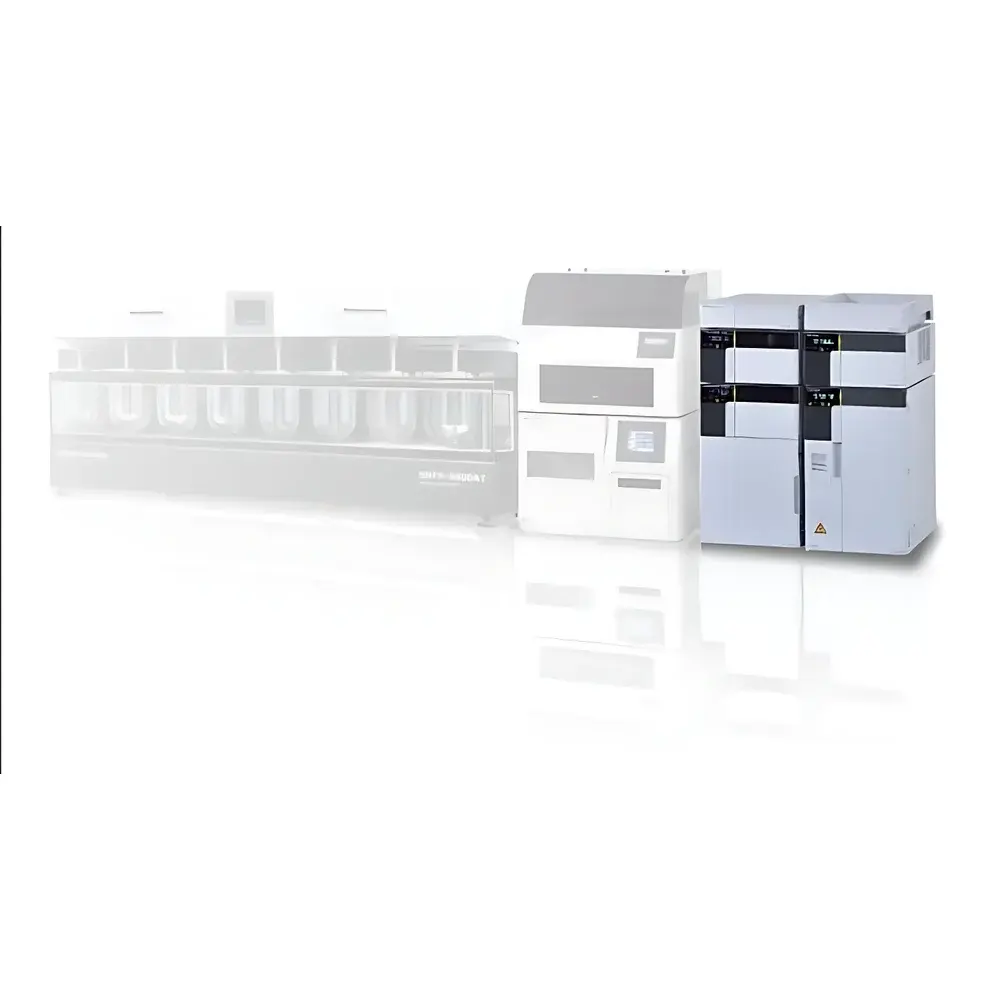
Shimadzu Nexera FV Fully Automated Dissolution Testing System with UHPLC Detection
| Brand | Shimadzu |
|---|---|
| Origin | Japan |
| Manufacturer Type | Original Equipment Manufacturer (OEM) |
| Import Status | Imported |
| Model | Nexera FV |
| Instrument Type | Ultra-High-Performance Liquid Chromatography (UHPLC)-Coupled Dissolution Testing System |
| Flow Rate Range | 0.0001–10 mL/min |
| Maximum Operating Pressure | 130 MPa (19,000 psi) |
| Autosampler Configuration | Integrated 8-position (standard) or 12-position (optional) flow-through vial rack |
| Temperature Control | Ambient to 45 °C (column oven & dissolution bath interface compatible) |
| Wavelength Range | Not applicable (system interfaces with external UV-Vis or PDA detector |
| Data Acquisition Frequency | Up to 100 Hz (synchronized with dissolution sampling events) |
Overview
The Shimadzu Nexera FV is a purpose-built, fully integrated dissolution testing system that couples ultra-high-performance liquid chromatography (UHPLC) with automated flow-through dissolution methodology. Engineered specifically for pharmaceutical quality control and formulation development laboratories, the Nexera FV implements a closed-loop, direct-flow architecture—eliminating manual sample transfer, pipetting, and offline dilution steps. Its core measurement principle relies on real-time, on-line chromatographic quantification of active pharmaceutical ingredient (API) concentration in dissolution media, synchronized precisely with sampling intervals from USP Apparatus 2 (paddles) or Apparatus 4 (flow-through cells). The system operates at up to 130 MPa (19,000 psi), enabling sub-2-minute chromatographic separations with high resolution and reproducibility—critical for capturing rapid dissolution profiles of immediate-release formulations or detecting subtle batch-to-batch differences in modified-release products.
Key Features
- Direct-flow integration: Eight standard (or twelve optional) flow-through vials are plumbed directly to dissolution apparatuses, ensuring zero dead volume and minimal carryover between samples.
- Dual-mode autosampling: Supports both Direct Analysis Mode (for extended sampling intervals ≥30 min, e.g., extended-release tablets) and Fraction Mode (for high-frequency sampling down to 5-min intervals, ideal for fast-dissolving oral solids).
- UHPLC-grade performance: Delivers <2 µL system dispersion, <0.1% RSD retention time precision, and gradient dwell volume <100 µL—meeting ICH Q2(R2) requirements for method robustness in dissolution assay validation.
- Pressure-stable fluidic architecture: Dual-plunger parallel low-pulsation pumps with active backpressure regulation maintain consistent flow across variable viscosity conditions (e.g., surfactant-containing media).
- Automated dilution capability: Integrated dilutor module performs programmable 1:2 to 1:100 serial dilutions directly within the flow path, eliminating manual preparation errors and improving assay linearity range.
Sample Compatibility & Compliance
The Nexera FV accommodates standard USP-compliant dissolution vessels (900 mL, 1 L), as well as miniaturized 100–250 mL formats for early-stage formulation screening. It supports all common dissolution media—including aqueous buffers, organic-aqueous mixtures (up to 95% acetonitrile), and surfactant solutions (e.g., SDS, polysorbate 80). The system conforms to FDA Guidance for Industry: Dissolution Testing of Immediate-Release Solid Oral Dosage Forms (1997, updated 2022), and its audit trail, electronic signature, and data integrity controls comply with 21 CFR Part 11 when operated with LabSolutions CS v5.96 or later. All hardware and software components meet ISO/IEC 17025:2017 general requirements for competence of testing and calibration laboratories.
Software & Data Management
DT Solution software provides method-driven workflow automation: users define dissolution test parameters (vessel type, rotation speed, temperature, sampling schedule) once per product, and the software auto-generates corresponding UHPLC analysis sequences, including injection volume, gradient program, and peak integration settings. LabSolutions DB/CS enables multi-data reporting—simultaneously importing dissolution timepoints, chromatographic peak areas, and reference standard responses to compute % dissolved, f2 similarity factor, and profile overlay plots per ICH Q5A(R2) and Q5D guidelines. Raw data, processed results, audit logs, and report PDFs are stored in a relational database with immutable timestamps, supporting GLP/GMP traceability and regulatory inspection readiness.
Applications
- Regulatory dissolution testing for ANDA and NDA submissions under FDA, EMA, and PMDA requirements.
- Comparative dissolution profiling of generic vs. reference listed drug products (RLDPs).
- Stability-indicating dissolution method development for degradation-prone APIs.
- Excipient interaction studies during preformulation—monitoring dissolution rate shifts induced by polymer grade, particle size, or surfactant concentration.
- Real-time release testing (RTRT) support in continuous manufacturing environments via API concentration trending and multivariate statistical process control (MSPC).
FAQ
Does the Nexera FV require a separate UV-Vis or PDA detector?
Yes—the Nexera FV is a chromatographic dissolution interface platform; it must be coupled with a Shimadzu SPD-M30A, SPD-40, or equivalent UV-Vis/PDA detector for quantitative analysis.
Can the system handle viscous dissolution media containing 1% methylcellulose?
Yes—its pressure-compensated flow path and solvent compatibility up to 95% organic mobile phase allow stable operation with high-viscosity media when paired with appropriate column chemistries (e.g., wide-pore C18 or HILIC phases).
Is method transfer from conventional HPLC dissolution methods supported?
Yes—DT Solution includes a method conversion wizard that scales gradient times, flow rates, and injection volumes based on column dimensions and system dispersion characteristics, facilitating seamless transition from 5 µm HPLC to sub-2 µm UHPLC methods.
How is system suitability verified for dissolution testing?
The platform supports automated system suitability testing (SST) per USP <711>, including precision (n=6 replicate injections), tailing factor, and resolution checks—executed before each batch and logged with full audit trail.
What cybersecurity protocols are implemented in LabSolutions CS for networked deployment?
LabSolutions CS v5.96+ supports TLS 1.2 encryption, Active Directory integration, role-based access control (RBAC), and configurable password policies aligned with NIST SP 800-53 Rev. 5 controls for laboratory IT infrastructure.




