
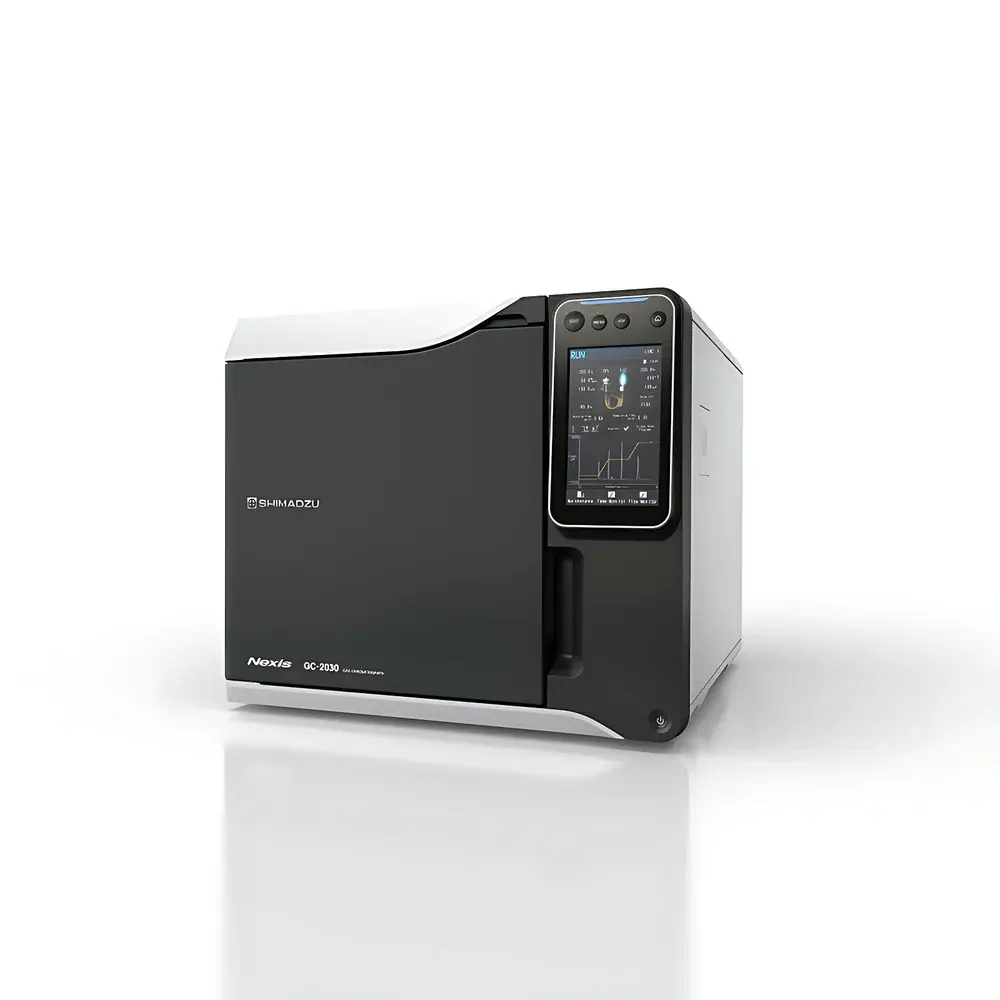
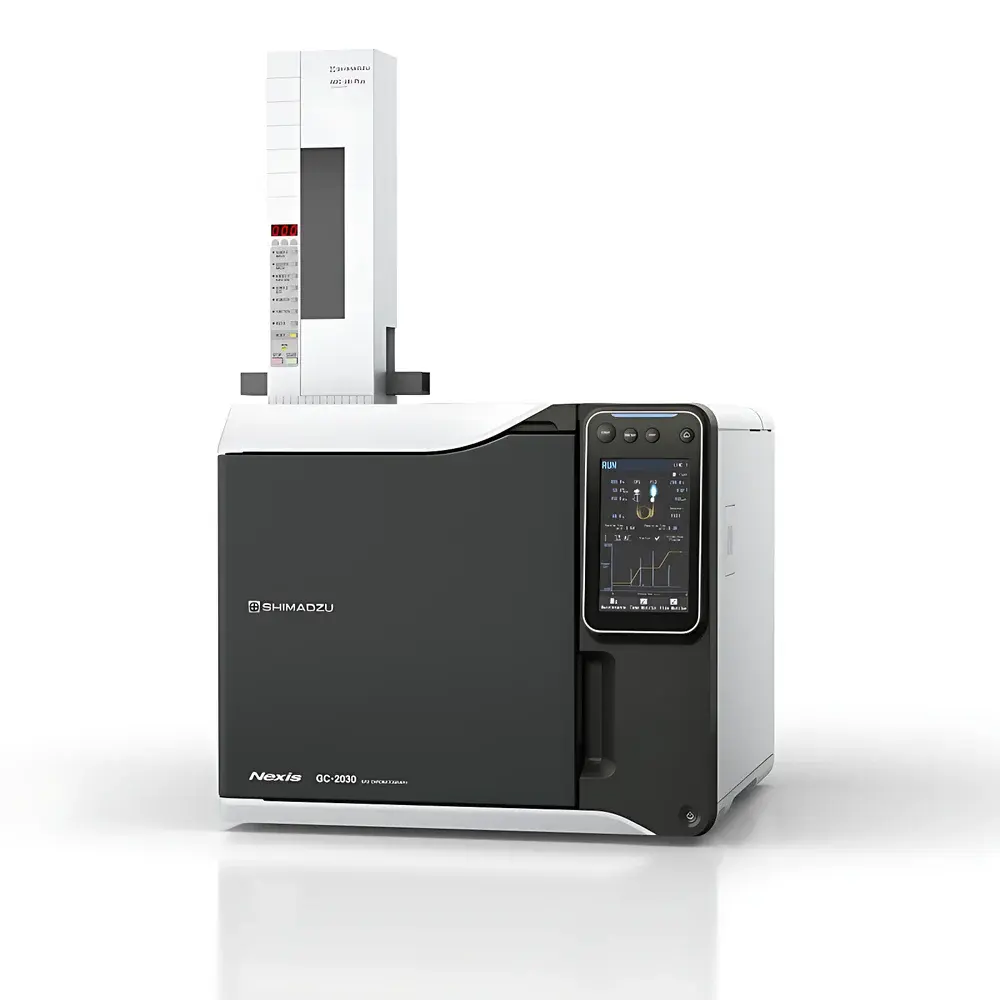
Shimadzu Nexis GC-2030 Gas Chromatograph
| Key | Brand: Shimadzu |
|---|---|
| Origin | Jiangsu, China |
| Manufacturer Type | Original Equipment Manufacturer (OEM) |
| Instrument Type | Laboratory Gas Chromatograph |
| Application Scope | General-Purpose Analysis |
| Oven Temperature Range | Ambient +2 °C to 450 °C |
| Oven Ramp Rate | 0.01–250 °C/min |
| Oven Cool-Down Time | ~3.4 min (450 °C → 50 °C) |
| Carrier Gas Flow Control | 0–1300 mL/min He |
| Carrier Gas Pressure Control | 0–1035 kPa (7 programmable segments) |
| Injector Max Temp | 450 °C |
| Injector Pressure Setting Range | 0–1035 kPa |
| Injector Total Flow Setting Range | 0–1300 mL/min He |
Overview
The Shimadzu Nexis GC-2030 is a high-performance, general-purpose laboratory gas chromatograph engineered for precision, operational reliability, and method robustness in regulated and research environments. Built upon Shimadzu’s proven gas chromatography platform, it employs advanced electronic pressure and flow control (AFC/APC) architecture to deliver precise, reproducible carrier gas delivery across helium, nitrogen, and hydrogen carrier gases. Its column oven features rapid thermal response with programmable ramp rates up to 250 °C/min and sub-minute cool-down capability—enabling high-throughput analysis without compromising retention time stability or peak shape fidelity. The system supports standard split/splitless, PTV, and on-column injection configurations, and integrates seamlessly with Shimadzu’s GCMS-QP series for hyphenated analysis. Designed for compliance-critical workflows, the Nexis GC-2030 meets foundational requirements for GLP/GMP-aligned laboratories, including stable baseline operation, trace-level detection sensitivity, and audit-ready system diagnostics.
Key Features
- Intelligent Touch Interface: A 9.7-inch capacitive color touchscreen provides intuitive, gesture-based navigation—mirroring modern mobile UX paradigms. All instrument parameters—including oven programming, injector settings, detector configuration, and method sequencing—are fully controllable via direct touch. Remote monitoring and method execution are supported through Shimadzu LabSolutions GC software on Windows-based workstations.
- ClickTek Column Installation System: A mechanical and sensor-assisted coupling mechanism that eliminates torque wrenches and leak-checking steps. Integrated micro-switches and pressure feedback detect optimal sealing position during column insertion, ensuring consistent, leak-free connections with <1×10⁻⁸ mL/sec He leak rate performance.
- Advanced AFC/APC Architecture: Dual independent electronic pneumatic controllers regulate both pressure and flow with ±0.01 kPa and ±0.1 mL/min accuracy across seven programmable segments—supporting complex multi-step methods with carrier gas switching (e.g., He→H₂ transitions) and backflush protocols.
- Enhanced Detector Performance: Optimized FID, ECD, FPD, and BID detectors feature redesigned jet geometries, low-noise electronics, and improved thermal management—achieving detection limits of ≤1.5 pg C/s (FID), ≤0.003 pg/mL (ECD, γ-BHC), and ≤0.05 pg S/s (FPD), with RSDs <1.2% (n=6) for replicate injections.
- Energy-Efficient Column Oven: Patented insulation and adaptive heating/cooling algorithms reduce power consumption by up to 35% versus prior-generation ovens. Auto-start/stop scheduling and carrier gas-saving modes (e.g., low-flow standby) further minimize operational overhead without sacrificing method transferability.
Sample Compatibility & Compliance
The Nexis GC-2030 accommodates a broad range of volatile and semi-volatile analytes—from hydrocarbons and pesticides to residual solvents and environmental pollutants—in matrices including water, soil extracts, pharmaceutical formulations, and petrochemical distillates. It supports ASTM D3606, USP , ISO 11843-2, and EPA Methods 8021B, 8260D, and 8270E when configured with appropriate columns and detectors. Instrument diagnostics—including real-time pressure/flow deviation alerts, column bleed monitoring, and automatic leak detection—generate timestamped logs compatible with FDA 21 CFR Part 11-compliant data integrity frameworks when used with LabSolutions GC v5.9 or later. Routine IQ/OQ documentation packages are available for GxP validation support.
Software & Data Management
Controlled exclusively via Shimadzu LabSolutions GC software (Windows 10/11, 64-bit), the Nexis GC-2030 enables full method development, sequence management, peak integration, calibration curve generation, and report export (PDF, CSV, XML). The software includes built-in system suitability assessment tools aligned with ICH Q2(R2) guidelines and supports electronic signatures, audit trails, and user role-based access control. Raw data files (.gcd) are stored in vendor-neutral formats compliant with ASTM E1957-22 for long-term archival. Optional integration with LIMS platforms (e.g., Thermo Fisher SampleManager, LabVantage) is available via ASTM E1578-compliant drivers.
Applications
- Residual solvent analysis in APIs and excipients per ICH Q3C guidelines
- Volatile organic compound (VOC) profiling in drinking water per EPA 524.2
- Fatty acid methyl ester (FAME) quantification in biodiesel per EN 14103
- Pesticide multiresidue screening in fruits and vegetables (QuEChERS workflow)
- Hydrocarbon fingerprinting in crude oil and refined products (ASTM D5292)
- Impurity profiling in polymer additives and plasticizers (e.g., phthalates, antioxidants)
FAQ
Does the Nexis GC-2030 support hydrogen as a carrier gas?
Yes—it is certified for safe H₂ operation with integrated hydrogen sensor, automatic leak detection, and fail-safe shutdown logic compliant with IEC 61010-1.
Can the system be validated for GMP environments?
Yes—Shimadzu provides IQ/OQ documentation templates, 21 CFR Part 11 configuration guides, and third-party validation support services.
Is remote operation supported?
Yes—LabSolutions GC allows secure remote desktop access and method queue management over LAN/WAN with TLS 1.2 encryption.
What column dimensions and phases are compatible?
Standard 0.1–0.53 mm ID fused-silica capillary columns up to 60 m length; all common stationary phases (e.g., 5%, 35%, 65% phenyl polysiloxanes, PEG, cyanopropylphenyl, and ionic liquid phases) are supported.
How frequently does preventive maintenance require intervention?
With ClickTek-enabled maintenance and automated diagnostics, routine service intervals extend to 6 months under typical usage; injector liner replacement and detector cleaning are typically required every 200–300 injections.
Related Products






