
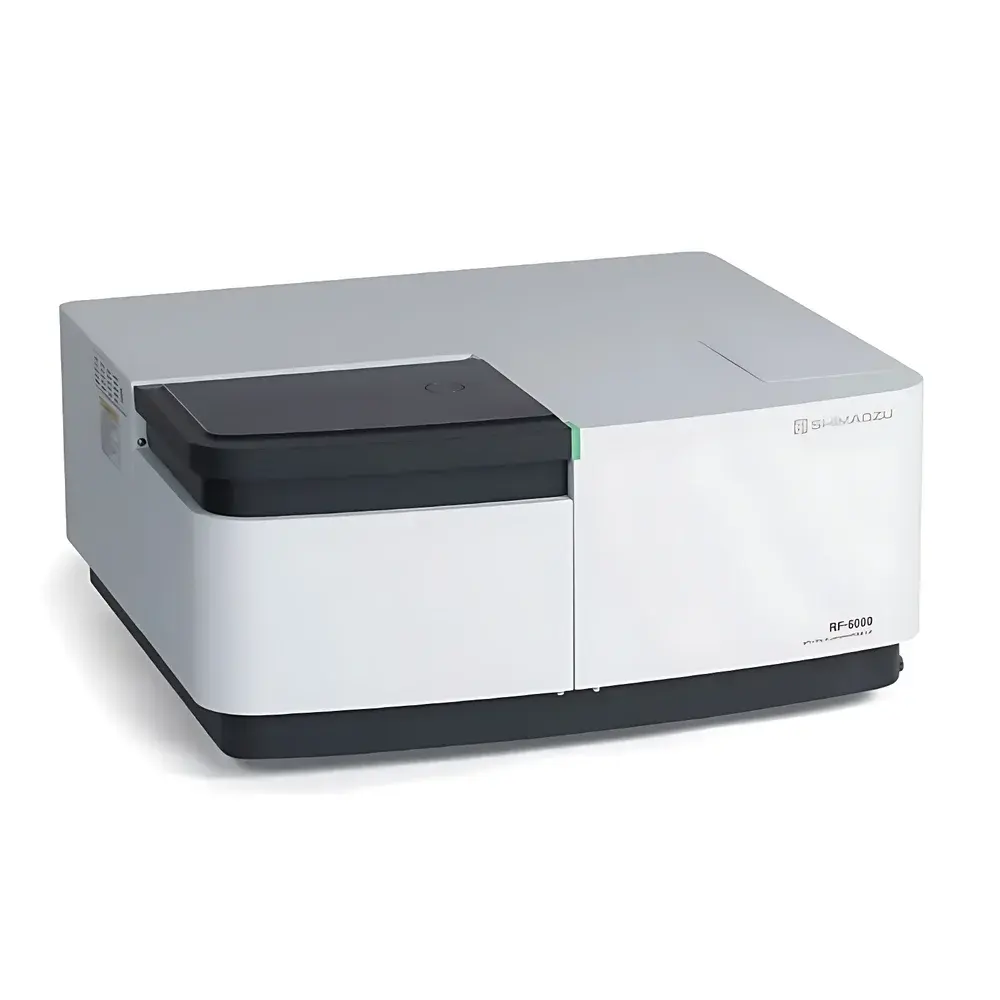
Shimadzu RF-6000 Molecular Fluorescence Spectrophotometer
| Brand | Shimadzu |
|---|---|
| Origin | Japan |
| Manufacturer Type | Original Equipment Manufacturer (OEM) |
| Import Status | Imported |
| Model | RF-6000 |
| Wavelength Accuracy | ±1.0 nm |
| Spectral Bandwidth (Slit Width) | 1.0–20.0 nm |
| Optical Resolution | 1.0 nm |
| Sensitivity (S/N Ratio) | ≥1000:1 (RMS) |
| Wavelength Range | Excitation 200–900 nm, Emission 200–900 nm |
| Scan Speed | Up to 60,000 nm/min |
| Light Source | Long-life Xenon Lamp (2000 h typical lifetime) |
| Detector | Broadband Photomultiplier Tube (PMT), extended to 900 nm |
| Dispersion Element | Dual grating + interference filter system |
| Quantum Yield Measurement | Supported (absolute and relative) |
Overview
The Shimadzu RF-6000 is a high-performance molecular fluorescence spectrophotometer engineered for quantitative and qualitative analysis of fluorescent compounds across pharmaceutical, environmental, biochemical, and materials science laboratories. It operates on the principle of photoluminescence spectroscopy—measuring the intensity and spectral distribution of light emitted by analytes following excitation at specific wavelengths. The instrument employs a dual-grating monochromator combined with interference filters to achieve precise wavelength selection and exceptional stray-light rejection. Its optical architecture supports both conventional steady-state fluorescence measurements and advanced modalities including synchronous scanning, three-dimensional (3D) excitation-emission matrix (EEM) mapping, and absolute quantum yield determination using an integrating sphere accessory (optional). Designed for compliance with international analytical standards—including ISO 17025, USP , and ICH Q2(R2) guidelines—the RF-6000 delivers trace-level detection sensitivity and long-term signal stability required for regulated QC/QA environments.
Key Features
- High-sensitivity detection with signal-to-noise ratio ≥1000:1 (RMS), enabling reliable quantification of low-concentration fluorophores in complex matrices.
- Ultra-fast spectral acquisition up to 60,000 nm/min, significantly reducing analysis time for routine screening and high-throughput applications.
- Dual dispersion system combining holographic gratings and tunable interference filters ensures optimal resolution (1.0 nm) and flexible spectral bandwidth control (1.0–20.0 nm).
- Integrated xenon lamp with 2000-hour operational lifetime minimizes maintenance frequency and enhances measurement reproducibility over extended campaigns.
- Broadband PMT detector covering 200–900 nm enables simultaneous characterization of UV, visible, and near-infrared fluorescent species without hardware reconfiguration.
- Automated spectral correction for both excitation and emission pathways compensates for instrumental response nonlinearity, ensuring accurate spectral shape preservation.
Sample Compatibility & Compliance
The RF-6000 accommodates standard 10 mm quartz cuvettes, microvolume cells (down to 50 µL), solid-sample holders, and temperature-controlled accessories (e.g., Peltier modules). It supports fluorescence polarization, time-resolved decay profiling (with optional TCSPC upgrade), and quantum yield measurements using NIST-traceable reference standards. All firmware and software modules comply with FDA 21 CFR Part 11 requirements for electronic records and signatures when configured with audit trail and user access control. Instrument performance verification is automated via built-in diagnostic routines aligned with ASTM E275 and ISO 8577 standards.
Software & Data Management
Labsolution RF v2.x provides a unified interface for method development, real-time monitoring, and post-acquisition processing. Key capabilities include automatic baseline correction, peak deconvolution, multi-component spectral unmixing, and batch processing of EEM datasets. Raw data are stored in vendor-neutral .csv and .jdx formats; metadata—including instrument parameters, calibration history, and operator ID—is embedded per ICH M7-compliant documentation practices. Audit trails record all parameter changes, data exports, and report generation events, supporting GLP/GMP audits and regulatory submissions.
Applications
- Pharmaceutical development: impurity profiling, excipient compatibility studies, and stability-indicating assay validation.
- Environmental analysis: polycyclic aromatic hydrocarbon (PAH) detection in water and soil extracts.
- Life sciences: protein conformational analysis via intrinsic tryptophan fluorescence, nucleic acid binding assays, and enzyme kinetics monitoring.
- Materials research: characterization of quantum dots, organic LEDs (OLEDs), and luminescent nanomaterials.
- Food safety: detection of mycotoxins (e.g., aflatoxin B1), vitamins (e.g., riboflavin), and adulterants via native or derivatized fluorescence.
FAQ
Does the RF-6000 support absolute quantum yield measurement?
Yes—when equipped with the optional integrating sphere accessory and calibrated reference standards, the system calculates absolute quantum yield with traceability to NIST SRM 936a.
Is the software compliant with 21 CFR Part 11?
Yes—Labsolution RF supports role-based access control, electronic signatures, and full audit trail functionality when deployed in validated environments.
What is the typical lifetime of the xenon lamp under continuous operation?
The lamp is rated for ≥2000 hours of operation under standard usage conditions; output stability is monitored in real time and reported via the status dashboard.
Can the RF-6000 perform time-resolved fluorescence measurements?
Native support is for steady-state measurements; time-correlated single-photon counting (TCSPC) requires optional hardware integration and dedicated software modules.
How does the instrument handle spectral calibration verification?
Built-in holmium oxide and didymium glass filters enable automated wavelength accuracy checks before each analytical session, with results logged in the audit trail.





