
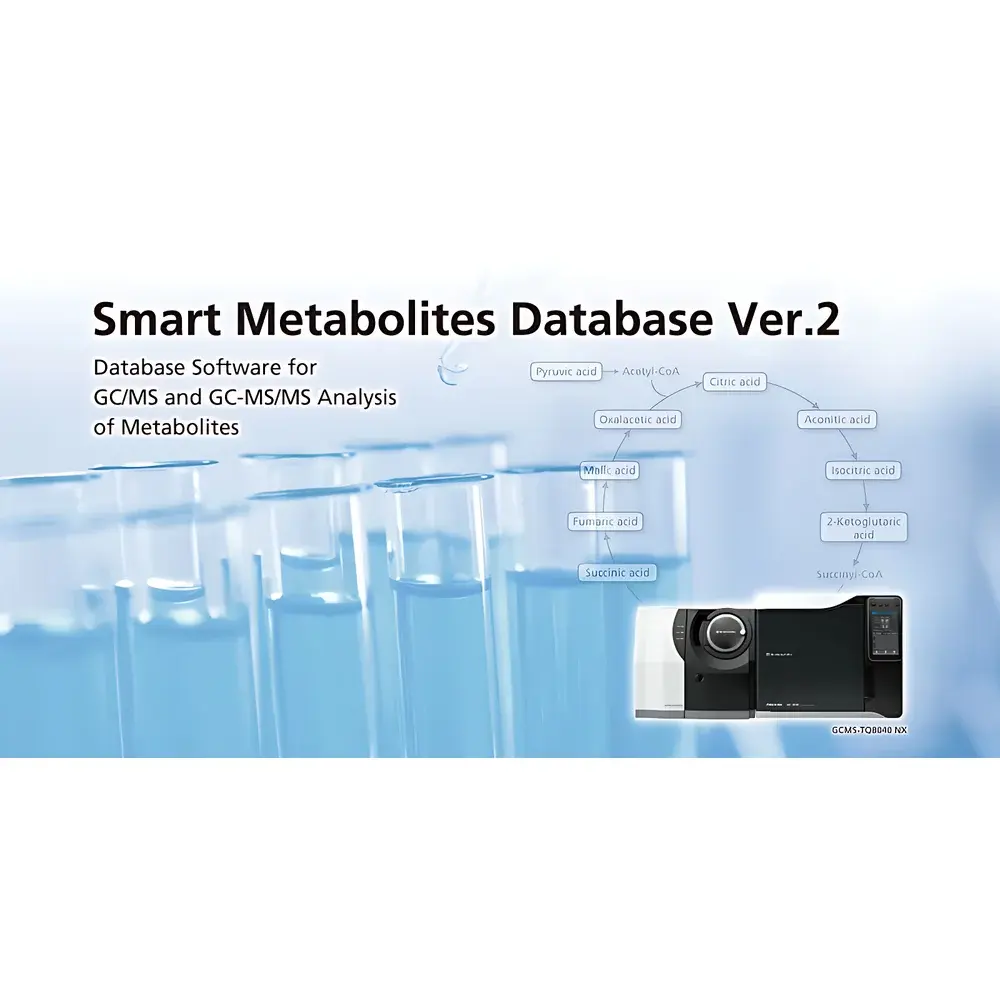
Shimadzu Smart Metabolites Database Ver.2
| Brand | Shimadzu |
|---|---|
| Origin | Japan |
| Manufacturer Type | Manufacturer |
| Origin Category | Imported |
| Model | Smart Metabolites Database Ver.2 |
| Chromatography Type | Conventional GC-MS |
| Database Compound Count | 600+ metabolites |
| Coverage Expansion | Plant secondary metabolites (e.g., catechin, chlorogenic acid), amino acids, fatty acids, sugars |
| Includes | Pre-optimized MRM methods, AART retention time calibration, sample-type-based filtering, derivatization protocols for sugars, GC/MS workflow support, metabolomics handbook |
Overview
The Shimadzu Smart Metabolites Database Ver.2 is a purpose-built, vendor-specific spectral and methodological knowledge base designed to accelerate targeted and semi-targeted metabolite identification and quantification in gas chromatography–mass spectrometry (GC-MS) workflows. It does not constitute hardware but serves as an integrated software resource embedded within Shimadzu’s GCMSsolution and LabSolutions platforms. The database leverages authentic reference mass spectra, retention index data, and chemometric relationships derived from rigorously validated analytical conditions across diverse biological matrices. Its core function is to bridge the gap between raw GC-MS output and biologically interpretable metabolite profiles—particularly for low-molecular-weight compounds (<1000 Da) central to metabolic pathway analysis, including primary metabolites (e.g., organic acids, amino acids, sugars) and plant secondary metabolites (e.g., flavonoids, phenylpropanoids). Engineered for reproducibility in complex biological samples—such as plasma, urine, tissue homogenates, and plant extracts—the database addresses persistent challenges in metabolomics: co-elution interference, low-abundance analyte detection, and method development scalability.
Key Features
- Expanded compound coverage: Contains spectral and quantitative information for over 600 metabolites, with dedicated expansion of plant secondary metabolites—including catechin, chlorogenic acid, rutin, and quercetin glycosides—enabling functional food and phytochemical research.
- Pre-validated MRM method generation: Integrates optimized multiple reaction monitoring (MRM) transitions, collision energies, and dwell times for each compound, enabling trace-level detection without requiring individual standard calibration.
- AART (Automatic Adjustment of Retention Time) compatibility: Supports retention time alignment across runs and instruments using internal standard referencing, improving cross-laboratory reproducibility and reducing manual peak annotation effort.
- Sample-type intelligent filtering: Allows users to restrict analysis to metabolite subsets relevant to specific sample categories (e.g., “plant extract,” “human plasma,” “cell lysate”), minimizing false-positive annotations and accelerating data review.
- Sugar-specific derivatization & semi-quantitative workflows: Introduces an alternative oxime-trimethylsilyl (Oxime-TMS) protocol optimized for mono- and disaccharide separation, accompanied by built-in calibration curve templates for 24 key carbohydrates—enabling rapid semi-quantitative assessment without pure sugar standards.
- End-to-end GC/MS metabolomics guidance: Bundled with the “Metabolomics Handbook,” a step-by-step technical guide covering sample preparation (extraction, derivatization), instrument tuning, data acquisition parameters, peak deconvolution settings, and multivariate statistical interpretation (PCA, PLS-DA).
Sample Compatibility & Compliance
The database supports routine analysis of hydrophilic and moderately volatile metabolites extracted from human biofluids (serum, urine, CSF), cultured cells, animal tissues, and plant materials following standard derivatization protocols (e.g., MSTFA + 1% TMCS). All included methods comply with widely adopted analytical validation frameworks referenced in ISO/IEC 17025 and aligned with FDA Guidance for Industry on Bioanalytical Method Validation (2018). While the database itself is not subject to 21 CFR Part 11 certification, its integration into LabSolutions software enables full audit trail logging, electronic signature support, and user-access controls when deployed in GLP/GMP-regulated environments. Compound identifications meet minimum criteria defined by the Metabolomics Standards Initiative (MSI): Level 1 (confirmed with reference standard), Level 2 (probable structure based on spectral match + retention index), or Level 3 (putative annotation via library search).
Software & Data Management
Fully embedded within Shimadzu’s GCMSsolution (v4.50+) and LabSolutions (v5.90+) software suites, the database operates via direct linkage to acquired GC-MS data files (.qgd, .lcd). It supports batch processing of multi-sample datasets, automatic peak table generation with integrated retention time correction, and export of annotated results in CSV, Excel, and mzXML formats for downstream statistical analysis in R, SIMCA, or Python-based pipelines (e.g., MetaboAnalyst, XCMS Online). All method templates are stored in XML-based configuration files, ensuring version-controlled deployment across laboratory networks. Metadata tagging follows ISA-Tab conventions, facilitating FAIR (Findable, Accessible, Interoperable, Reusable) data practices.
Applications
- Discrimination of cultivar-specific metabolic signatures in food science (e.g., tomato, tea, olive oil)
- Discovery of diagnostic biomarkers in clinical metabolomics studies of inborn errors of metabolism or oncology cohorts
- Quality control and authenticity verification of botanical supplements and functional foods
- Time-course profiling of stress-induced metabolic shifts in plant physiology research
- Method development support for regulatory submissions requiring comprehensive small-molecule characterization
FAQ
Is the Smart Metabolites Database Ver.2 compatible with third-party GC-MS systems?
No—it is exclusively designed for Shimadzu GC-MS instruments and requires GCMSsolution or LabSolutions software.
Does the database include isotopically labeled internal standards?
No—internal standard selection and calibration remain user-defined; however, recommended IS candidates are listed per compound class in the Metabolomics Handbook.
Can I add custom compounds to the database?
Yes—users may import custom mass spectra and retention indices via the database editor module, though these entries do not inherit pre-optimized MRM or AART functionality.
What derivatization reagents are supported?
Primary support is provided for MSTFA (+1% TMCS) and BSTFA (+1% TMCS); alternative silylation and alkylation protocols are documented in the Handbook but require user validation.
Is cloud-based access or remote license sharing supported?
Licensing is node-locked to the host PC running LabSolutions; concurrent network deployment requires enterprise licensing agreement with Shimadzu.




