
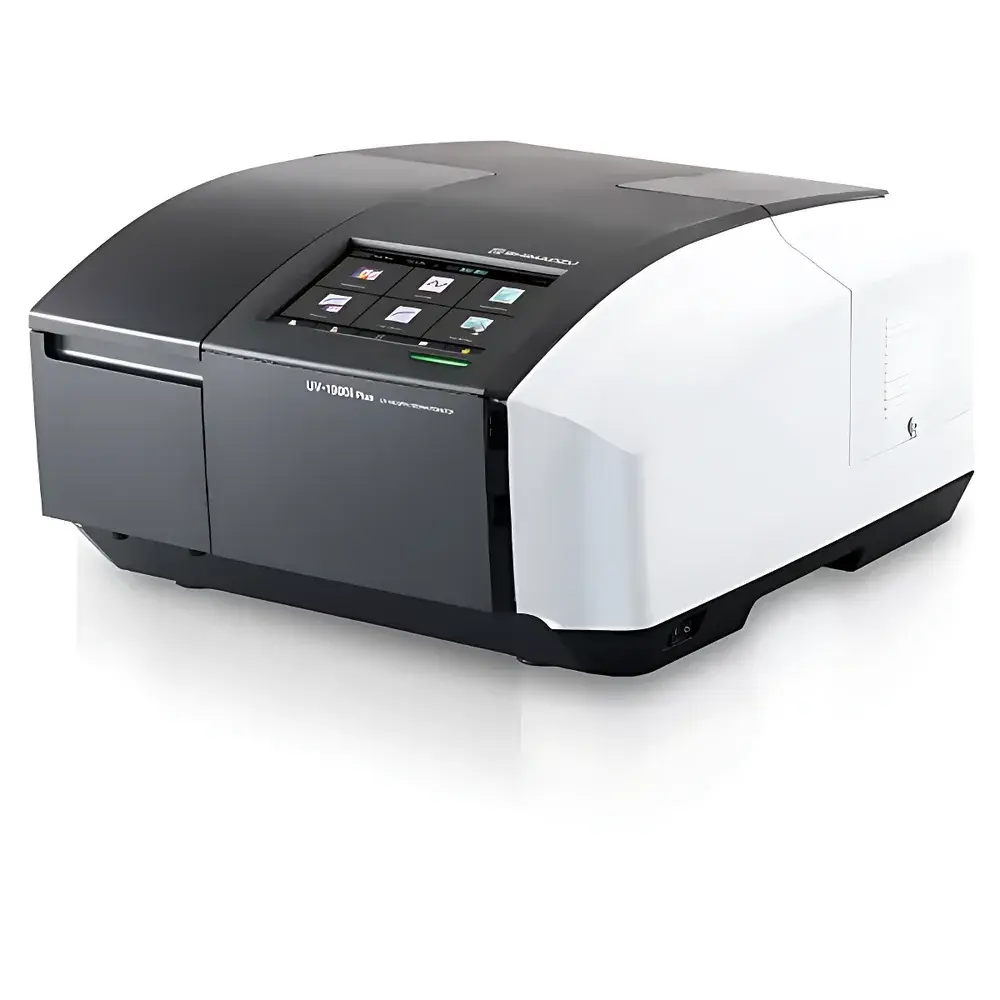
Shimadzu UV-1900i Plus Dual-Beam Ultraviolet-Visible Spectrophotometer
| Brand | Shimadzu |
|---|---|
| Origin | Japan |
| Manufacturer | Shimadzu Corporation |
| Instrument Type | Imported |
| Model | UV-1900i Plus |
| Optical Design | Dual-Beam |
| Detector | Photodiode Array (PDA) |
| Wavelength Range | 190–1100 nm |
| Wavelength Accuracy | ±0.1 nm |
| Wavelength Repeatability | ±0.1 nm |
| Spectral Bandwidth | 1 nm |
| Stray Light | ≤0.02% (at 220 nm and 340 nm) |
| Automation | Motorized Wavelength Scanning, Auto-Power-On/Wake-Up, Wireless Data Transfer (Wi-Fi), PictBridge-Compatible Printing |
| Software | LabSolutions UV-Vis DB/CS (with Audit Trail, User Management, and 21 CFR Part 11 Compliance Features) |
Overview
The Shimadzu UV-1900i Plus is a high-performance dual-beam ultraviolet-visible (UV-Vis) spectrophotometer engineered for precision absorbance, transmittance, and reflectance measurements across the 190–1100 nm spectral range. It employs a high-efficiency LO-RAY-LIGH low-stray-light holographic diffraction grating coupled with a thermally stabilized photodiode array (PDA) detector to deliver exceptional optical fidelity, rapid spectral acquisition, and long-term photometric stability. Unlike single-beam systems, its true dual-beam architecture continuously compares sample and reference beam intensities in real time—minimizing drift from lamp fluctuations or environmental thermal shifts. This design ensures superior baseline stability, high linearity over extended absorbance ranges (up to 3.5 AU), and robust reproducibility essential for quantitative analysis in regulated environments.
Key Features
- Dual-beam optical path with real-time reference compensation for enhanced photometric accuracy and reduced baseline drift
- LO-RAY-LIGH holographic grating delivering ≤0.02% stray light at 220 nm and 340 nm—critical for high-absorbance measurements and compliance with pharmacopeial limits (e.g., USP & JP)
- 1 nm spectral bandwidth meeting and exceeding European Pharmacopoeia resolution requirements for identity and purity testing
- High-resolution 7-inch color capacitive touchscreen with ergonomic layout, multi-touch gesture support, and responsive UI—enabling intuitive method setup, spectrum navigation, and real-time peak tracking
- Integrated wireless connectivity (IEEE 802.11 b/g/n) supporting secure Wi-Fi data export to networked PCs, cloud storage, or LIMS; compatible with PictBridge-certified printers for direct report generation
- Auto-wake functionality triggered by scheduled time or external signal (e.g., barcode scan), enabling unattended overnight assays and automated workflow integration
- Peripheral expansion via USB ports supporting external keyboards, 1D/2D barcode scanners, and HID-compliant input devices—streamlining sample ID entry and SOP-driven operation
Sample Compatibility & Compliance
The UV-1900i Plus accommodates standard 10 mm cuvettes (quartz, glass, or plastic), microvolume adapters (down to 0.5 µL), and optional solid-sample holders for reflectance or diffuse transmittance measurements. Its optical platform supports kinetic, scanning, quantitation, and multi-component analysis modes with configurable slit widths and integration times. From a regulatory standpoint, the system meets key international standards: wavelength accuracy (±0.1 nm) and repeatability (±0.1 nm) conform to ISO 9001 calibration traceability protocols; stray light performance satisfies USP , JP 17th Ed. General Test 2.21, and EP 2.2.25 specifications; and full software validation—including electronic signatures, audit trail, role-based access control, and data integrity safeguards—is enabled through LabSolutions UV-Vis DB/CS under FDA 21 CFR Part 11 and PIC/S GMP Annex 11 requirements.
Software & Data Management
LabSolutions UV-Vis DB/CS (Database / Client-Server edition) serves as the central analytical and compliance engine. It provides synchronized instrument control, real-time spectral visualization, automatic peak identification, and customizable report templates compliant with GLP/GMP documentation standards. The software supports multi-user environments with hierarchical permissions, encrypted database storage, and immutable audit logs recording all parameter changes, measurement events, and user actions. Raw spectral data are stored in vendor-neutral formats (e.g., JCAMP-DX, CSV), facilitating third-party integration with enterprise LIMS, ELN, or statistical analysis platforms. All validation documentation—including IQ/OQ/PQ protocols, URS, and risk assessments—is available upon request to support laboratory qualification processes.
Applications
The UV-1900i Plus is routinely deployed in pharmaceutical QC laboratories for assay of active pharmaceutical ingredients (APIs), excipient verification, dissolution profile monitoring, and cleaning validation swab analysis. In academic and industrial R&D settings, it supports enzyme kinetics studies, ligand-binding assays, nanoparticle characterization (e.g., plasmon resonance detection), and polymer degradation profiling. Environmental labs utilize its high stray-light rejection for trace nitrate/nitrite quantification in water samples; food safety labs apply it for colorant concentration, antioxidant capacity (e.g., DPPH assay), and adulterant screening. Its fast scanning capability (<1 sec per full 190–1100 nm spectrum) enables time-resolved reaction monitoring without kinetic accessory hardware.
FAQ
Does the UV-1900i Plus support 21 CFR Part 11 compliance out of the box?
Yes—when configured with LabSolutions UV-Vis DB/CS and appropriate IT infrastructure (e.g., domain authentication, encrypted network), it delivers full electronic signature, audit trail, and user access management capabilities required for regulated submissions.
Can I use non-Shimadzu cuvettes or accessories?
Standard 10 mm pathlength cuvettes from third-party manufacturers are fully compatible if they meet dimensional tolerances (e.g., ISO 3664); however, Shimadzu-certified quartz cells are recommended for UV-range applications below 220 nm to ensure optimal transmission and durability.
Is wavelength calibration traceable to NIST or JCSS standards?
Yes—the factory calibration is traceable to the National Metrology Institute of Japan (NMIJ/JCSS) and includes documented uncertainty budgets; users may perform periodic verification using NIST-traceable holmium oxide or didymium filters.
What maintenance is required to sustain optical performance?
Routine maintenance includes monthly desiccant replacement in the monochromator chamber, biannual lamp alignment verification, and annual PDA dark-current recalibration—procedures supported by built-in diagnostic tools and service manuals.
How does the dual-beam architecture improve measurement reliability compared to single-beam designs?
By continuously splitting and alternating the light beam between sample and reference positions, it eliminates time-dependent intensity variations from deuterium/tungsten lamp aging or thermal drift—resulting in sub-0.001 AU baseline noise and improved long-term repeatability across daily operational cycles.




