
Shimadzu UV Cuvettes and Absorption Cells
| Brand | Shimadzu |
|---|---|
| Origin | Japan |
| Product Type | Imported Spectroscopy Accessories |
| Models | 200-34944, 200-66578-12 |
| Optical Path Lengths | 1 mm to 100 mm |
| Material Options | UV-grade Quartz (S), Optical Glass (G), IR-grade Quartz (IR) |
| Spectral Transmission Ranges | Quartz (S): 190–2500 nm |
| Glass (G) | 320–2500 nm |
| IR Quartz | 250–3200 nm |
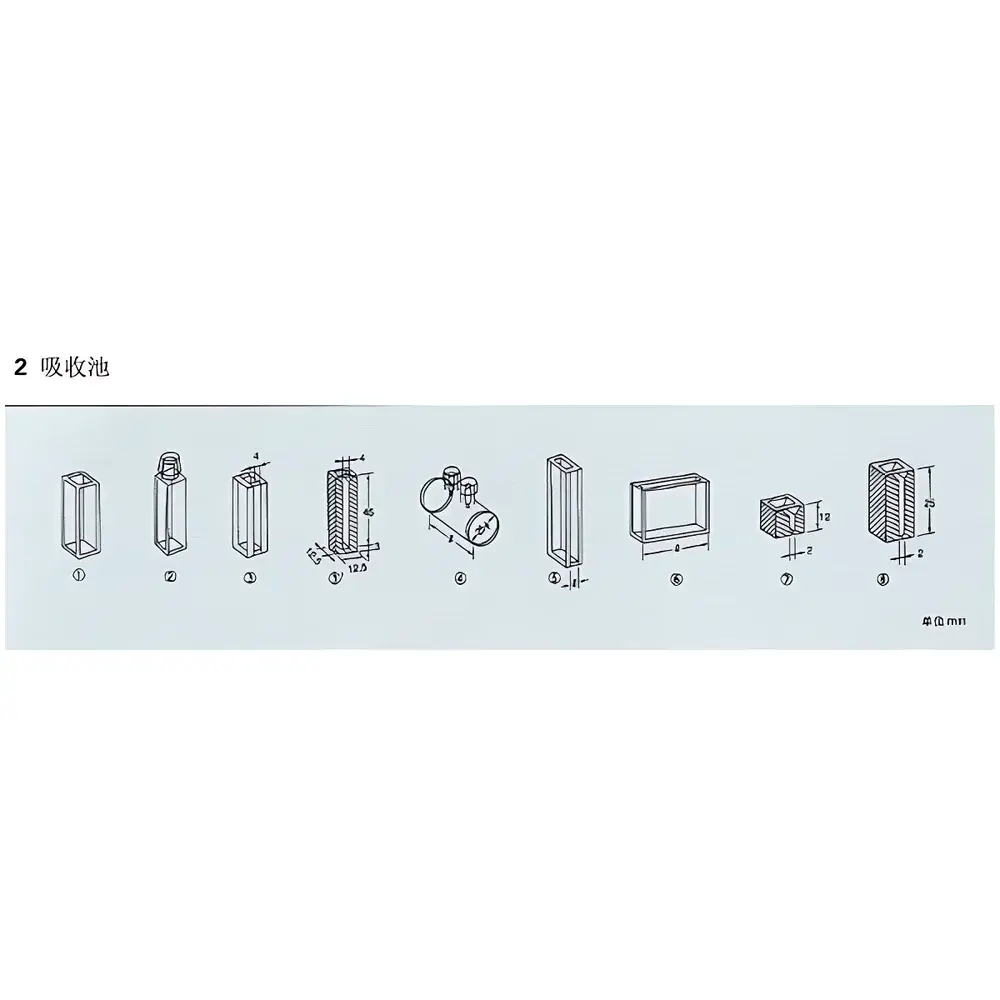
| Configurations | Standard, Sealed, Semi-micro, Micro, Ultra-micro, Dark, Cylindrical, Short-path |
Overview
Shimadzu UV cuvettes and absorption cells are precision-engineered optical components designed for quantitative and qualitative spectroscopic analysis across ultraviolet, visible, and near-infrared (UV-Vis-NIR) spectral regions. These cells operate on the fundamental Beer–Lambert principle, where absorbance (A) is linearly proportional to analyte concentration (c), molar absorptivity (ε), and optical path length (l): A = ε·c·l. As critical interface elements between sample and spectrophotometer, their dimensional accuracy, surface flatness, parallelism (< 3 arcsec), and material homogeneity directly determine measurement fidelity, baseline stability, and photometric reproducibility. Manufactured in Japan under ISO 9001-certified cleanroom conditions, each cuvette undergoes rigorous spectral validation and dimensional metrology to ensure compliance with ASTM E275 and ISO 10110-7 standards for optical element quality.
Key Features
- Precision-machined optical path lengths: Available in discrete increments from 1 mm to 100 mm (including 1, 2, 5, 10, 20, 50, and 100 mm), enabling optimization of sensitivity and dynamic range per application—e.g., 1 mm for highly concentrated samples, 100 mm for trace-level detection.
- Material-specific transmission optimization: UV-grade fused silica (S-type) provides >90% transmittance from 190 nm to 2500 nm; optical crown glass (G-type) offers cost-effective performance from 320 nm to 2500 nm; IR-grade quartz (IR-type) extends usable range to 3200 nm for NIR applications.
- Dedicated configurations for specialized workflows: Sealed cuvettes prevent solvent evaporation and volatile loss during kinetic assays; dark cuvettes eliminate stray light interference in low-signal measurements; semi-micro (≥ 75 µL), micro (≥ 15 µL), and ultra-micro (≥ 2 µL) formats conserve precious or hazardous samples.
- Cylindrical cuvettes with quartz, glass, or IR windows support flow-cell integration and circular dichroism (CD) instrumentation; short-path variants (1–5 mm) minimize matrix effects in turbid or highly scattering media.
- High-precision polishing: All optical surfaces meet λ/10 surface flatness and < 0.2 µm scratch-dig specifications per MIL-PRF-13830B, ensuring minimal wavefront distortion and scatter-induced noise.
Sample Compatibility & Compliance
Shimadzu cuvettes accommodate aqueous, organic, and corrosive solvents—including acetonitrile, chloroform, and 6 M HCl—when used within manufacturer-recommended exposure limits. Quartz S-type cells resist thermal shock up to ΔT = 120 °C and are compatible with autoclaving (dry heat only). All models comply with GLP documentation requirements for traceability: each batch carries a Certificate of Conformance listing lot number, spectral scan data (200–3200 nm), and interferometric verification reports. For regulated environments, these accessories support 21 CFR Part 11–compliant workflows when paired with Shimadzu UV-Vis spectrophotometers (e.g., UV-2700i, UV-2600i) and LabSolutions software.
Software & Data Management
While cuvettes themselves are passive optical components, their selection directly influences data integrity in Shimadzu’s LabSolutions UV-Vis software suite. The software’s “Cell Correction” module allows users to register path length, material type, and serial-numbered calibration references—enabling automatic absorbance normalization and error propagation modeling. Audit trails log cell usage history per sample ID, supporting ISO/IEC 17025-compliant laboratory accreditation. Optional QR-coded labeling (available upon request) enables barcode-driven inventory tracking and LIMS integration.
Applications
- Pharmaceutical QC: Quantitative assay of active pharmaceutical ingredients (APIs) per USP and EP 2.2.25 using 10 mm quartz cells calibrated against NIST-traceable standards.
- Enzyme kinetics: Real-time monitoring of NADH/NADPH oxidation at 340 nm using sealed 1 cm cuvettes to maintain anaerobic conditions.
- Nanoparticle characterization: DLS-compatible quartz cells (e.g., 200-66578-12) for sub-2 µL volume measurements in protein aggregation studies.
- Environmental analysis: High-path-length (50–100 mm) cells for low-concentration nitrate/nitrite detection in drinking water per EPA Method 353.2.
- Materials science: IR-quartz cylindrical cells for in situ monitoring of polymer curing kinetics in FT-NIR spectrometers.
FAQ
What is the maximum recommended temperature for Shimadzu quartz cuvettes?
Standard UV-grade quartz cuvettes (S-type) are rated for continuous use up to 80 °C; short-term exposure to 120 °C is permissible if thermal gradients remain below 10 °C/min.
Can I use glass cuvettes (G-type) for UV measurements below 320 nm?
No—optical glass exhibits strong absorption below 320 nm; UV-grade quartz (S-type) is mandatory for reliable quantitation at 190–320 nm.
How do I validate cuvette path length accuracy?
Shimadzu provides NIST-traceable interferometric verification reports with each lot; users may cross-validate using a certified reference standard such as potassium dichromate in 0.005 M H₂SO₄ per USP .
Are ultra-micro cuvettes compatible with standard 10 mm spectrophotometer holders?
Yes—models like 200-66578-12 feature standard 12.5 × 12.5 mm external dimensions and integrate seamlessly into conventional cuvette compartments without adapters.
Do dark cuvettes require special handling or cleaning protocols?
Dark cuvettes employ internal matte-black anodized aluminum or carbon-coated walls; avoid abrasive cleaners—use only lint-free wipes with spectroscopic-grade methanol followed by nitrogen purge.




