
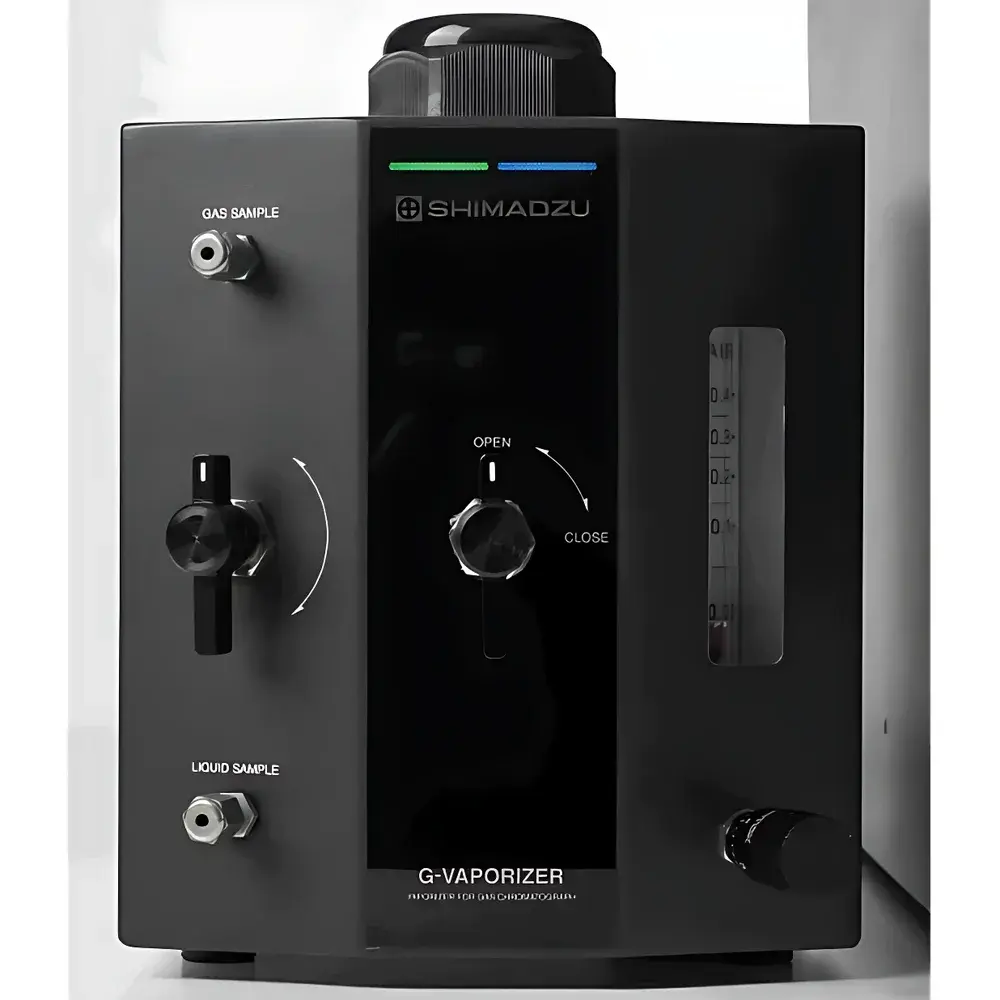
Shimadzu G-VAPORIZER Flash Vaporizer for Gas Chromatography Systems
| Brand | Shimadzu |
|---|---|
| Origin | Jiangsu, China |
| Manufacturer Type | Original Equipment Manufacturer (OEM) |
| Product Category | Domestic Instrument |
| Model | G-VAPORIZER |
| Price Range | USD 3,900 – 5,600 (FOB) |
| Instrument Type | Laboratory Gas Chromatograph Accessory |
| Application Field | Petrochemical & Coal Chemical Industries |
| Maximum Operating Temperature | 230 °C |
| Maximum Sample Inlet Pressure | 9 MPa (1305 psi) |
| Heating Zone | Heated Transfer Line with Active Temperature Control |
| Inlet Configuration | Dual-Mode (Gas/Liquid) with Solenoid Valve Integration |
| Communication Interface | GC-System Synchronization via Digital I/O or RS-232 |
| Surface Treatment | Passivated Stainless Steel Tubing |
| Filtration | Integrated Particulate Filter (5 µm) |
Overview
The Shimadzu G-VAPORIZER is a purpose-engineered flash vaporizer designed as a dedicated front-end sample introduction module for gas chromatography (GC) systems. It operates on the principle of rapid, pressure-controlled phase transition—converting pressurized liquid samples into homogeneous vapor streams immediately prior to GC column injection. Unlike conventional split/splitless injectors, the G-VAPORIZER maintains sample integrity under elevated backpressure (up to 9 MPa), enabling quantitative transfer of thermally labile or high-boiling compounds without premature condensation or fractionation. Its integration into Shimadzu GC platforms—including the GC-2010 Pro, GC-2030, and Nexis GC-2030—is achieved via native digital handshake protocols, ensuring synchronized temperature ramping, valve actuation, and event logging within the GC control environment. The device is engineered for routine use in regulated petrochemical and coal chemical laboratories where reproducible vaporization of crude oil fractions, hydroprocessed feedstocks, and liquefied petroleum gases (LPG) is critical to method robustness.
Key Features
- High-pressure vaporization capability: Rated for continuous operation up to 9 MPa inlet pressure, supporting direct analysis of pressurized liquid samples from sampling cylinders or process lines.
- Dual-mode inlet architecture: Configurable for either gaseous or liquid sample introduction; includes factory-calibrated solenoid valves with TTL/RS-232 interface for precise timing control relative to GC oven and detector events.
- Active heated transfer line: Fully insulated, temperature-regulated capillary path (0–230 °C, ±0.5 °C stability) minimizes cold spots and suppresses post-vaporization recondensation—critical for C10–C40 hydrocarbon analysis.
- Visual flow monitoring: Integrated borosilicate glass rotameter enables real-time observation of vapor-phase mass flow rate, facilitating method development and troubleshooting without interrupting system operation.
- Inert fluidic pathway: All wetted surfaces feature electropolished, silanized stainless steel construction; optional deactivated fused silica liners available for ultra-trace sulfur or nitrogen compound analysis.
- Modular mechanical design: Compact footprint (240 × 180 × 120 mm) allows benchtop integration adjacent to GC inlet modules; tool-free access to filter cartridge and valve manifold simplifies preventive maintenance.
Sample Compatibility & Compliance
The G-VAPORIZER accommodates a broad range of sample matrices including light naphthas, diesel-range distillates, Fischer–Tropsch liquids, and liquefied natural gas (LNG) condensates. It complies with ASTM D7096 (determination of hydrocarbon types in middle distillates by GC), ISO 6247 (petroleum products—determination of total sulfur content), and relevant sections of USP for residual solvent quantification in pharmaceutical intermediates. When deployed in GLP-compliant environments, its firmware supports audit-trail-enabled parameter logging (per FDA 21 CFR Part 11 requirements) when operated through Shimadzu LabSolutions GC software with appropriate user authentication and electronic signature configuration.
Software & Data Management
Native interoperability is achieved through Shimadzu LabSolutions GC software (v5.93 or later). The G-VAPORIZER appears as a configurable hardware module within the instrument method editor—allowing independent setpoints for vaporizer zone temperature, valve open/close delay times, and pressure hold duration. All operational parameters are timestamped and embedded in raw data files (.gcd format); changes to settings generate immutable log entries viewable in the “Instrument Event History” panel. Optional integration with LIMS via ASTM E1384-compliant data export ensures traceability across analytical workflows.
Applications
- Quantitative speciation of C3–C12 hydrocarbons in refinery off-gas streams using PLOT column GC.
- Analysis of oxygenates (e.g., MTBE, ethanol) in gasoline blends under pressurized injection conditions to prevent volatility-related bias.
- Trace-level detection of mercaptans and sulfides in liquefied petroleum gas (LPG) per GPA 2286 methodology.
- Direct injection of coal-derived synthetic crude oils without pre-distillation, preserving heavy end distribution profiles.
- Method transfer support for ASTM D5134 (aromatics in reformulated gasoline) where consistent vapor-phase composition is essential for reproducible retention indexing.
FAQ
Can the G-VAPORIZER be used with non-Shimadzu GC systems?
Yes—provided the host GC offers programmable digital I/O or RS-232 command capability, custom driver integration is supported via Shimadzu’s Hardware Integration Kit (HIK) documentation.
Is calibration required before first use?
No factory calibration is needed; however, users must perform temperature verification using a NIST-traceable probe at three points (50 °C, 150 °C, 230 °C) and document results per ISO/IEC 17025 Section 6.4.3.
What maintenance intervals are recommended?
Filter replacement every 200 injections or quarterly (whichever occurs first); full inert surface inspection and leak testing annually or after exposure to corrosive sulfur compounds.
Does it support unattended operation in sequence mode?
Yes—when configured with LabSolutions Sequence Mode and validated valve timing, up to 99 samples can be processed automatically with integrated pressure decay monitoring for fault detection.
How is pressure safety managed during operation?
A redundant mechanical pressure relief valve (set at 10 MPa) and electronic overpressure cutoff (9.5 MPa threshold) are integrated; both trigger immediate valve closure and GC pause signal transmission.







