
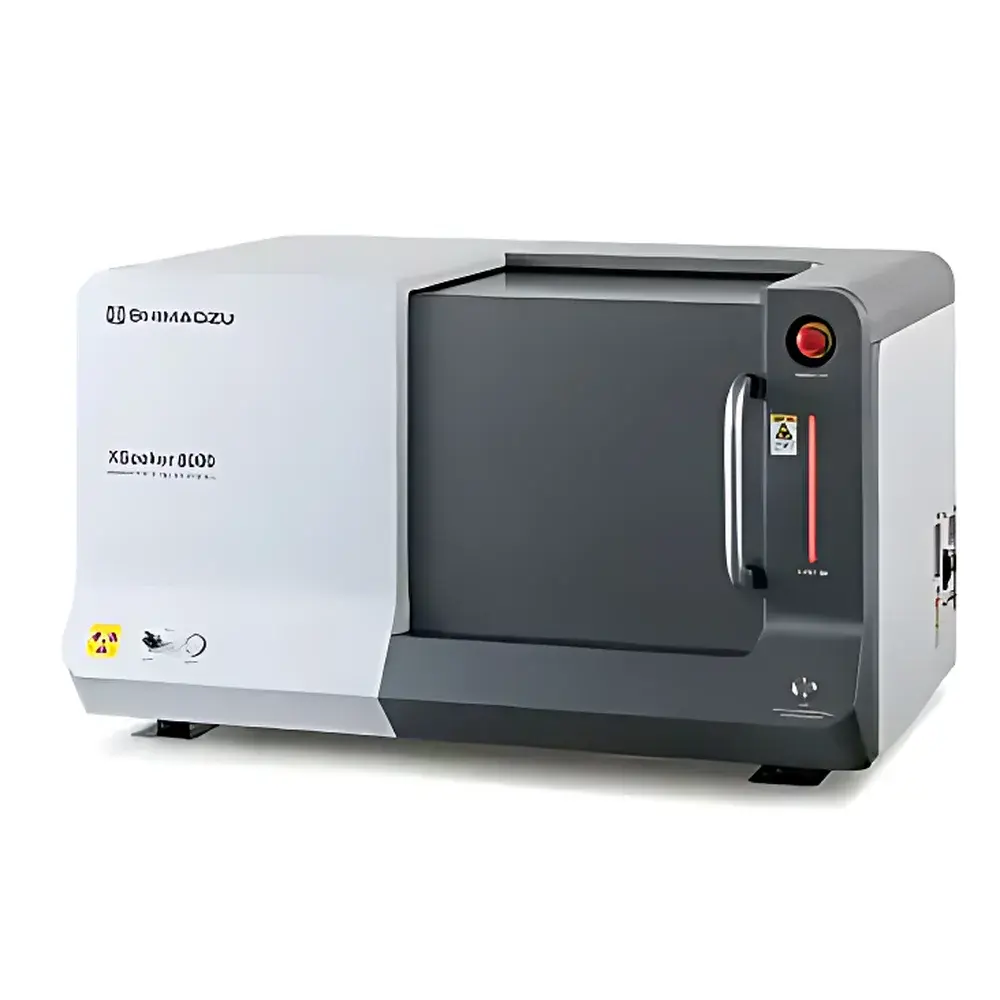
Shimadzu XSeeker 8000 Benchtop X-ray Computed Tomography System
| Brand | Shimadzu |
|---|---|
| Origin | Japan |
| Manufacturer Type | Original Equipment Manufacturer (OEM) |
| Origin Category | Imported |
| Model | XSeeker 8000 |
| Detector Type | Flat-Panel Detector |
| Scan Mode | Rotation-Only (RO) |
| Spatial Resolution | Micron-Level |
| Maximum Penetration | 100 mm Al-equivalent |
| Maximum Sample Dimensions | Ø300 mm × H320 mm |
| Maximum Sample Weight | 10 kg |
| System Footprint (Main Unit) | 893 mm (W) × 640 mm (D) × 526 mm (H) |
Overview
The Shimadzu XSeeker 8000 is a high-performance benchtop X-ray computed tomography (CT) system engineered for non-destructive, three-dimensional internal and external structural analysis of industrial components. Utilizing cone-beam geometry and flat-panel detector architecture, it implements filtered back-projection and iterative reconstruction algorithms to generate volumetric datasets with micron-level spatial resolution. Designed specifically for quality control laboratories, R&D centers, and failure analysis facilities, the XSeeker 8000 delivers quantitative metrology-grade imaging without requiring dedicated shielded rooms—its integrated radiation containment meets international safety standards for low-dose operation in standard laboratory environments.
Key Features
- Compact benchtop footprint with integrated radiation shielding: external leakage rate <1 µSv/h, compliant with IEC 61331-1 and national regulatory requirements for Class II X-ray equipment.
- Rotation-only (RO) scanning geometry ensures mechanical stability and repeatability; eliminates complex translational motion, reducing calibration drift and maintenance overhead.
- High-throughput acquisition: full-volume CT scan completed in as little as 12 seconds; reconstructed cross-sectional images displayed within 30 seconds via optimized GPU-accelerated reconstruction engine.
- Automated pre-scan self-calibration sequence initiated at system power-up—no manual alignment or reference calibration required prior to routine operation.
- Intuitive human-machine interface: one-touch CT start button initiates fully automated workflow including beam conditioning, exposure optimization, rotation control, and reconstruction.
- Integrated navigation illumination system projects concentric ring patterns onto the sample stage, enabling rapid visual estimation of field-of-view boundaries and optimal positioning without trial scans.
- Real-time status dashboard displays operational parameters—including tube voltage/current, detector temperature, gantry position, and radiation interlock status—for immediate fault diagnosis and procedural verification.
Sample Compatibility & Compliance
The XSeeker 8000 accommodates samples up to Ø300 mm × H320 mm and 10 kg mass, supporting diverse industrial materials including aluminum die-castings, polymer composites, sintered metals, ceramic substrates, and additive-manufactured parts. Its 100 mm aluminum-equivalent penetration capability enables inspection of medium-density castings and assembled subcomponents. The system conforms to ISO 15739:2013 (imaging performance evaluation), ASTM E2737-21 (standard practice for micro-CT data acquisition), and supports audit-ready documentation for GLP/GMP environments. Radiation safety protocols align with IEC 62495 and local regulatory frameworks governing occupational exposure limits.
Software & Data Management
Shimadzu’s proprietary CT software suite provides native support for multiplanar reconstruction (MPR), volume rendering (VR), and maximum intensity projection (MIP). All visualization parameters—including window/level, slice thickness, and rendering opacity—are saved per-project and automatically recalled during subsequent scans of geometrically similar specimens. Raw projection data is stored in DICOM-compliant format; reconstructed volumes export to standard formats (e.g., NRRD, TIFF stack, STL) for integration with third-party metrology tools (e.g., VGStudio MAX, Thermo Scientific Avizo). Audit trail functionality records user actions, parameter changes, and reconstruction settings—supporting FDA 21 CFR Part 11 compliance when configured with electronic signature modules.
Applications
- Porosity and inclusion analysis in aluminum and magnesium die-cast components per ASTM E1559 and ISO 10042.
- Dimensional metrology of internal features (e.g., wall thickness, channel geometry, undercuts) without sectioning—traceable to NIST-traceable phantoms.
- Assembly verification: detection of missing fasteners, misaligned inserts, or solder joint voids in electronic enclosures and automotive modules.
- Reverse engineering of legacy parts where CAD data is unavailable; STL exports feed directly into design validation workflows.
- Time-resolved in situ studies (with optional motorized stage) for thermal expansion, deformation, or fluid infiltration monitoring.
FAQ
Does the XSeeker 8000 require periodic manual recalibration?
No. The system performs an automated calibration sequence—including detector gain correction, beam hardening compensation, and geometric alignment verification—at every power-on cycle.
Can the system be integrated into an existing LIMS or MES environment?
Yes. Through configurable API endpoints and HL7/DICOM-SR export options, metadata and measurement reports can be routed to enterprise systems for traceability and statistical process control.
Is operator training required for routine scanning?
Basic operation requires less than two hours of supervised instruction; advanced metrology and defect classification workflows are supported by Shimadzu-certified application engineers.
What safety certifications does the system hold?
It carries CE marking per EU Directive 2013/59/Euratom, complies with Japanese Ordinance No. 139 on Radiation Hazard Prevention, and satisfies ANSI N43.3-2020 for cabinet X-ray systems.
How is image quality validated over time?
A traceable QC phantom (Shimadzu PQC-CT1) is included for daily performance verification, assessing spatial resolution, contrast-to-noise ratio (CNR), and uniformity per ISO/IEC 17025-accredited procedures.



