
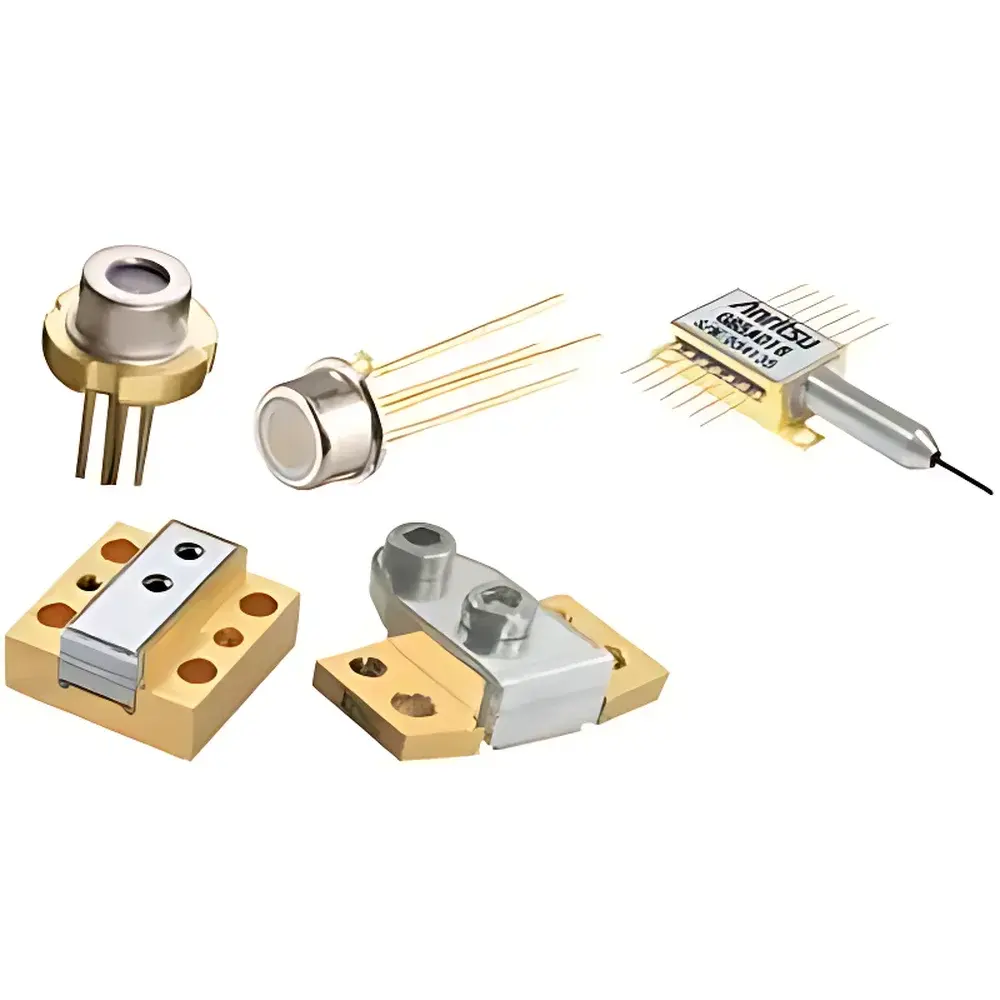
Shinano Optics S1/S3 Series Fiber-Coupled Low-Power Semiconductor Laser Modules
| [Origin | USA |
|---|---|
| Manufacturer Type | Authorized Distributor |
| Origin Category | Imported |
| Model | S1FC635, S1FC675, S1FC780, S1FC1310, S1FC1550, S3FC1310, S3FC1550, LPS-FC/LPM-SMA Series |
| Output Power Range | 1.5–22.5 mW |
| Wavelength Options | 635–1550 nm |
| Fiber Types | SM600, SM800-5.6-125, SMF-28 |
| Connector Types | FC/PC, SMA |
| Integrated Electronics | Constant-Current Driver (S1), Thermo-Electric Cooler (TEC) + Driver (S3), DFB Laser Diode Option (LPS-1550DFB-FC)] |
Overview
The Shinano Optics S1 and S3 Series fiber-coupled low-power semiconductor laser modules are engineered for precision optical alignment, interferometric sensing, spectroscopic excitation, and OEM integration in laboratory and industrial instrumentation. These modules operate on the principle of edge-emitting diode lasing, with light efficiently coupled into single-mode or multimode optical fibers via optimized lensed-fiber or pigtailed configurations. Unlike free-space diode lasers, the integrated fiber delivery ensures spatial mode stability, reduced sensitivity to mechanical perturbation, and compatibility with standard fiber-optic infrastructure—including patch panels, circulators, and wavelength division multiplexers. Each module is factory-aligned and characterized for spectral purity, pointing stability (< ±1 µrad/°C), and power repeatability (±0.5% over 8 hours at constant temperature). The S1 series provides compact current-regulated operation; the S3 series adds thermoelectric temperature control (±0.05 °C setpoint accuracy) for narrow-linewidth DFB variants—critical for applications demanding wavelength stability below 1 pm over 24 h.
Key Features
- Fiber-coupled architecture with guaranteed coupling efficiency ≥65% into SMF-28 (1310/1550 nm) and ≥70% into SM600 (635–780 nm)
- Integrated constant-current drivers (S1) or dual-stage driver+TEC controllers (S3), eliminating external benchtop electronics
- Low relative intensity noise (RIN) < −140 dB/Hz (10 kHz–10 MHz) across all visible and NIR models
- Hermetically sealed TO-56 or 14-pin butterfly packages with industry-standard thermal management interfaces
- Compliance with IEC 60825-1:2014 Class 3R laser safety requirements (accessible emission limit ≤5 mW for visible wavelengths)
- Optional DFB laser configuration (LPS-1550DFB-FC) delivering linewidth 50 dB
Sample Compatibility & Compliance
These laser modules are compatible with standard silica-based single-mode (SMF-28, SM600, SM800) and multimode (62.5/125 µm) fibers. All FC/PC and SMA connectors meet IEC 61754-1 and IEC 61754-4 dimensional specifications. Optical output is polarization-maintaining only upon request (custom PM-fiber pigtails available under part number suffix “-PM”). The modules conform to RoHS 2015/863/EU and REACH SVHC regulations. For regulated environments—including clinical diagnostics, pharmaceutical process monitoring, and aerospace test benches—the S3 series supports optional firmware logging of operational parameters (current, TEC voltage, case temperature) traceable to NIST-traceable calibration records. While not certified for FDA 21 CFR Part 11 out-of-the-box, audit-ready data export (CSV/JSON) and user-accessible firmware update logs enable straightforward validation per GLP/GMP Annex 11 requirements.
Software & Data Management
No proprietary GUI is bundled; instead, Shinano Optics provides open ASCII command protocols (RS-232 and USB-VCP) for integration into LabVIEW, Python (PySerial), MATLAB, or custom SCADA systems. Commands support real-time readback of monitored parameters (output power via integrated photodiode, junction temperature, driver status flags) and programmable setpoints (current, TEC setpoint). Firmware version 2.3+ includes configurable watchdog timers and automatic fault shutdown (e.g., overtemperature, open-circuit fiber detection). Configuration files are stored in non-volatile EEPROM and survive power cycling. Optional OEM SDK includes C/C++ header files, .NET wrappers, and documented API call sequences—enabling full remote orchestration within automated test platforms compliant with IEEE 1622-2019 (automated instrumentation standards).
Applications
- Optical coherence tomography (OCT) reference arms requiring stable, low-coherence broadband sources (S1FC1310/S1FC1550)
- Fiber Bragg grating (FBG) interrogation systems where wavelength drift < 0.1 pm/°C is mandatory (S3FC1550 with DFB)
- Confocal fluorescence microscopy excitation (635 nm, 785 nm) with minimal thermal load on live specimens
- Atomic physics setups (e.g., Rb/D2 line pumping at 780 nm) requiring frequency stabilization via external cavity feedback
- Calibration of photodetectors, spectrometers, and optical power meters per ISO/IEC 17025-accredited procedures
- OEM integration into portable gas analyzers (TDLAS) using 1310/1550 nm absorption lines of CH₄, CO₂, and H₂O
FAQ
Are these lasers suitable for continuous-wave (CW) spectroscopy applications?
Yes—each model is rated for indefinite CW operation at specified output power when mounted on a heatsink with thermal resistance ≤2 K/W. Derating curves and maximum case temperature limits are provided in the technical datasheet.
Can I replace the FC/PC connector with an FC/APC or SC connector?
Custom connector options (FC/APC, SC/PC, LC/PC) are available as build-to-order variants with no change to optical performance or lead time; contact engineering support for mechanical drawings and torque specifications.
Do you provide spectral characterization reports for individual units?
Yes—every shipped module includes a factory test report listing measured center wavelength (±0.5 nm), spectral width (FWHM), SMSR (for DFB models), and power stability over 12 h (±0.3% RMS).
Is analog modulation supported?
All S1 and S3 modules feature a 0–5 V analog modulation input (bandwidth DC–100 kHz) referenced to the internal current setpoint, enabling direct TTL-compatible or arbitrary waveform-driven intensity control.
What is the expected lifetime under nominal operating conditions?
MTTF exceeds 50,000 hours at 25 °C case temperature, per Telcordia GR-468-CORE reliability testing protocols (including accelerated life testing at 85 °C/85% RH).





