
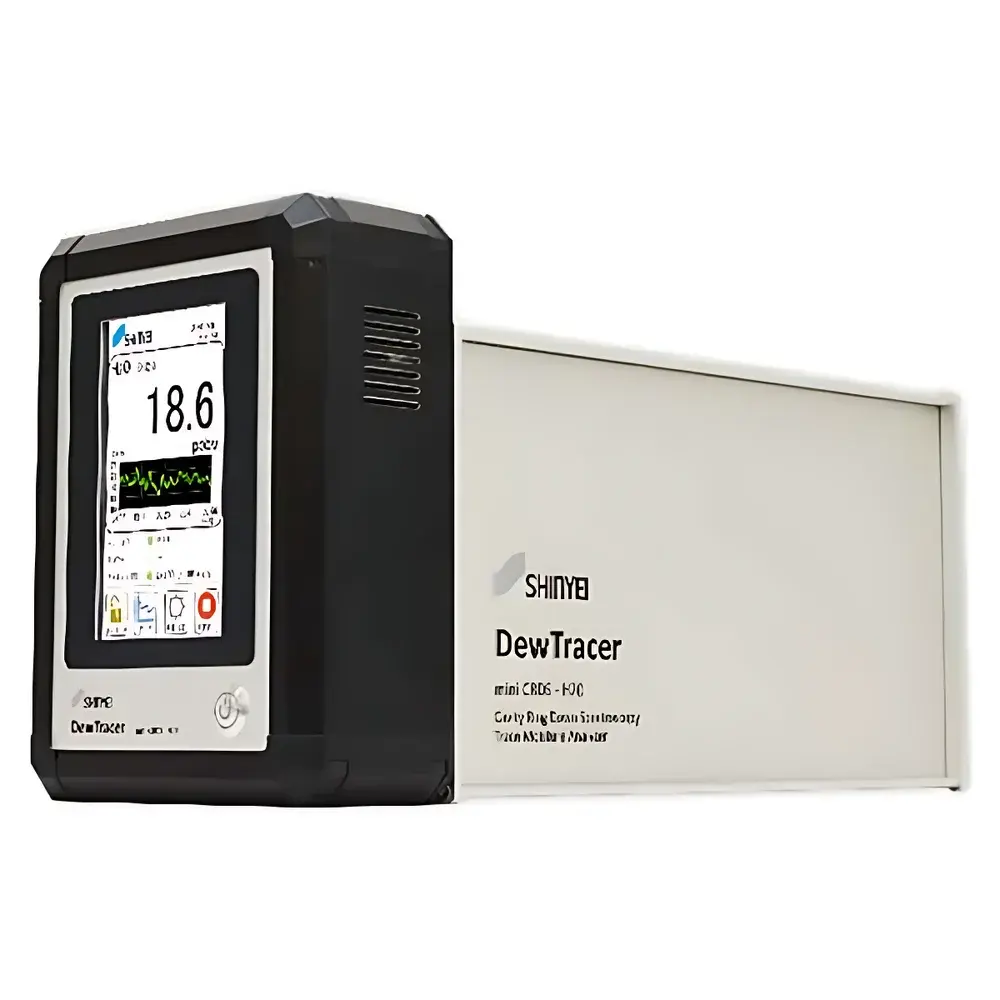
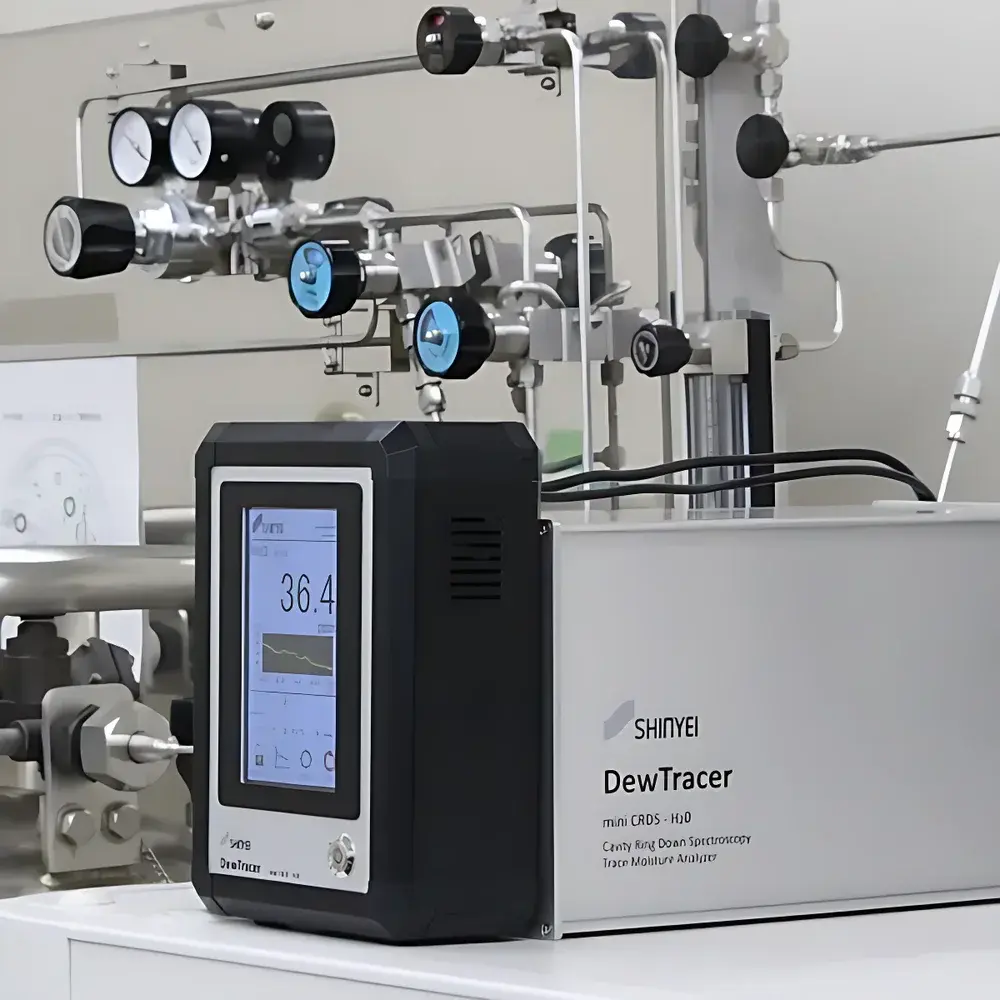
ShinYEI mini CRDS-H2O Cavity Ring-Down Spectroscopy (CRDS) Trace Moisture Analyzer
| Brand | ShinYEI |
|---|---|
| Origin | Japan |
| Model | mini CRDS-H2O |
| Measurement Principle | Cavity Ring-Down Spectroscopy (CRDS) |
| Range | 12 ppbv to 20 ppmv (equivalent to -100 °C to +55 °C dew point) |
| Accuracy | ±4% of reading or 12 ppbv LOD |
| Response Time | ~60 s (90% from 50 to 1000 ppbv) |
| Operating Temperature | 10 °C to 40 °C |
| Sample Gas Flow Rate | <2 L/min |
| Sample Gas Temperature | 5 °C to 60 °C |
| Sample Gas Pressure | 86–106 kPaA |
| Gas Compatibility | Air, N₂, O₂, Ar, CO₂ |
| Interface | RS-232C, analog output (optional) |
| Power Supply | AC adapter (100–240 VAC, 50/60 Hz, max 1.4 A) |
| Enclosure Rating | IP67 |
| Dimensions (Sensor Unit) | 150 × 300 × 165 mm |
| Dimensions (Display/Control Unit) | 150 × 80 × 200 mm |
| Weight (Sensor Unit) | ~5 kg |
| Weight (Display/Control Unit) | ~1.7 kg |
Overview
The ShinYEI mini CRDS-H2O is a compact, high-precision trace moisture analyzer engineered for laboratory and industrial process environments requiring absolute, calibration-free quantification of water vapor at sub-part-per-trillion levels. Unlike conventional hygrometers relying on empirical sensor responses—such as capacitive, aluminum oxide, or chilled-mirror technologies—the mini CRDS-H2O implements cavity ring-down spectroscopy (CRDS), a first-principles optical absorption technique rooted in quantum mechanics and fundamental constants. In CRDS, a near-infrared laser (typically centered at 1.39 µm, where H₂O exhibits strong rotational-vibrational absorption) is coupled into an optical cavity formed by two ultra-high-reflectivity mirrors (>99.995%). The decay time (τ) of light intensity within the cavity—defined as the time required for intracavity power to fall to 1/e of its initial value—is measured with picosecond resolution. Because τ is inversely proportional to total cavity loss, and molecular absorption contributes directly to that loss, water concentration is derived from τ via Beer-Lambert law without reliance on reference standards or factory calibration curves. This absolute measurement architecture ensures long-term stability, eliminates drift-induced recalibration cycles, and supports compliance with ISO/IEC 17025 traceability requirements.
Key Features
- True absolute measurement: No calibration curve dependency—quantitative results derived directly from physical constants and measured ring-down time.
- Ultra-low detection limit: 12 ppbv (parts per trillion by volume) with ±4% accuracy across full range (12 ppbv–20 ppmv), corresponding to dew points from –100 °C to +55 °C.
- Modular architecture: Physically separated sensor head and display/control unit enable flexible installation—benchtop, wall-mounted, or integrated into gas cabinets or gloveboxes.
- Robust optical design: IP67-rated sensor housing resists corrosion, particulate ingress, and condensation in demanding cleanroom and manufacturing settings.
- Fast dynamic response: <60-second 90% step response between 50 and 1000 ppbv—critical for real-time monitoring of purge gas purity during semiconductor wafer handling or battery electrolyte filling.
- Gas-flexible operation: Validated for use with air, N₂, O₂, Ar, and CO₂; compatibility with specialty gases (e.g., SF₆, NH₃, H₂) available upon consultation and optional spectral interference assessment.
Sample Compatibility & Compliance
The mini CRDS-H2O operates under defined sample conditions: flow rate ≤2 L/min, pressure 86–106 kPaA (absolute), and temperature 5–60 °C. Its non-contact optical path avoids catalytic degradation, surface adsorption, or memory effects common in metal-oxide sensors. The system meets IEC 61326-1 for electromagnetic compatibility in laboratory environments and conforms to JIS B 7952 (Japanese Industrial Standard for moisture analyzers). While not inherently 21 CFR Part 11 compliant, the instrument supports audit-ready data logging when paired with validated third-party software platforms implementing electronic signature, user access control, and immutable record retention—enabling alignment with GLP and GMP workflows in pharmaceutical excipient drying validation or medical gas certification.
Software & Data Management
Data acquisition is managed via RS-232C serial interface, supporting ASCII-based command-response protocol for integration into SCADA, MES, or LabVIEW-controlled test benches. Optional analog outputs (0–5 V or 4–20 mA) provide direct interfacing with PLCs or chart recorders. ShinYEI provides a Windows-compatible configuration utility for setting units (ppbv/ppmv/dew point), alarm thresholds, averaging intervals, and gas-specific correction factors. Raw ring-down time traces and processed moisture values are timestamped and exportable as CSV for post-acquisition analysis. When deployed in regulated environments, users may implement external data integrity frameworks—such as those certified to ASTM E2500-13—for metadata tagging, version-controlled method storage, and electronic audit trail generation.
Applications
- Semiconductor fabrication: Monitoring ultra-high-purity carrier gases (N₂, Ar) and tool purge lines where moisture >50 ppbv induces gate oxide defects.
- Advanced battery R&D: Quantifying residual H₂O in dry rooms (<1 ppmv target), electrolyte solvents, and solid-state electrolyte synthesis atmospheres.
- Medical device manufacturing: Verifying moisture content in sterilization-grade compressed air and nitrogen used in packaging and assembly.
- Optical fiber preform drying: Real-time control of furnace purge gas to prevent OH⁻ impurity incorporation.
- Calibration lab traceability: Serving as a primary reference standard for transferring moisture metrology to secondary instruments via gravimetric or electrolytic comparators.
FAQ
Is the mini CRDS-H2O suitable for continuous unattended operation?
Yes—its solid-state laser diode, passive cavity design, and thermal-stabilized optics support 24/7 deployment with mean time between failures (MTBF) exceeding 15,000 hours under specified environmental conditions.
Does it require periodic zero/span calibration?
No. As an absolute measurement technique, CRDS does not require span calibration. Zero verification using certified dry gas (e.g., <1 ppbv H₂O in N₂) is recommended annually for quality assurance, but not for accuracy maintenance.
Can it measure moisture in corrosive gases such as HCl or Cl₂?
Not out-of-the-box. Standard wetted materials (stainless steel 316L, PTFE seals) are incompatible with strongly oxidizing or acidic species. Custom inertized gas paths (e.g., electropolished Hastelloy, fused silica tubing) are available upon engineering review.
How is traceability to SI units established?
The CRDS measurement equation incorporates fundamental constants (speed of light, Avogadro’s number) and mirror reflectivity values traceable to NMIJ (National Metrology Institute of Japan) through calibrated spectrophotometry—enabling direct linkage to the International System of Units without intermediate reference standards.
What maintenance is required beyond routine gas filtration?
None beyond replacing inlet particulate filters (recommended every 6 months in non-cleanroom environments) and verifying optical window cleanliness. No consumables, no reagents, and no sensor replacement schedule apply.





