
ShiPing DJS-2012R Plus Stackable Incubated Orbital Shaker
| Brand | ShiPing |
|---|---|
| Origin | Shanghai, China |
| Manufacturer Type | Direct Manufacturer |
| Instrument Type | Stackable Incubated Shaker |
| Model | DJS-2012R Plus |
| Oscillation Frequency Range | 30–300 rpm |
| Orbital Amplitude | Φ25 mm |
| Temperature Range | 4°C to 60°C (ambient as low as −18°C) |
| Number of Shaking Platforms | 1 |
| Internal Chamber Volume | ≥180 L |
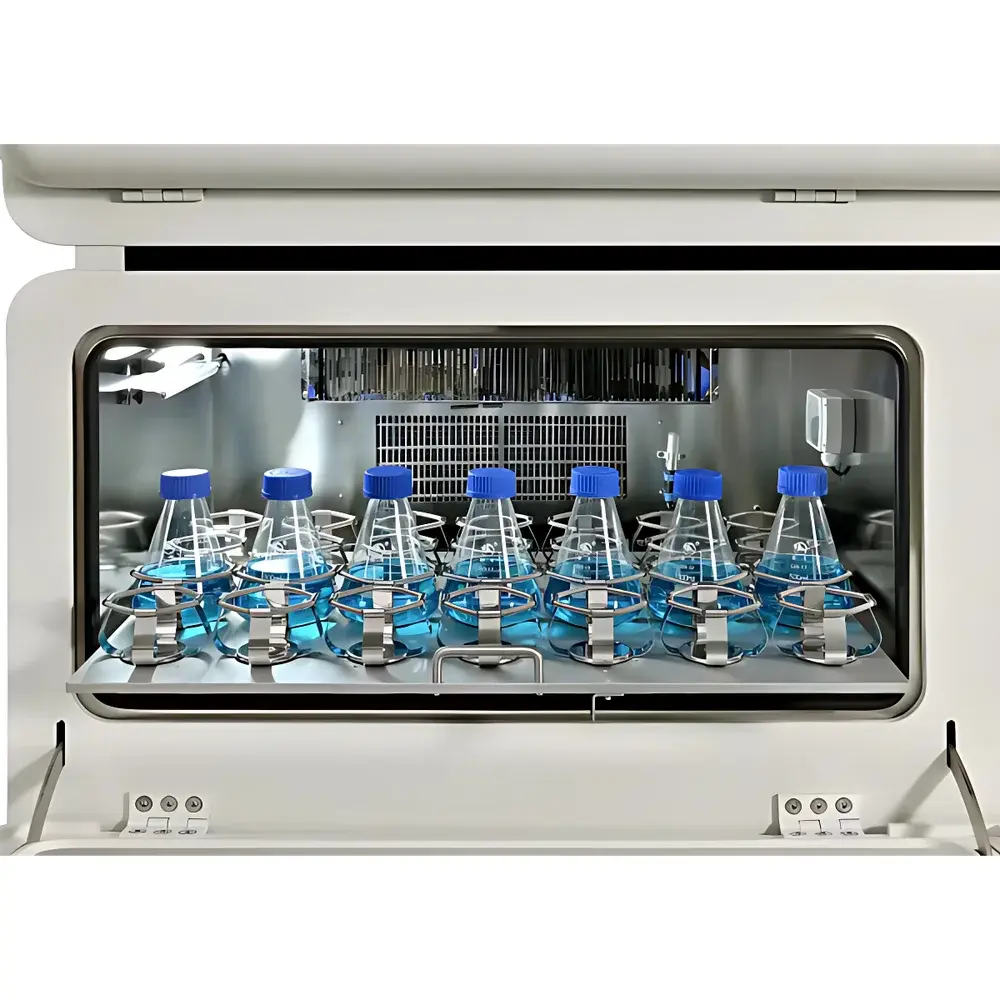
| Max Capacity | ≥2000 mL × 12, or 1000 mL × 15, or 500 mL × 28, or 250 mL × 40 |
| Display | ≥7-inch true-color touchscreen (English/Chinese switchable) |
| Noise Level | ≤45 dB(A) |
| Power Supply | 220 V ±10%, 50/60 Hz |
| Net Weight | ~320 kg |
| Certifications | ISO 9001, CE |
Overview
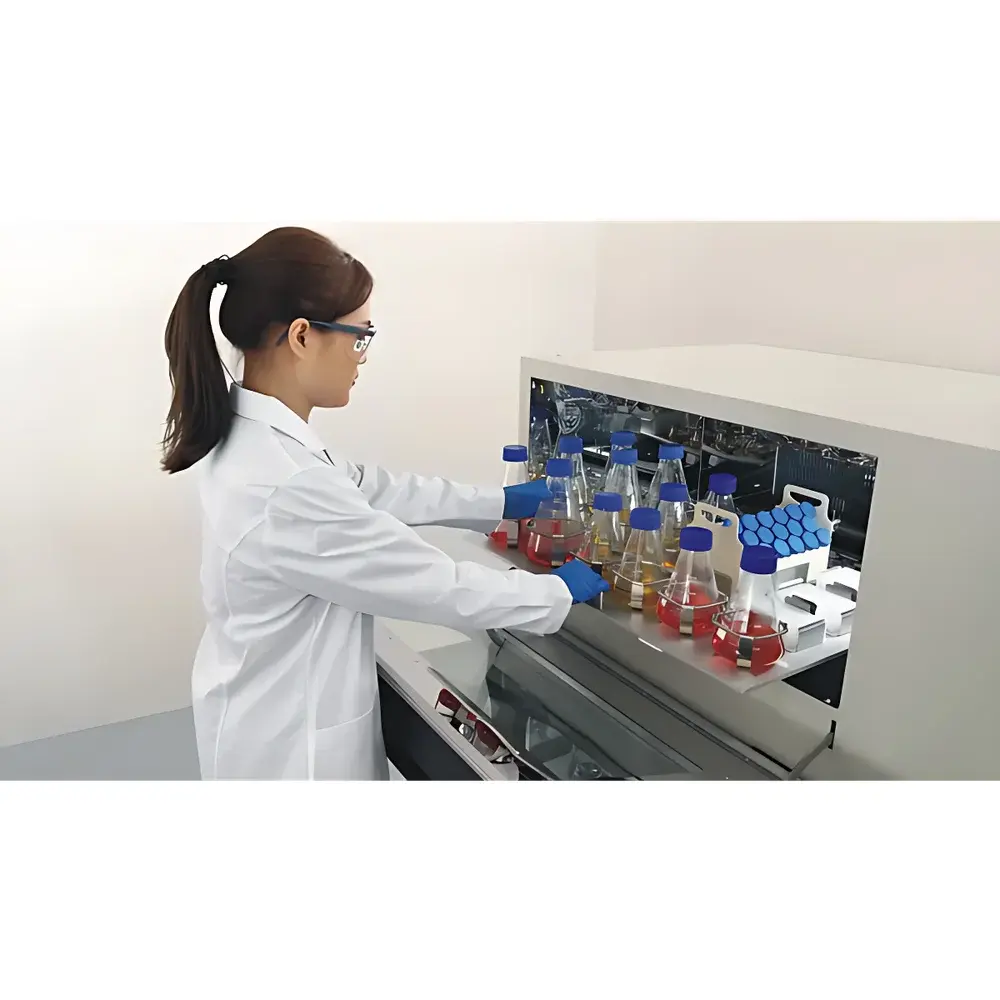
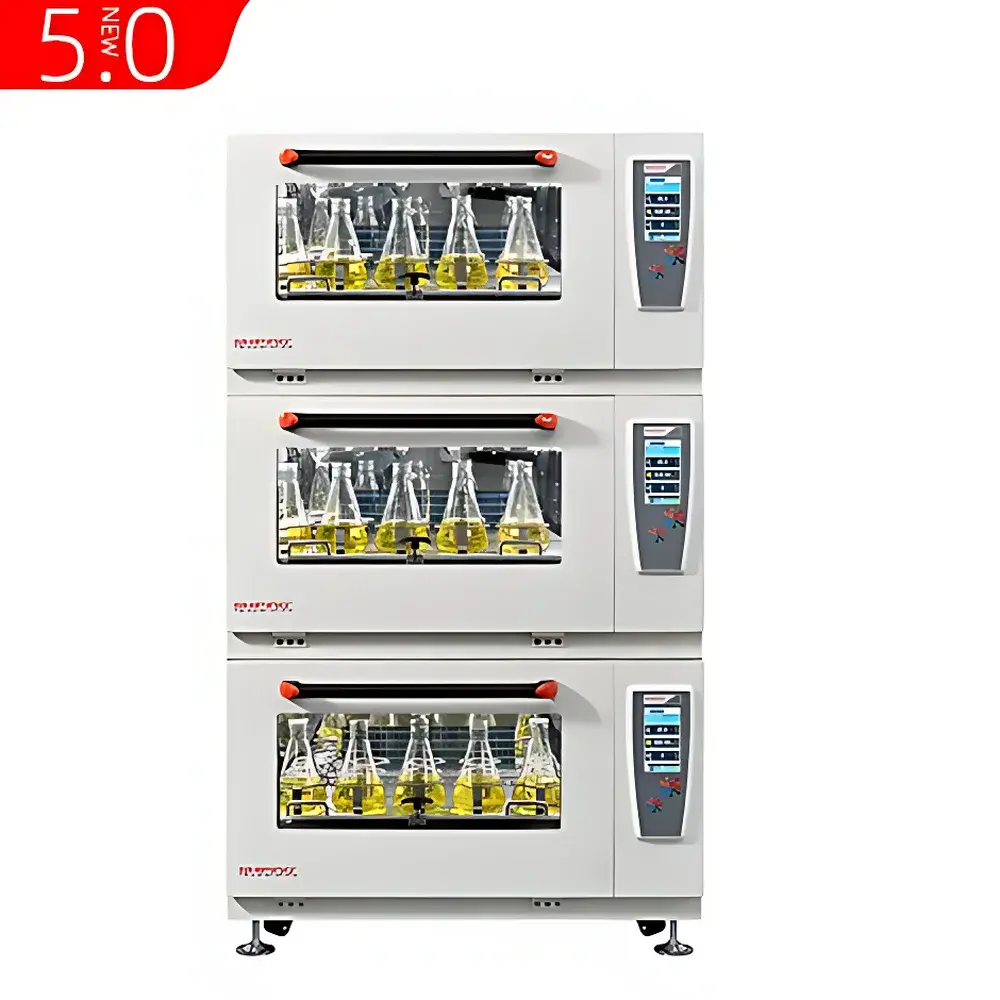
The ShiPing DJS-2012R Plus Stackable Incubated Orbital Shaker is an engineered platform for precise, long-duration cultivation and agitation under controlled thermal conditions. It operates on the principle of orbital shaking—generating uniform circular motion with a fixed 25 mm diameter trajectory—to ensure consistent suspension, oxygenation, and mass transfer in liquid cultures. Integrated with high-efficiency variable-frequency refrigeration and PID-based microprocessor temperature control, the unit maintains stable incubation across its full operating range (4°C to 60°C), even in ambient environments as cold as −18°C. Designed for scalability, the system supports up to three units stacked vertically—minimizing lab floor footprint while maintaining independent operational integrity per layer. Its structural architecture prioritizes mechanical longevity, low acoustic emission (<45 dB[A]), and GMP-aligned hygiene standards—making it suitable for regulated R&D, QC, and production-scale life science workflows.
Key Features
- Single-axis, five-dimensional dynamic balance drive mechanism—eliminates multi-axis mechanical wear, ensures zero positional drift, and delivers energy-efficient operation over extended duty cycles.
- Variable-frequency refrigeration system using R134a eco-friendly refrigerant; achieves frost-free evaporator operation, >30% energy reduction versus fixed-frequency compressors, and superior thermal stability (±0.5°C uniformity at 37°C).
- 304 stainless steel mirror-finish interior chamber with seamless arc-corner construction—fully autoclavable, non-porous, and compliant with ISO 14644 cleanroom-compatible surface requirements.
- Imported double-row precision bearings rated for ≥100,000 hours of continuous operation under full load; certified origin documentation available upon request.
- Servo motor control enables ±1 rpm speed accuracy across the full 0–300 rpm range—critical for reproducible kinetic studies and sensitive cell line maintenance.
- 7-inch resistive-capacitive touchscreen with role-based access control (three-tier permission levels), audit-trail-enabled operation logs, and USB data export—aligned with FDA 21 CFR Part 11 and EU Annex 11 data integrity expectations.
- Dual lighting system: white LED illumination for real-time culture observation and UV-C germicidal lamp (254 nm) for chamber decontamination between runs.
Sample Compatibility & Compliance
The DJS-2012R Plus accommodates diverse vessel formats—including Erlenmeyer flasks (250–2000 mL), test tubes, microtiter plates, and custom fixtures—via interchangeable 304 stainless steel clamping plates, spring platforms, and enzyme-linked immunosorbent assay (ELISA) plate holders. Its internal dimensions (850 × 565 × 395 mm) and standard platform size (780 × 500 mm) support high-density loading configurations without compromising airflow or thermal homogeneity. The unit conforms to ISO 9001:2015 quality management standards and carries CE marking per Directive 2014/30/EU (EMC) and 2014/35/EU (LVD). All electrical and refrigeration components meet IEC 61000-6-3 emissions limits and IEC 61000-4-2/4/5 immunity specifications. Structural materials comply with USP extractables profiling guidelines for pharmaceutical contact surfaces.
Software & Data Management
The embedded control firmware supports up to five independent temperature–time programs, each containing up to 100 programmable segments with ramp/soak profiles and timer-based start/stop triggers (max duration: 999 hours). Local data storage retains ≥800,000 timestamped records—covering setpoints, actual values, alarms, and user actions—for ≥5 years. All entries include digital signatures, timestamps, and operator IDs. USB 2.0 interface enables encrypted CSV export for LIMS integration or external validation reporting. Remote monitoring and bidirectional control are enabled via Ethernet or Wi-Fi through a secure TLS 1.2–encrypted web interface—accessible from desktop browsers or native iOS/Android applications. Optional 3Q (IQ/OQ/PQ) documentation packages support GxP-compliant installation and operational qualification.
Applications
This shaker serves core functions in microbial physiology (e.g., E. coli expression optimization), mammalian cell expansion (CHO, HEK293), enzymatic assay development, hybridization kinetics, and bioprocess parameter screening. Its low-noise, high-stability performance makes it appropriate for shared core facilities and GLP-regulated laboratories conducting ASTM E2500-13–based method validation. Common use cases include: recombinant protein fermentation under dissolved oxygen–limited conditions; antibody titer enhancement via pH-shift protocols; environmental microbiology enrichment cultures; and stability testing of biologics formulations per ICH Q5C guidelines. Optional add-ons—such as active humidification, programmable light/dark cycles, gas mixing (N₂/CO₂/O₂), and embedded thermal printers—extend utility into photobioreactor mimicry and cGMP traceability workflows.
FAQ
Does the DJS-2012R Plus support validation documentation for GMP environments?
Yes—comprehensive IQ/OQ/PQ templates, calibration certificates, and material traceability records are available upon order confirmation.
Can multiple stacked units operate independently with different setpoints?
Yes—each unit features autonomous control logic, isolated power circuits, and independent network addressing for synchronized yet decoupled operation.
Is the UV lamp intensity validated for microbial reduction efficacy?
The 254 nm UV-C source delivers ≥100 µW/cm² at 1 meter; log-reduction validation against Bacillus atrophaeus spores is provided in the optional sterilization report.
What is the maximum allowable load imbalance during operation?
The dynamic balance system tolerates ≤5% mass asymmetry across the platform without inducing vibration amplification or thermal deviation.
How is data integrity ensured during power interruption?
The controller retains all active parameters and runtime counters in non-volatile memory; “power-loss recovery” resumes scheduled programs automatically upon restoration.




