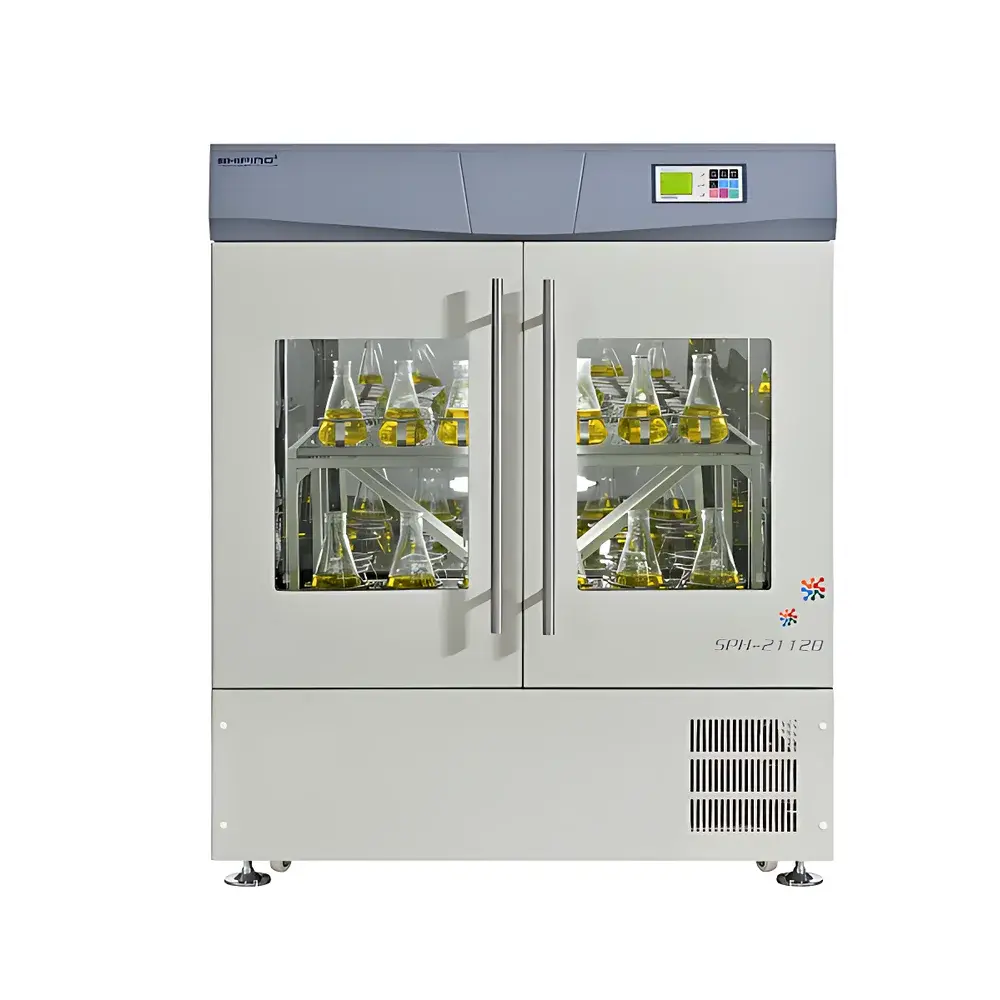
ShiPing SPH-2112B Vertical Dual-Door, Dual-Shelf High-Capacity Incubated Orbital Shaker
| Brand | ShiPing |
|---|---|
| Origin | Shanghai, China |
| Manufacturer Type | OEM Manufacturer |
| Product Category | Domestic (China-made) |
| Model | SPH-2112B |
| Price Range | USD 7,000–14,000 |
| Instrument Type | Incubated Orbital Shaker |
| Timer Range | 0–999.59 h |
| Oscillation Speed | 30–300 rpm |
| Orbit Diameter | 35 mm |
| Temperature Range | 4–60 °C |
| Shelf Quantity | 2 |
| Chamber Volume | 624 L |
| Internal Dimensions (W×D×H) | 1100 × 705 × 800 mm |
| Shelf Size | 928 × 530 mm |
| Max Load Capacity | 30 × 2000 mL or 36 × 1000 mL or 80 × 500 mL or 90 × 250 mL |
| Heating Power | 1100 W |
| Cooling Power | 334 W |
| Motor Power | 250 W |
| Total Power Consumption | 1885 W |
| Noise Level | <45 dB(A) |
| Temperature Uniformity | ±1 °C |
| Temperature Accuracy | ±0.1 °C |
| Ambient Operating Temp | 5–35 °C |
| Drive System | Single-Axis Parallel-Linkage Balanced Drive |
| Bearing Type | Imported Double-Row Precision Bearings |
| Compressor | Imported R134a Refrigeration Unit |
| Display | LCD with PID Microprocessor Control |
| Safety Features | Dual Over-Temp/Over-Speed Alarms, Independent Thermal Cut-Out, Leakage & Over-Current Protection, Sensor Fault Detection |
Overview
The ShiPing SPH-2112B is a vertically configured, dual-shelf incubated orbital shaker engineered for high-throughput, long-duration cell culture, microbial fermentation, enzyme kinetics, and hybridization applications under precisely controlled thermal and mechanical conditions. It operates on the principle of orbital shaking—generating uniform circular motion (35 mm diameter orbit) to suspend cells or reagents while maintaining homogeneous heat distribution across large-volume cultures. Its dual independent shelves support parallel experiments at identical or differential setpoints, enabling comparative studies in bioprocess development, QC microbiology, and molecular biology workflows. Designed for continuous operation in GLP-compliant laboratories, the unit integrates refrigeration, heating, and motion control within a rigid structural frame built for stability, low vibration transmission, and minimal acoustic emission (<45 dB(A)).
Key Features
- Robust dual-shelf architecture with 624 L total chamber volume and two independently accessible 928 × 530 mm stainless-steel shelves—each supporting up to 90 × 250 mL flasks or equivalent configurations.
- PID-controlled temperature regulation from 4 °C to 60 °C with ±0.1 °C setpoint accuracy and ±1 °C uniformity across the entire workspace—validated per ISO 17025 calibration traceability protocols.
- Single-axis parallel-linkage balanced drive mechanism eliminates mechanical backlash and bearing wear; delivers smooth, repeatable oscillation (30–300 rpm, ±1 rpm precision) without lubrication or periodic alignment.
- GMP-compliant interior constructed entirely from electropolished 304 stainless steel with seamless arc-cornered walls and removable shelf supports—designed for autoclave-compatible cleaning and residue-free decontamination.
- Dual-layer tempered safety glass door with argon-filled insulating gap ensures clear visual monitoring during sub-ambient operation (down to 4 °C) while minimizing thermal load and condensation.
- Integrated dual 8 W white-light LEDs for routine observation and dual 8 W UV-C lamps (254 nm) for chamber sterilization—programmable via timer or manual activation with interlocked safety cutoff.
- Triple-tier safety architecture: personnel protection (leakage current interruption, insulated chassis), sample integrity (independent over-temp cut-out, sensor redundancy), and system durability (compressor overload protection, motor thermal shutdown).
Sample Compatibility & Compliance
The SPH-2112B accommodates standard laboratory vessels—including Erlenmeyer flasks (up to 2000 mL), test tubes, microtiter plates (via optional plate clamps), and custom bioreactor bags—using interchangeable 304 stainless steel bottle clamps, spring-loaded platforms, or adhesive silicone mats. All wetted surfaces meet USP Class VI biocompatibility standards. The instrument complies with IEC 61010-1 (Safety Requirements for Electrical Equipment for Measurement, Control, and Laboratory Use) and IEC 61326-1 (EMC for Laboratory Instruments). Optional validation packages support IQ/OQ/PQ documentation aligned with FDA 21 CFR Part 11 and EU Annex 11 requirements, including audit-trail-enabled parameter logging and electronic signature capability.
Software & Data Management
Equipped with an embedded PID microprocessor controller featuring an intuitive LCD interface, the SPH-2112B supports eight-segment programmable ramp-and-hold temperature profiles, multi-step speed scheduling, and real-time parameter recall. All operational data—including setpoints, actual values, alarms, and runtime—are stored internally for ≥30 days and exportable via USB 2.0 to CSV-compatible formats. Optional firmware upgrades enable Ethernet connectivity for remote monitoring via SNMP or Modbus TCP, integration into LIMS environments, and scheduled automated reporting. Data encryption, user-level access control (admin/operator/guest), and factory-reset lockout ensure compliance with ISO/IEC 27001 information security frameworks.
Applications
This shaker serves critical roles in pharmaceutical upstream processing (E. coli and yeast expression systems), clinical microbiology (antibiotic susceptibility testing under aerobic/anaerobic gradients), food safety labs (pathogen enrichment per AOAC 990.12), environmental analysis (BOD incubation per ASTM D5210), and academic research (protein expression optimization, CRISPR library expansion, and organoid differentiation protocols). Its wide temperature range and dual-shelf design make it particularly suitable for side-by-side comparison of growth conditions, media formulations, or strain variants under identical environmental constraints.
FAQ
What is the maximum flask size supported per shelf?
Each shelf accommodates up to thirty 2000 mL Erlenmeyer flasks or equivalent volumetric loads—verified under full-speed (300 rpm), full-load, and 37 °C operating conditions.
Does the unit support validation for regulated environments?
Yes—optional qualification kits include pre-written IQ/OQ protocols, calibration certificates traceable to NIST standards, and 21 CFR Part 11–compliant audit trail generation.
Can the cooling system operate continuously at 4 °C in ambient temperatures above 30 °C?
The imported R134a compressor and optimized finned condenser maintain stable 4 °C performance at ambient temperatures ≤35 °C, as verified per IEC 60068-2-1 (cold testing) and IEC 60068-2-2 (dry heat testing).
Is remote monitoring available out-of-the-box?
Basic USB data export is standard; Ethernet-based remote access and cloud telemetry require optional communication module installation and firmware update.
What maintenance intervals are recommended for long-term reliability?
No scheduled lubrication is required due to the maintenance-free drive system; annual verification of temperature uniformity, speed accuracy, and alarm functionality is advised per ISO/IEC 17025 internal quality procedures.