
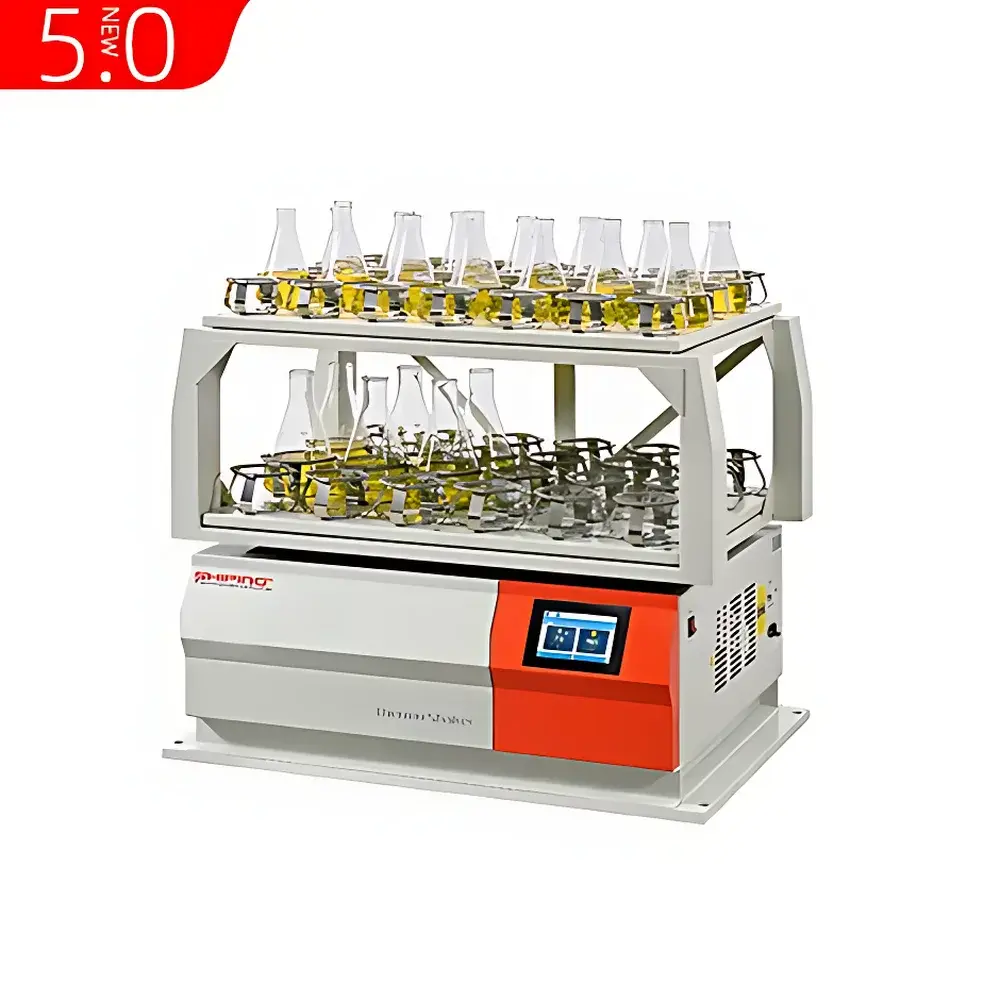
ShiPing SPH-C3112 Floor-Standing Dual-Deck Orbital Shaker
| Brand | ShiPing |
|---|---|
| Origin | Shanghai, China |
| Manufacturer Type | Direct Manufacturer |
| Instrument Category | Domestic |
| Model | SPH-C3112 |
| Price Range | USD 2,800 – 7,000 (FOB Shanghai) |
| Instrument Type | Dual-platform orbital shaker |
| Timer Range | 0–999.99 min |
| Oscillation Frequency | 30–300 rpm |
| Frequency Accuracy | ±1 rpm |
| Orbit Diameter | 50 mm |
| Temperature Control | Ambient-only (non-thermostatic) |
| Deck Quantity | 2 |
| Deck Dimensions | 840 × 620 mm per deck |
| Max Capacity per Deck | 48 × 1000 mL flasks |
| Net Weight | 332 kg |
| Overall Dimensions (W×D×H) | 900 × 675 × 790 mm |
| Power Consumption | 290 W |
| Voltage/Frequency | AC 200–240 V, 50–60 Hz |
| Drive System | Single-shaft parallel-linkage balanced drive |
| Bearing | NSK imported double-row angular contact ball bearings |
| Shaft Material | Quenched & tempered 45# carbon steel (220–250 HBW) |
| Structural Frame | Ductile iron core components with cold-rolled steel chassis and reinforced angle/c-channel framing |
| Safety Features | Independent overspeed audiovisual alarm, leakage current protection, overload circuit breaker, mechanical overtravel limiter, auto-restart after power recovery, parameter memory retention |
| Compliance | Designed to meet general laboratory safety requirements per IEC 61010-1 |
Overview
The ShiPing SPH-C3112 is a heavy-duty, floor-standing dual-deck orbital shaker engineered for high-throughput, long-duration incubation and mixing applications in life science laboratories. It operates on the principle of controlled orbital motion—generating uniform circular agitation at precise rotational frequencies—to ensure consistent suspension, aeration, and mass transfer across biological and chemical samples. Unlike thermostatic shakers, the SPH-C3112 is optimized for ambient-temperature environments where temperature stability is maintained externally (e.g., inside climate-controlled rooms or walk-in incubators), making it ideal for applications requiring mechanical agitation without integrated heating or cooling. Its robust mechanical architecture supports continuous operation over extended cycles—critical for bacterial culture expansion, enzymatic assays, hybridization protocols, and bioprocess development in pharmaceutical QC, academic research, and industrial biotechnology settings.
Key Features
- Dual independent decks: Two identical 840 × 620 mm stainless-steel-reinforced platforms enable simultaneous processing of heterogeneous sample sets—e.g., parallel strain comparisons or multi-condition time-course experiments—without cross-contamination risk.
- Parallel-linkage single-shaft drive: A patented dynamic balance mechanism based on a parallelogram linkage geometry eliminates eccentric torque, reducing mechanical wear, vibration transmission, and acoustic emission (<45 dB(A) at 1 m).
- Precision PID microprocessor control: Real-time environmental scanning adjusts motor output to maintain setpoint accuracy within ±1 rpm across the full 30–300 rpm range, even under variable load conditions (up to 48 × 1000 mL flasks per deck).
- Industrial-grade mechanical construction: Core transmission components—including gear housing, crank arm, and support frame—are fabricated from ductile iron (ASTM A536 Grade 65-45-12), machined on CNC bed mills to ≤±0.02 mm geometric tolerance.
- NSK double-row angular contact bearings: Rated for >100,000 hours L10 life under nominal load, providing low-friction rotation and resistance to axial thrust generated during high-amplitude orbital motion (Φ50 mm).
- Triple-layer safety architecture: Includes hardware-level overspeed cutoff, Class II insulation with RCD protection, and mechanical end-stop limiters—meeting IEC 61010-1 Clause 7.3.2 for laboratory equipment operational safety.
Sample Compatibility & Compliance
The SPH-C3112 accommodates standard microbiological and biochemical vessels—including Erlenmeyer flasks (100–1000 mL), test tubes, deep-well plates, and custom bioreactor sleeves—via universal clamping fixtures or silicone matting. Its non-thermostatic design complies with ISO 13485 Annex C requirements for ancillary equipment used in medical device manufacturing environments. While not intrinsically compliant with FDA 21 CFR Part 11, the unit supports integration into Part 11–validated workflows via external PLC-based logging systems that record timestamped RPM, runtime, and alarm events. It satisfies general lab infrastructure criteria referenced in CLSI EP26-A and ASTM E2500-13 for equipment qualification in analytical method validation.
Software & Data Management
The embedded LCD interface provides local parameter configuration (timer, speed, ramp profiles) but does not include onboard data storage or network connectivity. For regulated environments, users deploy third-party SCADA or LIMS-integrated controllers (e.g., Siemens Desigo CC or Thermo Fisher SampleManager) to capture real-time operational logs—including start/stop timestamps, deviation alerts, and cumulative runtime—enabling full traceability per ALCOA+ principles. Optional RS-485 Modbus RTU output allows remote monitoring of status registers (e.g., current RPM, fault codes, elapsed time) in centralized facility management systems.
Applications
- Bacterial and yeast culture propagation in shake flasks for inoculum preparation prior to bioreactor seeding
- Enzyme kinetics studies requiring homogeneous substrate dispersion and oxygen transfer optimization
- Nucleic acid hybridization (e.g., Southern/Northern blotting) with controlled agitation to enhance probe binding efficiency
- Protein solubilization and extraction from inclusion bodies under ambient buffer conditions
- Environmental microbiology—e.g., BOD testing, microbial degradation assays, and soil slurry enrichment
- Pharmaceutical stability testing per ICH Q5C guidelines using agitated open-container formats
FAQ
Is the SPH-C3112 suitable for use inside a CO₂ incubator?
No—its ambient-only design lacks sealed electronics, humidity-resistant enclosures, or corrosion-inhibiting coatings required for high-humidity, CO₂-rich environments.
Can both decks operate at different speeds simultaneously?
No—the dual decks are mechanically coupled and run at identical RPM; independent speed control requires two separate single-deck units.
What maintenance intervals are recommended for the NSK bearings?
Under normal laboratory use (≤12 h/day, 5 days/week), no scheduled lubrication or replacement is required within the first 10 years; visual inspection every 24 months is advised.
Does the unit support GMP-compliant electronic records?
Not natively—but when connected to a validated external data acquisition system with audit trail, electronic signature, and backup capabilities, it meets GMP Annex 11 expectations.
What flask configurations achieve maximum load capacity?
Per deck: 48 × 1000 mL Erlenmeyer flasks (with 20% fill volume), 70 × 500 mL flasks, or 108 × 250 mL flasks—subject to center-of-gravity constraints and balanced loading.



