
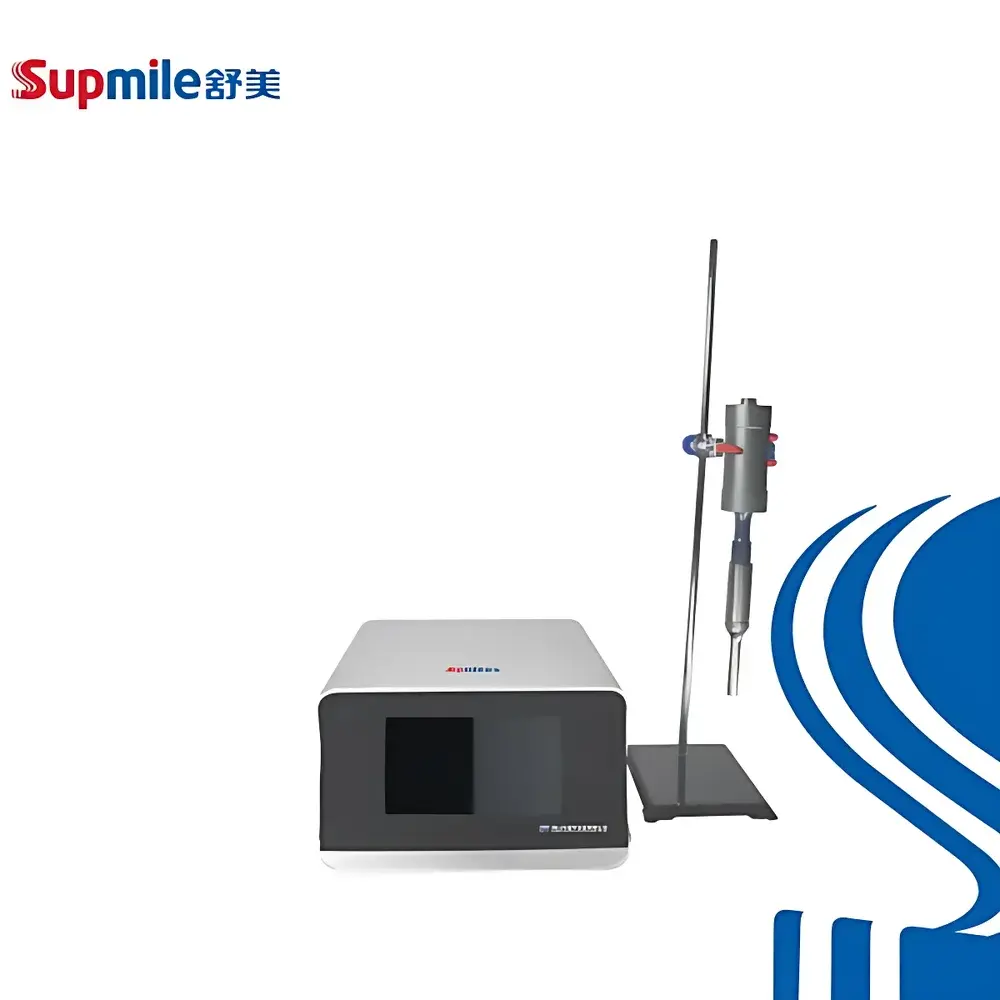
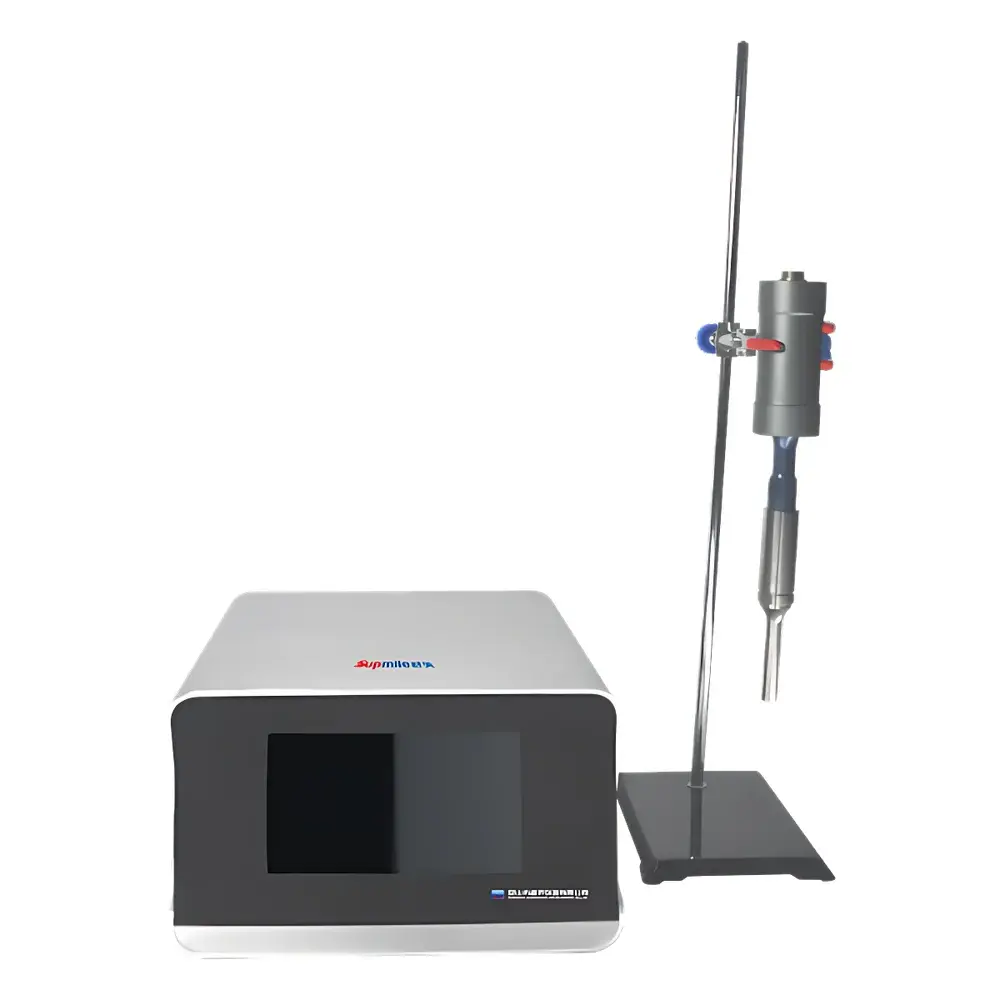
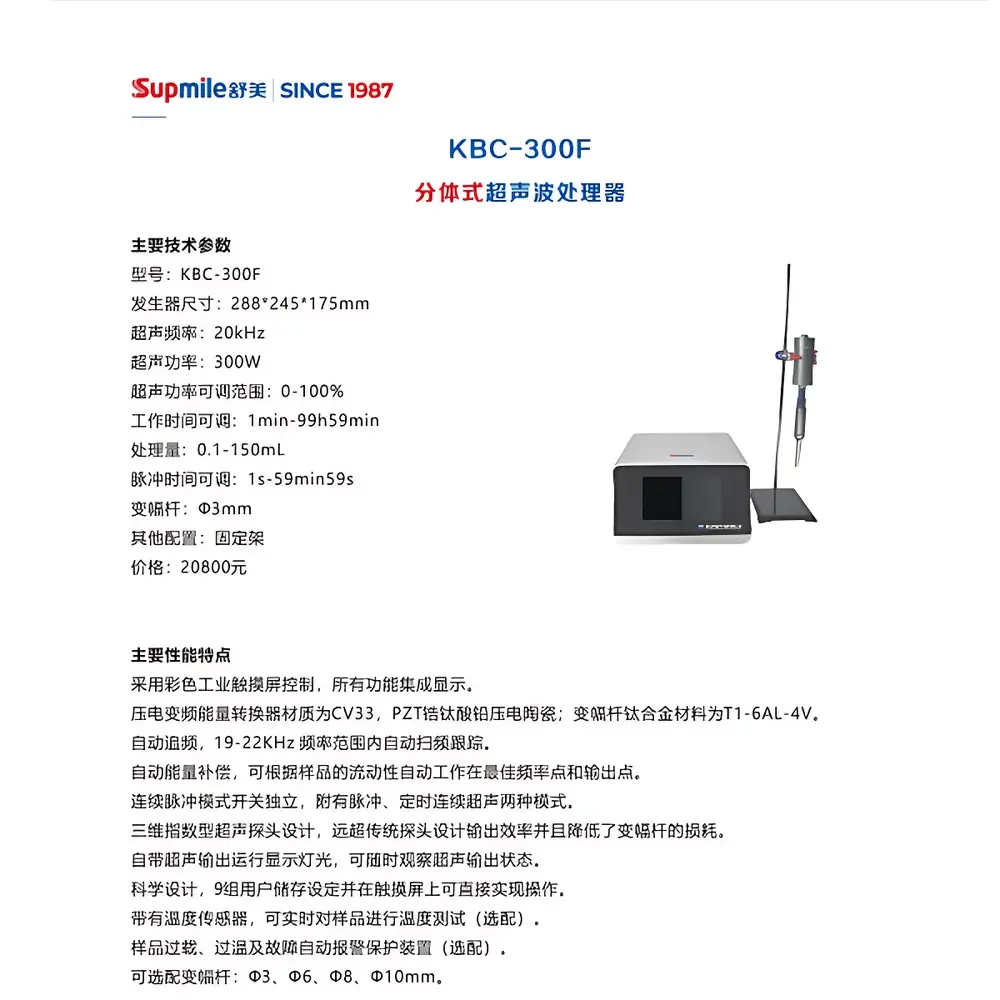
Shumei KBC-300F Split-System Ultrasonic Processor
| Brand | Shumei |
|---|---|
| Origin | Jiangsu, China |
| Manufacturer Type | OEM Producer |
| Country of Origin | China |
| Model | KBC-300F |
| Price | USD 2,950 (FOB Jiangsu) |
| Generator Dimensions | 288 × 245 × 175 mm |
| Ultrasonic Frequency | 20 kHz (auto-tracking range: 19–22 kHz) |
| Output Power | 300 W (adjustable 0–100%) |
| Time Setting Range | 1 min – 99 h 59 min |
| Pulse Duration | 1 s – 59 min 59 s |
| Sample Volume Capacity | 0.1–150 mL |
| Probe Tip Diameter | Φ3 mm (standard) |
| optional | Φ6 / Φ8 / Φ10 mm |
| Transducer Material | CV33 piezoceramic + PZT (lead zirconate titanate) |
| Horn Material | Ti-6Al-4V titanium alloy |
| Control Interface | Full-color industrial capacitive touchscreen |
| Operating Modes | Continuous & pulsed ultrasonication |
| Auto-frequency tracking | Yes |
| Real-time energy compensation | Yes |
| Built-in status LED indicator | Yes |
| User-programmable protocols | 9 presets |
| Optional accessories | Temperature probe (PT100), overload/overheat protection circuit |
Overview
The Shumei KBC-300F Split-System Ultrasonic Processor is an engineered solution for laboratory-scale sonochemical processing, cell disruption, nanoparticle dispersion, emulsification, and extraction applications requiring precise, reproducible high-intensity ultrasound delivery. Unlike integrated benchtop units, its split architecture separates the generator (power supply and control unit) from the transducer-horn assembly—enabling flexible setup in fume hoods, glove boxes, or custom reactor configurations while minimizing heat transfer to sensitive samples. The system operates on the principle of piezoelectric energy conversion: high-voltage AC signals drive PZT-based CV33 ceramic elements to generate mechanical vibrations at a nominal 20 kHz, amplified and focused through a Ti-6Al-4V ultrasonic horn. Its auto-frequency tracking capability continuously scans between 19–22 kHz to lock onto the resonant frequency of the loaded horn-sample system, ensuring stable cavitation intensity despite viscosity shifts or temperature drift.
Key Features
- Full-color industrial capacitive touchscreen interface with intuitive icon-driven navigation and real-time parameter visualization
- Intelligent auto-frequency tracking (19–22 kHz sweep) and dynamic energy compensation—maintains consistent acoustic output across varying sample rheology
- Dual operational modes: continuous ultrasonication and programmable pulse mode (1 s–59 min 59 s on/off cycles)
- Three-dimensional exponential horn geometry optimized for acoustic energy transfer efficiency and reduced lateral stress on the probe shaft
- Integrated status LED ring providing immediate visual feedback on active ultrasonic output state
- Nine user-defined protocol slots stored locally on the controller—enabling rapid recall of validated methods without external software
- Robust mechanical design: CV33 piezoceramic stack with high Curie temperature stability; Ti-6Al-4V horn resistant to corrosion and fatigue under prolonged duty cycles
Sample Compatibility & Compliance
The KBC-300F accommodates sample volumes from 0.1 mL (microcentrifuge tubes) to 150 mL (beakers or jacketed reactors), supporting aqueous, organic, and viscous media—including polymer solutions, colloidal suspensions, and biological lysates. Standard Φ3 mm titanium horn ensures high spatial intensity for small-volume homogenization; optional Φ6/Φ8/Φ10 mm horns extend applicability to larger vessels or lower-intensity dispersion tasks. While not certified to IEC 61000-6-3 (EMC) or UL 61010-1 out-of-the-box, the system complies with general electrical safety principles for laboratory equipment. Optional PT100 temperature probe integration supports GLP-aligned thermal monitoring, and configurable overtemperature/overload protection aligns with risk-mitigation requirements for unattended operation per ISO/IEC 17025 Clause 7.2.2.
Software & Data Management
The KBC-300F operates as a standalone instrument with no mandatory PC dependency. All method parameters—including power setpoint, duration, pulse sequence, and frequency offset—are configured and logged directly via the embedded touchscreen. Timestamped operation records (start time, total runtime, mode used, and fault events) are retained in non-volatile memory for audit trail purposes. For laboratories requiring electronic record integrity, the system supports optional RS-232 or USB-to-serial interface for passive data export to LIMS or ELN platforms. Though not natively 21 CFR Part 11 compliant, its deterministic control logic, user-accessible protocol storage, and hardware-level alarm logging provide foundational traceability suitable for internal QA workflows and preliminary GMP process development.
Applications
- Cell lysis and nuclear extraction in molecular biology workflows (e.g., bacterial, yeast, mammalian tissue)
- Preparation of uniform nanosuspensions for pharmaceutical formulation studies
- Accelerated solvent extraction (ASE) of phytochemicals or environmental analytes
- Dispersion stabilization of carbon nanotubes, graphene oxide, or metal oxide nanoparticles
- Emulsification of oil-in-water or water-in-oil systems for food science and cosmetic R&D
- In situ sonocatalysis experiments requiring controlled acoustic energy input
FAQ
Is the KBC-300F suitable for continuous operation over 8 hours?
Yes—its forced-air-cooled generator and thermally optimized transducer housing support extended duty cycles; however, horn tip temperature must be monitored when processing >50 mL volumes or high-viscosity media.
Can I use third-party titanium horns with this generator?
No—only Shumei-certified Ti-6Al-4V horns with calibrated resonance profiles are guaranteed compatible; mismatched horns may cause impedance mismatch, reduced efficiency, or transducer damage.
Does the system include validation documentation for IQ/OQ protocols?
The standard package includes a factory calibration certificate (frequency and power verification at 20 kHz ±0.5 kHz and 300 W ±3%). Full IQ/OQ templates and test scripts are available upon request for qualified laboratories.
What maintenance intervals are recommended for long-term reliability?
Inspect horn threads and coupling surface every 200 operating hours; replace ultrasonic coupling compound annually or after exposure to corrosive solvents.
Is remote control via Ethernet or Wi-Fi supported?
Not natively—but RS-232 serial output enables integration with PLCs or custom LabVIEW/Python control scripts using standard Modbus RTU framing.



