
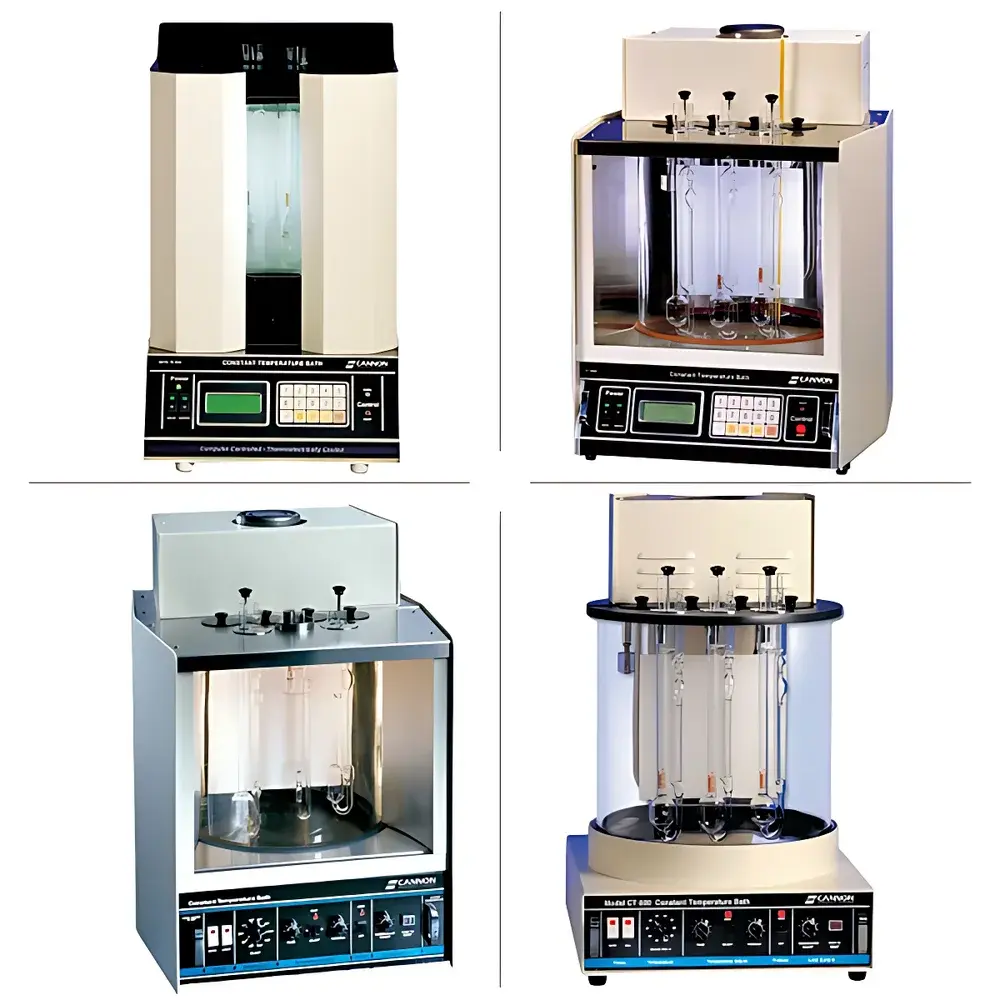
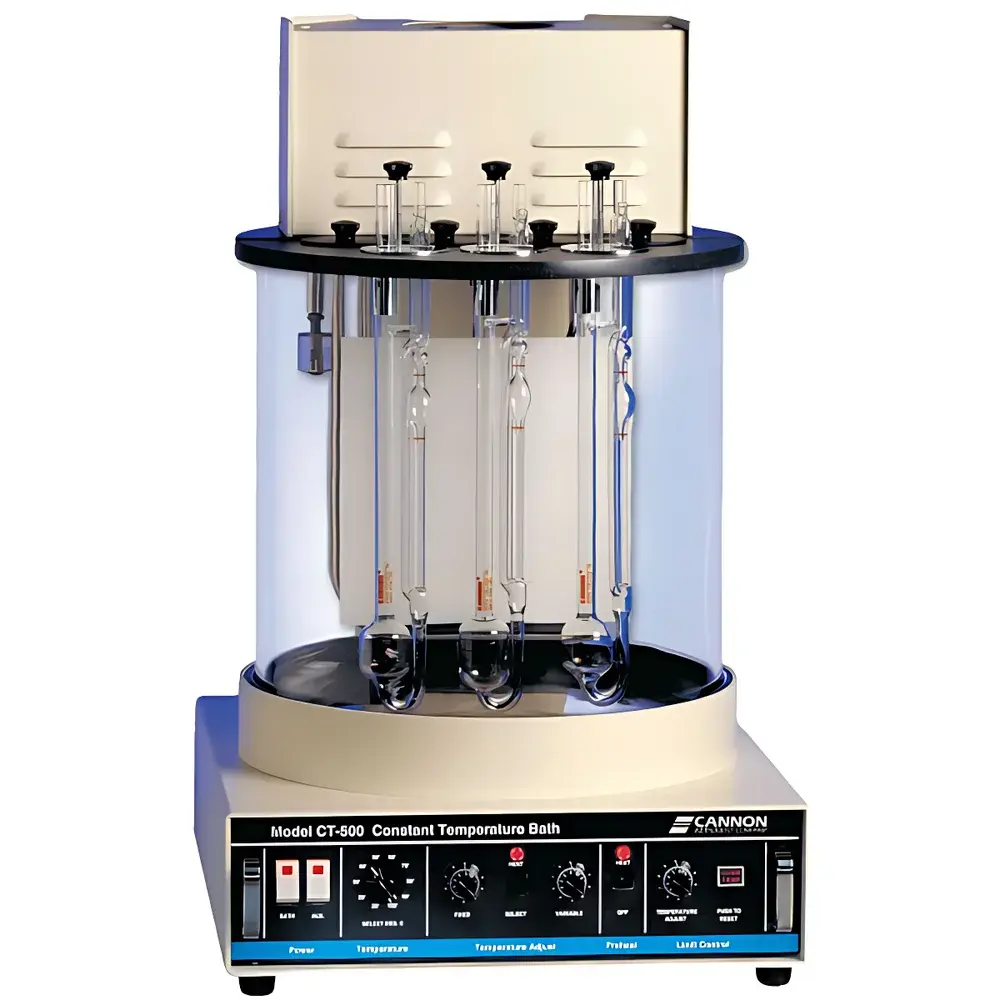
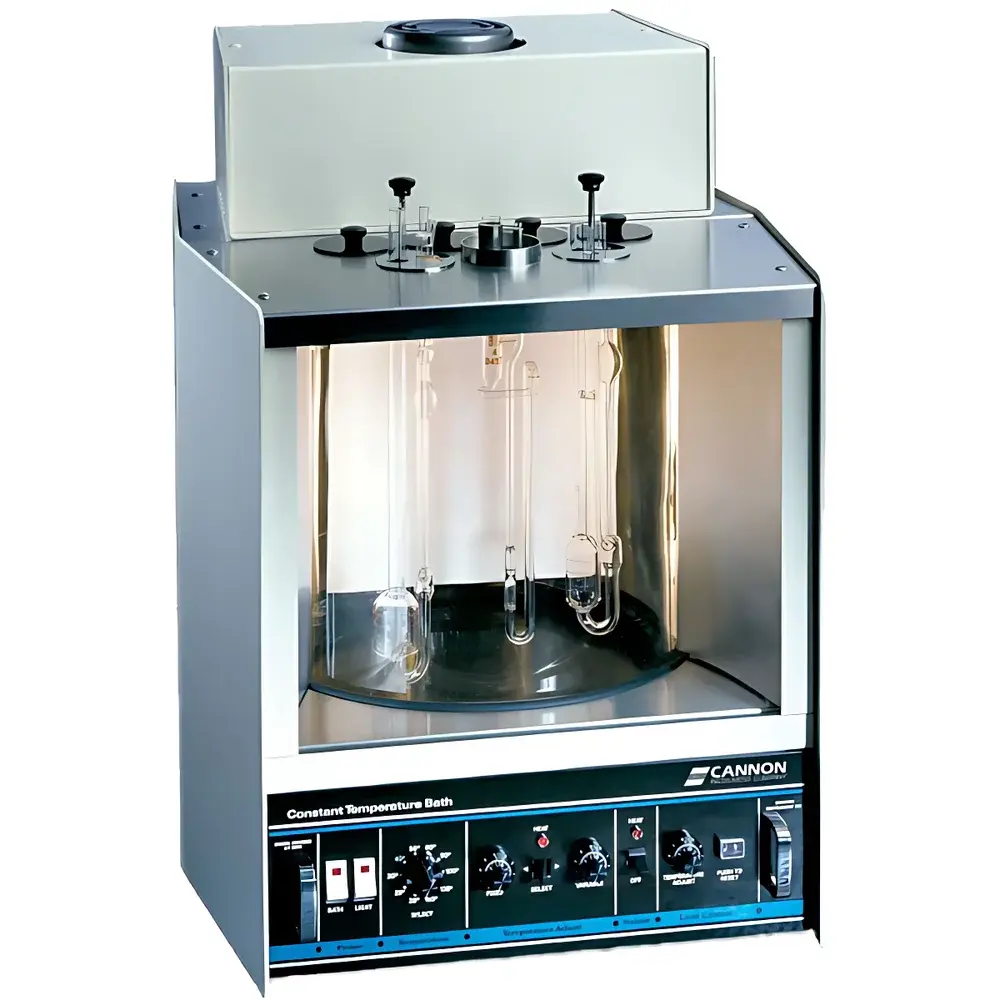
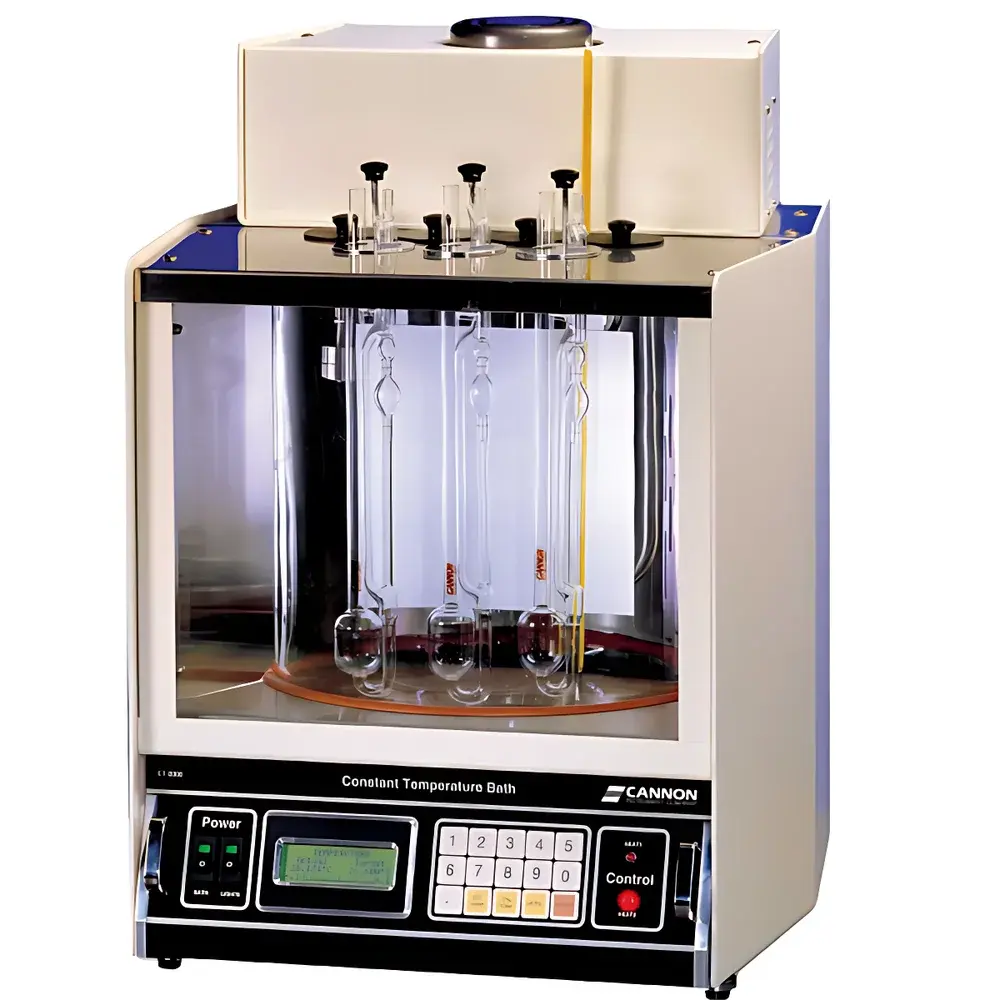
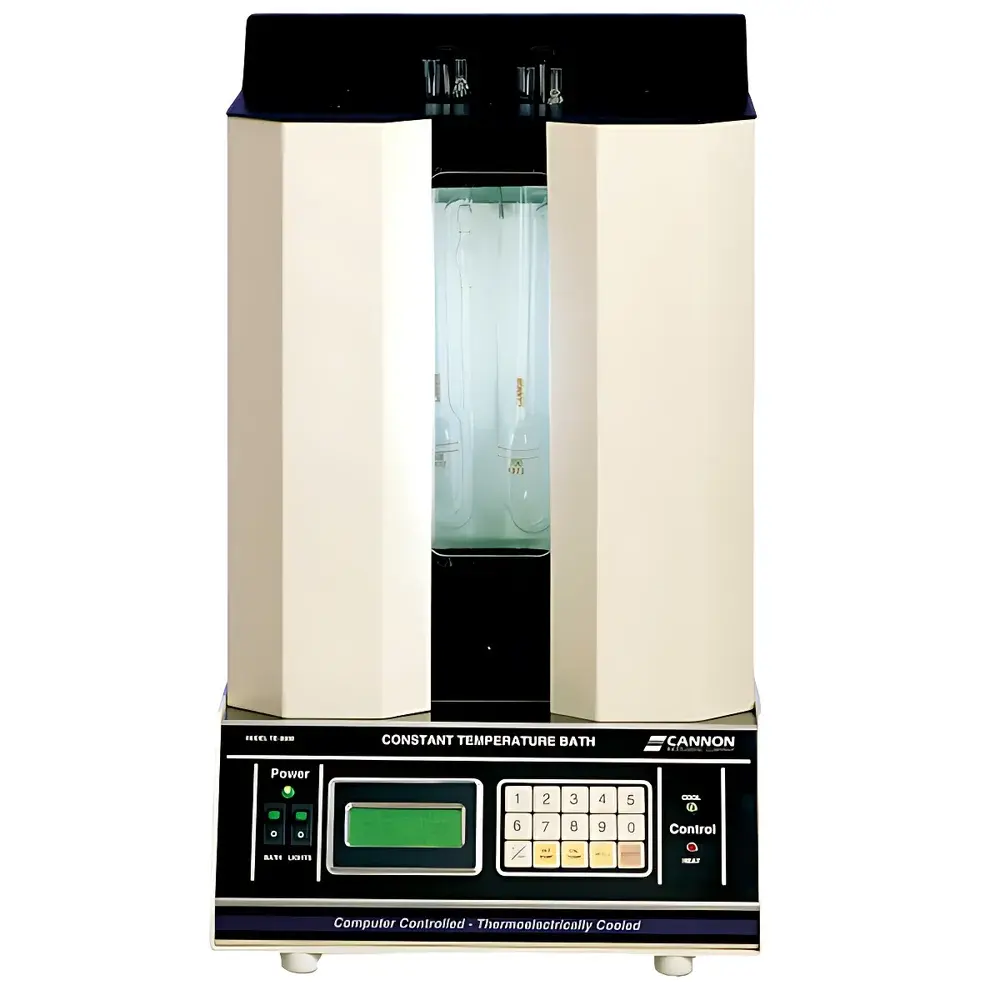
Cannon CT-1000F High-Temperature Viscometry Bath
| Brand | Cannon |
|---|---|
| Origin | USA |
| Model | CT-1000F |
| Temperature Range | Ambient to 150 °C |
| Temperature Stability | ±0.01 °C |
| Bath Volume | 17 L |
| Compliance | ASTM D445, ISO 3104, GB/T 265 |
| Safety Features | Dual thermal cutoffs, liquid-level interlock, stainless-steel wetted parts |
| Illumination | Dual fluorescent lamps with uniform diffused lighting |
| Bath Dimensions | Ø300 mm × H300 mm (transparent borosilicate glass) |
| Control | Proportional solid-state temperature controller with Pt100 sensor, motor-driven stirrer, 10 preset temperature buttons (20–150 °C), fine-tuning knob, VARIABLE mode for continuous adjustment |
Overview
The Cannon CT-1000F High-Temperature Viscometry Bath is a precision-engineered constant-temperature immersion bath designed exclusively for kinematic viscosity measurements using glass capillary viscometers in accordance with ASTM D445, ISO 3104, and GB/T 265. It operates on the principle of controlled thermal equilibrium within a highly stable, optically transparent fluid medium—typically silicone oil or high-flash-point mineral oil—enabling accurate capillary flow time determination at elevated temperatures up to 150 °C. Unlike general-purpose circulating baths, the CT-1000F integrates application-specific features including seven standardized 51-mm-diameter ports for simultaneous mounting of Ubbelohde or Cannon-Fenske viscometers, dual temperature-sensing redundancy, and a rigorously engineered thermal architecture that ensures spatial uniformity and temporal stability essential for traceable viscosity calibration.
Key Features
- Optimized optical design: 300 mm diameter × 300 mm height transparent borosilicate glass bath vessel with central stainless-steel baffle for consistent background contrast during capillary meniscus observation
- Dual-fluorescent illumination system providing glare-free, spectrally neutral, and spatially uniform internal lighting—critical for high-accuracy manual or automated meniscus detection
- Proportional solid-state temperature control using a platinum RTD (Pt100) sensor embedded in a stainless-steel sheath; achieves ±0.01 °C stability at setpoints and ±0.01 °C fine-tuning resolution
- 10 factory-preset temperature buttons (20, 25, 30, 40, 50, 60, 80, 100, 135, and 150 °C) for rapid method alignment in routine QC laboratories; VARIABLE mode enables continuous setpoint selection across full operating range
- Motor-driven stainless-steel impeller ensuring laminar, non-turbulent circulation—minimizing thermal gradients and vibration-induced measurement artifacts
- Triple-layer safety architecture: (1) primary and secondary thermal cutoffs (dual RTDs), (2) open-circuit fault detection on control sensor, and (3) liquid-level interlock preventing heater activation below minimum fill line
- All fluid-contact components—including bath support structure, port collars, and stirrer assembly—fabricated from passivated 316 stainless steel to resist thermal degradation and chemical attack from high-temperature oils
Sample Compatibility & Compliance
The CT-1000F accommodates standard ASTM/ISO-compliant glass capillary viscometers (e.g., Ubbelohde, Cannon-Fenske, and Ostwald types) with outer diameters ≤12 mm. Its seven 51-mm-diameter ports permit concurrent testing of multiple samples or replicate runs under identical thermal conditions—supporting statistical validation per ISO/IEC 17025 requirements. Two auxiliary ports are reserved for calibrated reference thermometers (e.g., NIST-traceable PRTs or digital thermistors) to independently verify bath temperature uniformity per ASTM D445 Annex A1. The instrument meets mechanical and electrical safety standards IEC 61010-1 and UL 61010-1, and its construction supports GLP/GMP documentation workflows through deterministic thermal response and auditable hardware-level safeguards.
Software & Data Management
The CT-1000F operates as a standalone analog-controlled bath without embedded microprocessor or digital interface. However, its stable thermal output and precise analog setpoint repeatability make it fully compatible with external data acquisition systems used in regulated environments. When integrated with validated LIMS or ELN platforms, temperature verification logs—generated via external calibrated thermometers—can be linked to viscosity test records for full 21 CFR Part 11 compliance. Optional accessories include NIST-traceable temperature verification kits and DIN-certified immersion thermometers, enabling documented uncertainty budgets per ISO/IEC 17025 Clause 6.4.
Applications
- Kinematic viscosity testing of lubricating oils, base stocks, and finished formulations per ASTM D445 at elevated service temperatures (e.g., 100 °C and 150 °C)
- Quality control of transformer oils, hydraulic fluids, and jet fuels requiring certified thermal stability during capillary flow measurement
- Research-grade rheological screening of polymer melts and thermally sensitive resins where capillary-based viscosity remains the reference method
- Calibration laboratories performing accredited viscosity reference material certification (e.g., SRM 2789, 2790) under ISO 17025
- Educational labs teaching fundamental principles of Newtonian fluid behavior and temperature-dependent viscosity relationships
FAQ
What viscosity standards does the CT-1000F support?
It is fully compliant with ASTM D445, ISO 3104, and GB/T 265 for kinematic viscosity measurement using glass capillary viscometers.
Can the CT-1000F be used with silicone oil as the bath medium?
Yes—its maximum operating temperature of 150 °C and stainless-steel wetted surfaces are compatible with high-stability silicone oils meeting ASTM D2983 specifications.
Is external cooling required to maintain sub-ambient temperatures?
No—the CT-1000F is designed for heating only; for sub-ambient operation, the TE-1500F or TE-3000F low-temperature models are recommended.
How is temperature uniformity verified across the bath volume?
Per ASTM D445 Annex A1, users should employ two calibrated thermometers placed at defined radial and axial positions; typical measured gradient is ≤0.02 °C across the central measurement zone.
Does the unit include a drain valve for bath fluid replacement?
Yes—a bottom-mounted stainless-steel quick-release valve facilitates safe, spill-free oil exchange without disassembly.



