
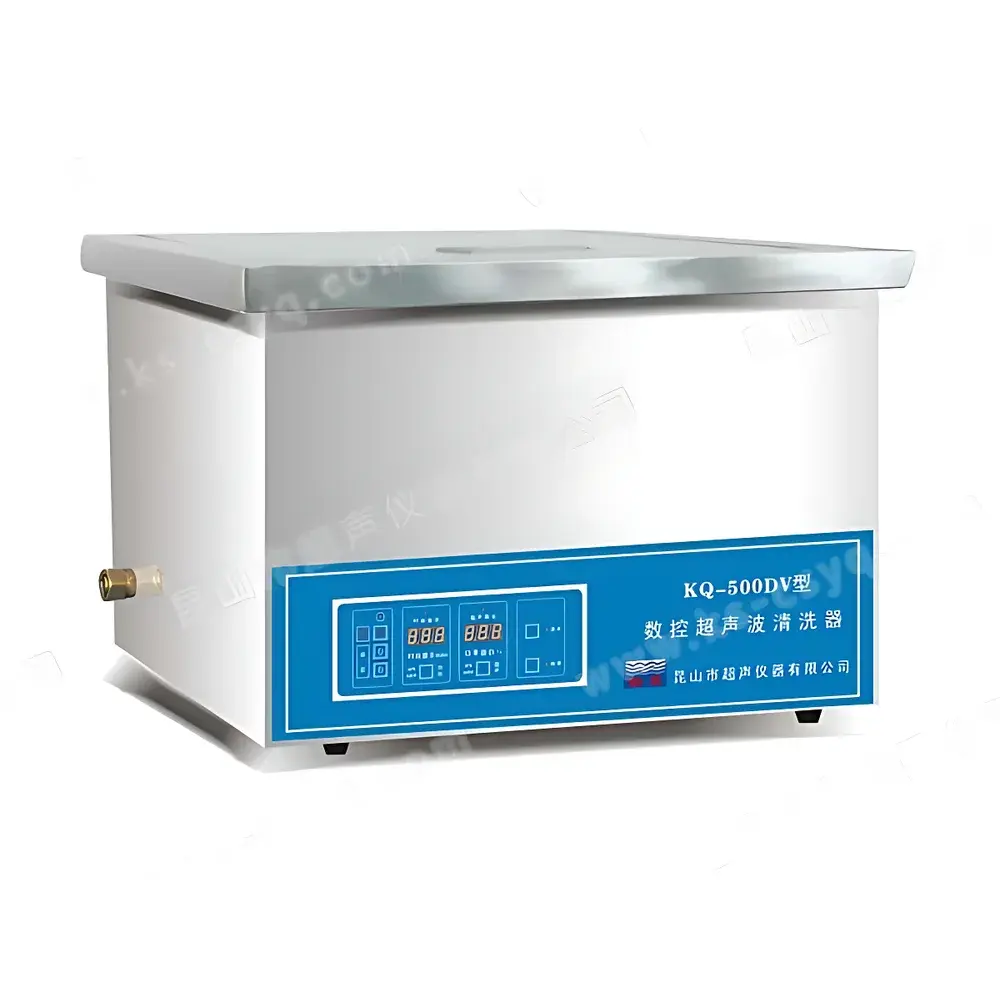
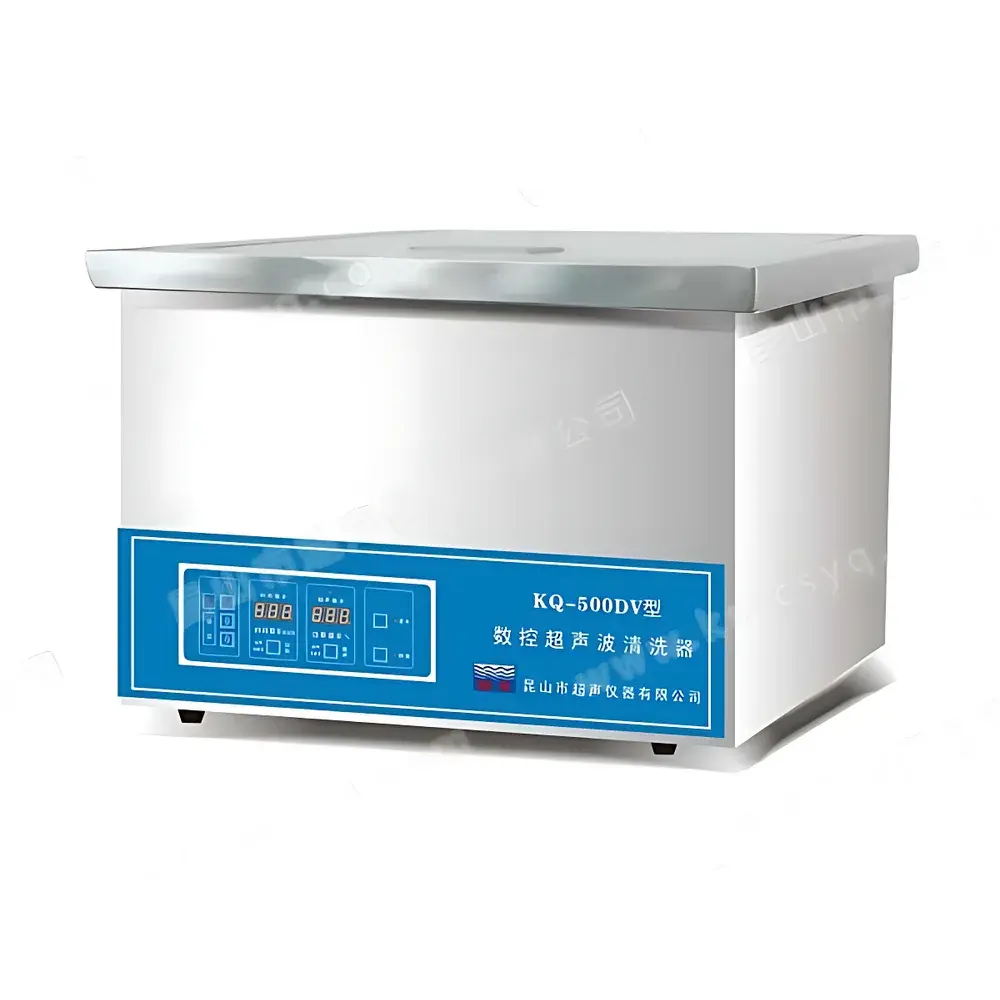
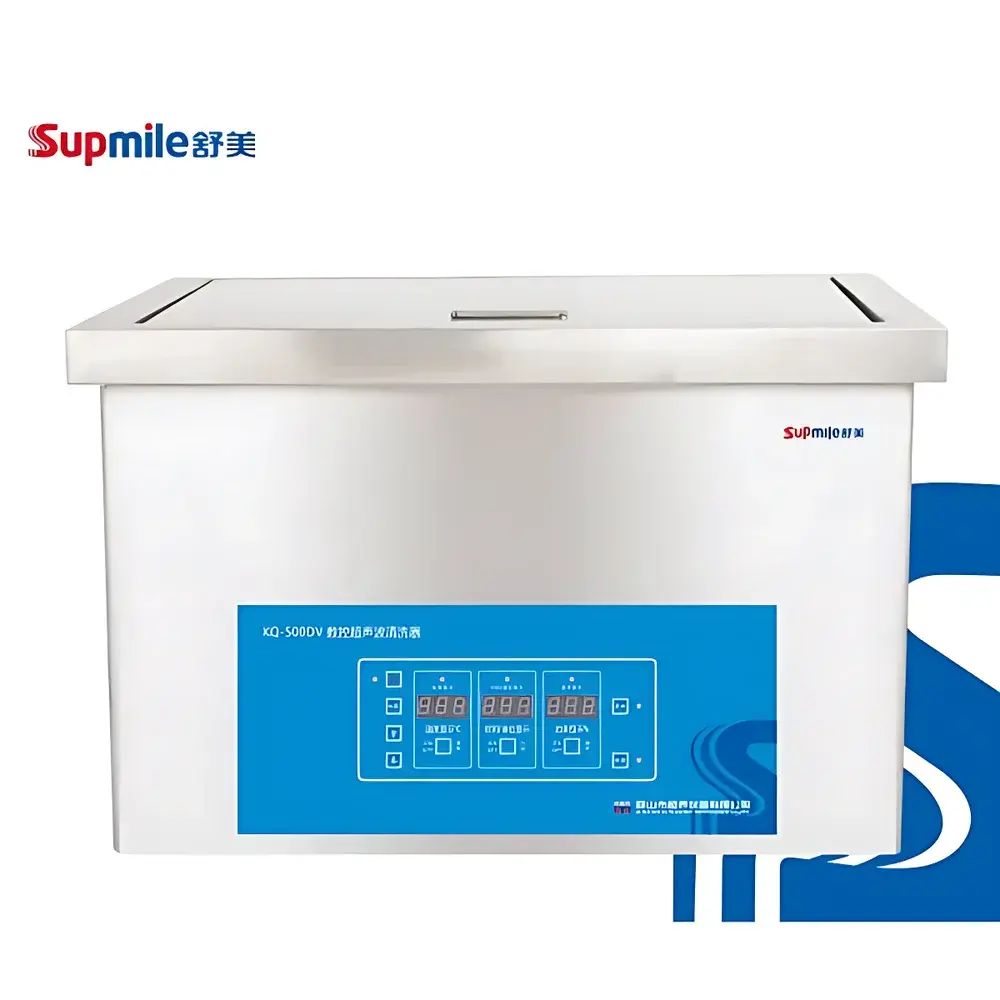
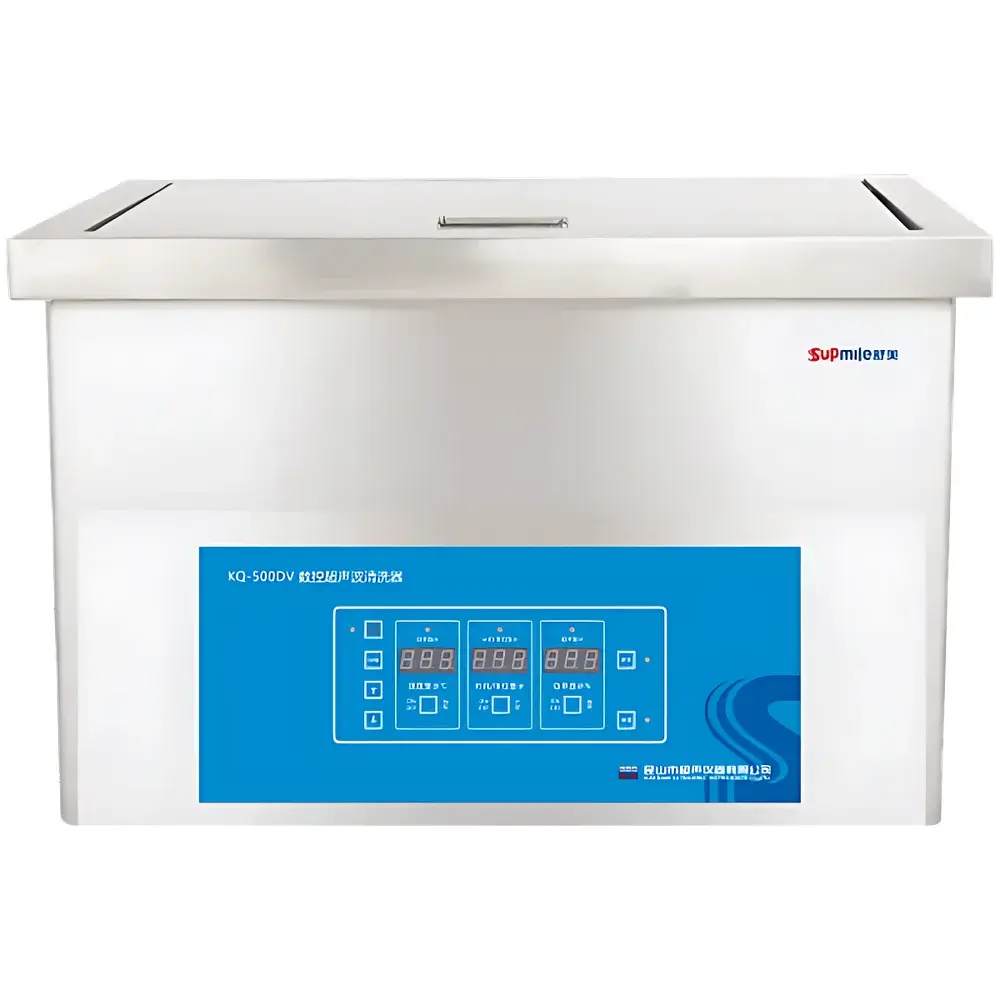
SHUMEI KQ-500DV Benchtop Digital Ultrasonic Cleaner
| Brand | SHUMEI |
|---|---|
| Origin | Jiangsu, China |
| Manufacturer Type | Direct Manufacturer |
| Equipment Type | General-Purpose Ultrasonic Cleaner |
| Model | KQ-500DV |
| Capacity | 27 L |
| Ultrasonic Frequency | 40 kHz |
| Ultrasonic Power Output | 500 W |
| Adjustable Power Range | 40–100% |
| Temperature Control Range | 10–80 °C |
| Timer Range | 1–480 min |
| Sound-Dampening Lid | Yes |
| Electrically Controlled Fill/Drain | Yes |
| Tank Dimensions (L×W×H) | 500 × 300 × 180 mm |
| External Dimensions (L×W×H) | 638 × 460 × 395 mm |
| Heating Power | 1000 W |
| Heating Method | PTC Surface-Mount Heater |
| Protection Features | Over-Temperature, Over-Voltage, Over-Current, Low-Water-Level Indication |
| Display | Digital LED with Memory Function for Time, Power, Temperature & Water Level |
| Auto-Frequency Sweeping | Yes |
| Transducer Configuration | Standard 40 kHz transducers, 50 W per unit |
| Construction Material | AISI 304 Stainless Steel Tank & Housing |
| Power Supply | 220 V AC, 50 Hz |
| Compliance | CE-marked design principles |
Overview
The SHUMEI KQ-500DV is a benchtop digital ultrasonic cleaner engineered for reproducible, non-destructive cleaning of precision laboratory components—including glassware, metal parts, optical lenses, microfluidic devices, and analytical sample holders. It operates on the principle of cavitation-induced acoustic energy transfer: high-frequency mechanical vibrations (40 kHz) generated by piezoelectric transducers are transmitted through aqueous or mild solvent-based cleaning media, producing transient microbubbles that collapse near surfaces to dislodge particulate contaminants, organic residues, and biofilm without abrasion. Its 27 L stainless steel tank—constructed from AISI 304 grade—provides stable thermal and chemical resistance during extended operation cycles. Designed for integration into QC/QA labs, R&D facilities, and medical device reprocessing units, the KQ-500DV delivers consistent cleaning efficacy across variable load geometries and material classes, supporting routine validation protocols under ISO 13485, ASTM D2603 (for ultrasonic cleaning performance evaluation), and internal GLP/GMP documentation frameworks.
Key Features
- Digital microcontroller-based interface with real-time display and memory retention for time (1–480 min), power (40–100%), temperature (10–80 °C), and water level (1–140 mm)
- PTC surface-mount heating system (1000 W) ensures uniform thermal distribution and rapid temperature stabilization with ±2 °C accuracy over full operating range
- Integrated auto-sweep frequency function minimizes standing wave formation and enhances cleaning uniformity across heterogeneous loads
- Electrically actuated fill-and-drain system enables programmable fluid management, reducing manual handling and cross-contamination risk
- Sound-dampening stainless steel lid with gasket-sealed closure reduces ambient noise to ≤55 dB(A) at 1 m distance and improves thermal insulation
- Comprehensive safety architecture: real-time monitoring of over-temperature, over-voltage, over-current, and low-water-level conditions with automatic shutdown and visual alarm indicators
- Modular transducer array (standard 40 kHz, 50 W per element) mounted directly to tank bottom for optimal energy coupling and long-term reliability
Sample Compatibility & Compliance
The KQ-500DV accommodates a broad spectrum of laboratory items: volumetric flasks, pipette tips, HPLC vials, surgical instruments, semiconductor wafers, and ceramic substrates. Its stainless steel tank resists corrosion from common cleaning agents including alkaline detergents, ethanol/water mixtures, and low-concentration acidic solutions (pH ≥ 2). The unit meets electromagnetic compatibility (EMC) and low-voltage directive principles aligned with CE marking conventions. While not certified as medical-grade sterilization equipment, it supports pre-sterilization cleaning steps compliant with ISO 15883-1 and AAMI ST35 standards when used in conjunction with validated cleaning chemistries. All operational parameters—including elapsed time, setpoints, and fault logs—are timestamped and retainable for audit trails required under FDA 21 CFR Part 11–compatible documentation systems.
Software & Data Management
The embedded firmware supports parameter recall and repeat-cycle execution without external software dependency. All user-defined settings—including ramp profiles for temperature and power—are stored in non-volatile memory and persist after power cycling. Event logs capture start/stop timestamps, active protection triggers (e.g., low-water alerts), and cumulative operational hours—exportable via manual screen capture for inclusion in lab notebooks or electronic quality records. Though no USB or Ethernet connectivity is integrated, the digital interface conforms to human factors engineering guidelines (IEC 62366-1), ensuring intuitive navigation during routine operation and minimizing operator error.
Applications
- Removal of polishing compounds and metal fines from precision machined parts prior to metrology inspection
- Cleaning of chromatography columns, autosampler needles, and syringe filters to prevent carryover contamination
- Decontamination of reusable cell culture inserts and electrophoresis combs between experimental runs
- Preparation of TEM grids and SEM stubs by eliminating hydrocarbon residue without solvent immersion
- Supporting ASTM E2889-13 (Standard Practice for Ultrasonic Cleaning Validation in Pharmaceutical Manufacturing)
- Processing of dental and orthopedic instruments in compliance with ANSI/AAMI ST79:2017 Annex D guidance
FAQ
Is the KQ-500DV suitable for cleaning delicate optical components?
Yes—when operated at reduced power (40–60%) and moderate temperature (30–45 °C) using deionized water or low-surface-tension solvents, it effectively removes sub-micron particles without damaging coated lenses or diffraction gratings.
Can the unit be validated for regulated environments?
While the KQ-500DV itself does not carry formal 21 CFR Part 11 certification, its deterministic parameter control, audit-ready event logging, and stable performance enable IQ/OQ/PQ protocol development per ISO/IEC 17025 and GAMP 5 guidelines.
What maintenance is required for long-term reliability?
Transducer performance should be verified annually via output power measurement; tank integrity and lid seal condition must be inspected quarterly; descaling of heating elements is recommended every 200 operational hours when using hard water.
Does it support multi-frequency operation out of the box?
No—the standard configuration operates exclusively at 40 kHz. Optional multi-frequency modules (20/25/28/33/40 kHz) are available as factory-installed upgrades subject to model-specific hardware revision.
Is remote monitoring or network integration possible?
Not natively. The current firmware lacks communication interfaces (RS-232, USB, or Ethernet); however, analog signal taps for temperature and timer status are accessible via internal test points for custom SCADA integration.



