
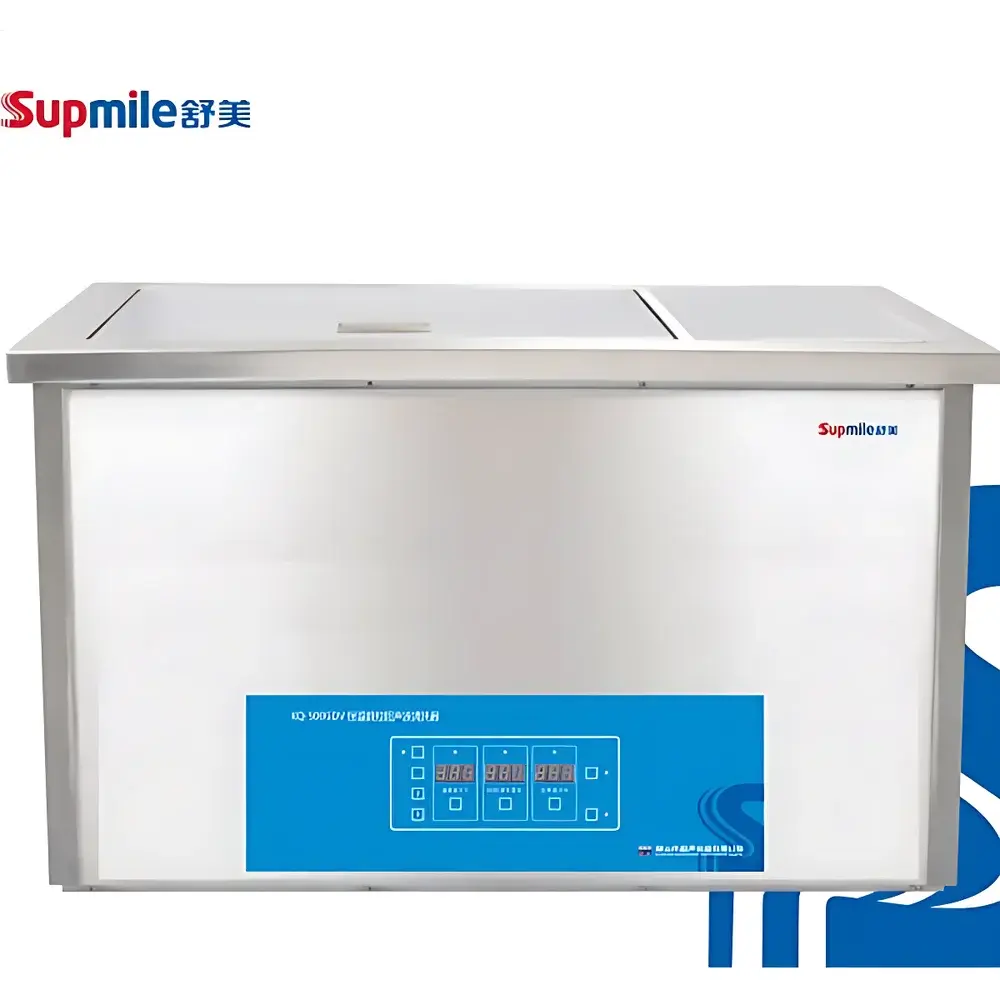
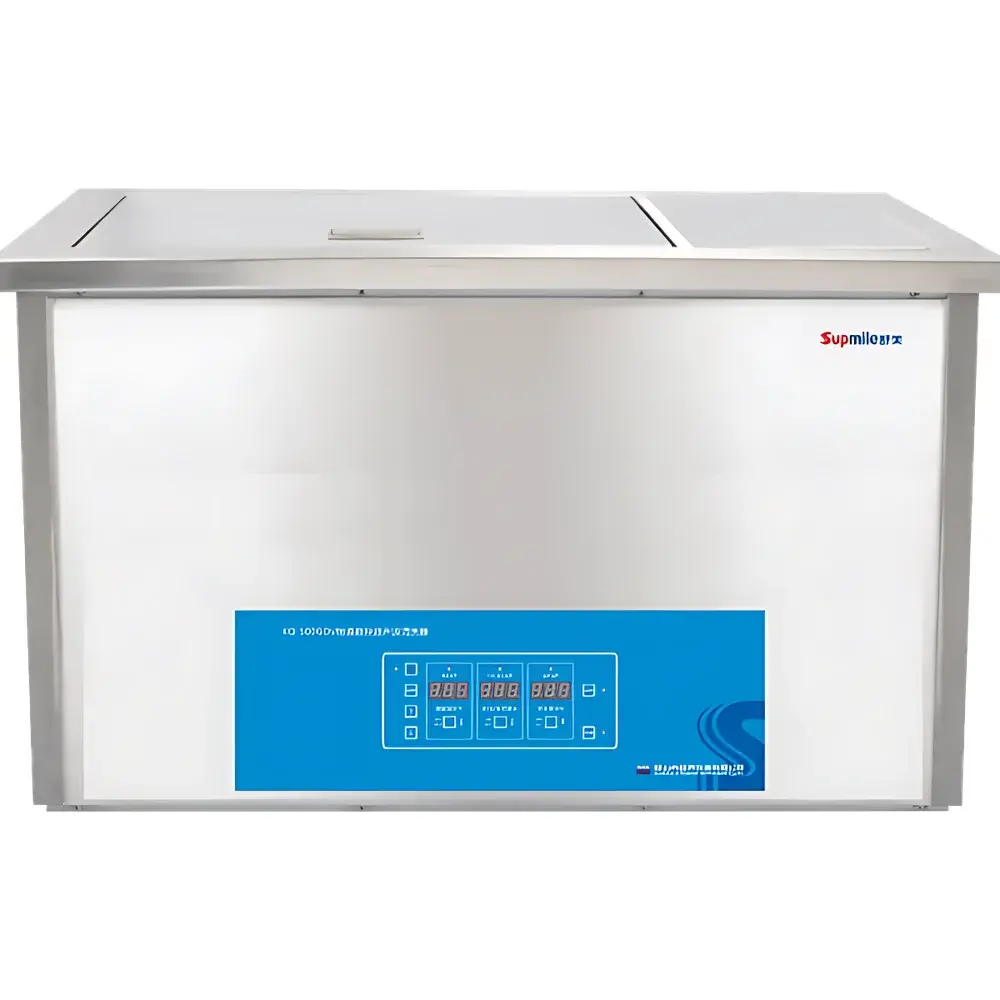
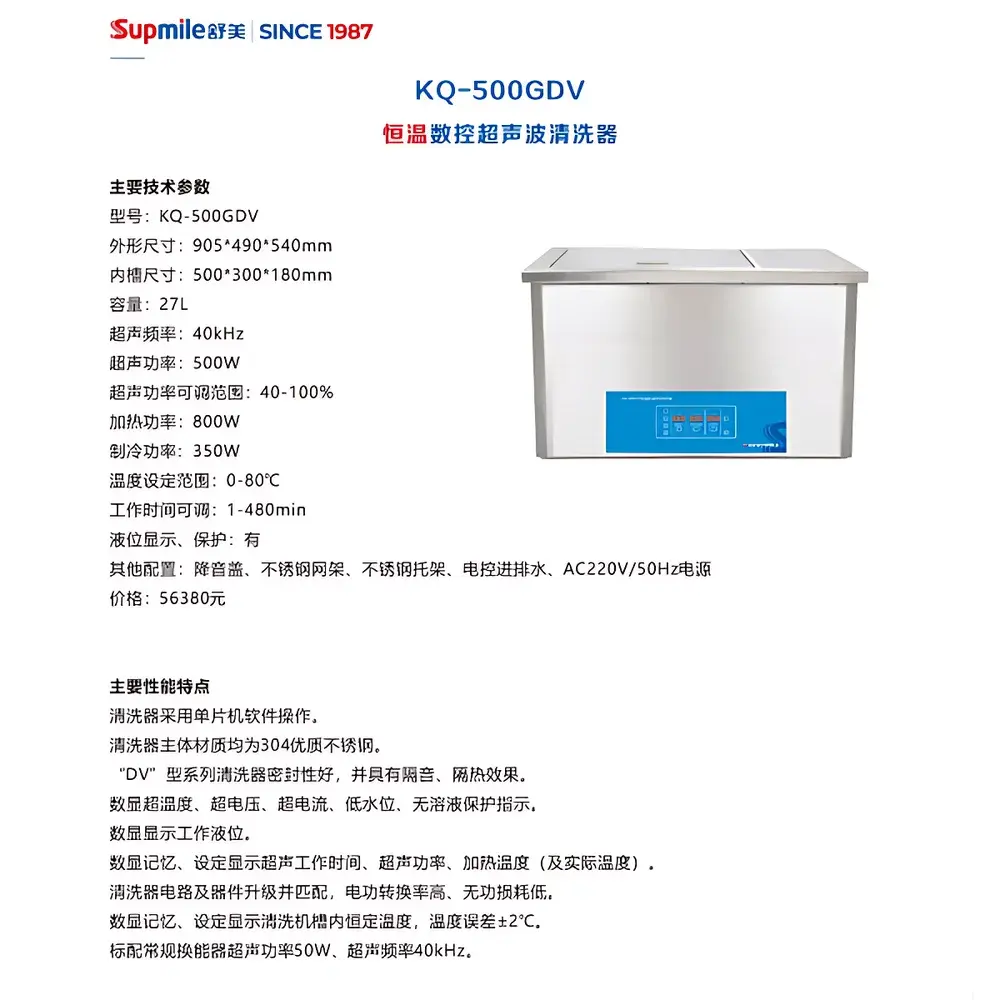
Shumei KQ-500GDV Digital Temperature-Controlled Ultrasonic Cleaner
| Brand | Shumei |
|---|---|
| Origin | Jiangsu, China |
| Manufacturer Type | OEM/ODM Manufacturer |
| Product Category | Domestic |
| Model | KQ-500GDV |
| Instrument Type | General-Purpose |
| Tank Capacity | 27 L |
| Ultrasonic Frequency | 40 kHz |
| Ultrasonic Power Output | 500 W |
| Adjustable Ultrasonic Power | 40–100% |
| Temperature Control Range | 0–80 °C |
| Heating Power | 800 W |
| Cooling Power | 350 W |
| Timer Range | 1–480 min |
| Sound-Dampening Lid | Yes |
| Electronic Inlet/Drain Control | Yes |
| Tank Dimensions (L×W×H) | 500 × 300 × 180 mm |
| External Dimensions (L×W×H) | 905 × 490 × 540 mm |
| Power Supply | AC 220 V / 50 Hz |
| Temperature Accuracy | ±2 °C |
| Liquid Level Monitoring & Protection | Yes |
| Standard Accessories | Stainless Steel Mesh Basket, Stainless Steel Rack, Sound-Dampening Lid |
Overview
The Shumei KQ-500GDV Digital Temperature-Controlled Ultrasonic Cleaner is a general-purpose laboratory cleaning system engineered for precision, repeatability, and operational safety in routine and regulated environments. It operates on the principle of high-frequency ultrasonic cavitation—generating microscopic implosions in liquid media at a fixed frequency of 40 kHz—to dislodge particulate contaminants, organic residues, and biofilms from instrument surfaces, glassware, metal components, and delicate analytical hardware. Unlike analog or mechanically timed units, the KQ-500GDV integrates a microprocessor-based control architecture that enables independent digital regulation of ultrasonic intensity, bath temperature, and cycle duration—ensuring consistent energy delivery and thermal stability across repeated cleaning protocols. Its 27 L stainless steel tank (500 × 300 × 180 mm internal dimensions) provides scalable capacity for batches of volumetric flasks, chromatography vials, pipette tips, surgical tools, and PCB substrates. The unit is constructed entirely from AISI 304 stainless steel, offering corrosion resistance, non-reactivity with common solvents (e.g., isopropanol, acetone, aqueous alkaline detergents), and compatibility with ISO 13485 and GLP-aligned facility requirements.
Key Features
- Digital microcontroller interface with real-time display of ultrasonic power (%), bath temperature (°C), elapsed time (min), and liquid level status
- Precise temperature control from 0 to 80 °C with ±2 °C accuracy; integrated heating (800 W) and active cooling (350 W) modules maintain thermal equilibrium during extended cycles
- Adjustable ultrasonic output (40–100% of 500 W nominal power) allows optimization for sensitive substrates or heavily soiled loads without compromising transducer longevity
- Sound-dampening lid reduces ambient noise to <55 dB(A) at 1 m distance, meeting OSHA and EU Directive 2003/10/EC occupational exposure limits for continuous operation
- Comprehensive safety interlocks: low-level fluid detection, overtemperature cutoff, overcurrent protection, and automatic shutdown upon lid opening or abnormal voltage fluctuation
- Electronic inlet and drain control enables programmable fill-and-empty sequences, reducing manual handling and cross-contamination risk in multi-user labs
- Integrated liquid level sensor with visual indicator ensures minimum operating volume compliance and prevents dry-run damage to transducers
Sample Compatibility & Compliance
The KQ-500GDV accommodates a broad range of sample geometries and material classes—including borosilicate glassware, titanium alloy instruments, silicone gaskets, ceramic filters, and polymer-coated sensors—without inducing surface pitting or delamination when operated within recommended parameters. Its sealed “DV”-series enclosure design minimizes heat loss and acoustic leakage, supporting stable thermal profiles required for temperature-sensitive cleaning (e.g., enzyme-coated ELISA plates or antibody-conjugated beads). The unit conforms to IEC 61000-6-3 (EMC emissions) and IEC 61000-6-2 (immunity) standards. While not certified to UL or CE for medical device reprocessing, it meets baseline requirements for ancillary lab equipment under ISO/IEC 17025:2017 clause 6.4.2 (equipment suitability) and supports audit-ready documentation when paired with validated cleaning SOPs.
Software & Data Management
The KQ-500GDV operates via embedded firmware with no external PC dependency. All operational parameters—including power setpoint, target temperature, timer value, and real-time sensor feedback—are stored in non-volatile memory and recalled on power-up. While the unit lacks network connectivity or data export functionality, its digital display logs timestamped events (e.g., temperature deviation alerts, low-level triggers) for manual traceability. For laboratories subject to FDA 21 CFR Part 11 or EU Annex 11, users may integrate the cleaner into broader validation frameworks by documenting parameter settings, cycle execution records, and maintenance logs using LIMS or electronic lab notebooks (ELN). Firmware updates are performed locally via service-mode access, ensuring version control and regulatory alignment.
Applications
- Pre-analytical preparation of HPLC/GC sample vials, autosampler trays, and column frits
- Removal of solder flux and oxidation residues from printed circuit boards prior to AOI inspection
- Cleaning of optical components (lenses, cuvettes, fiber connectors) without abrasive contact
- Decontamination of reusable surgical instruments in research animal facilities (non-sterile applications)
- Extraction support for environmental samples (e.g., soil sieves, sediment traps) prior to ICP-MS analysis
- Routine maintenance of viscometers, rheometers, and particle size analyzers requiring solvent-rinsed cells
FAQ
What is the maximum allowable solution volume for optimal cavitation efficiency?
For uniform energy distribution and avoidance of standing-wave node formation, the working volume should be maintained between 18 L and 25 L—approximately 65–90% of total tank capacity.
Can this unit be used with flammable solvents such as acetone or ethanol?
No. The KQ-500GDV is not explosion-proof and lacks intrinsically safe circuitry. Only aqueous or high-flashpoint (>60 °C) cleaning solutions are permitted.
Is calibration of the temperature sensor traceable to NIST standards?
The built-in PT100 sensor is factory-calibrated; however, end-users must perform periodic verification using an accredited external thermometer per ISO/IEC 17025 clause 6.5.2.
Does the unit support continuous operation beyond 480 minutes?
No. The maximum programmable cycle is 480 minutes (8 hours); longer processes require manual restart or external timer integration.
What maintenance intervals are recommended for transducer performance assurance?
Visual inspection of tank integrity and transducer mounting bolts every 6 months; ultrasonic output verification using aluminum foil test or calorimetric power measurement annually.
Related Products



