
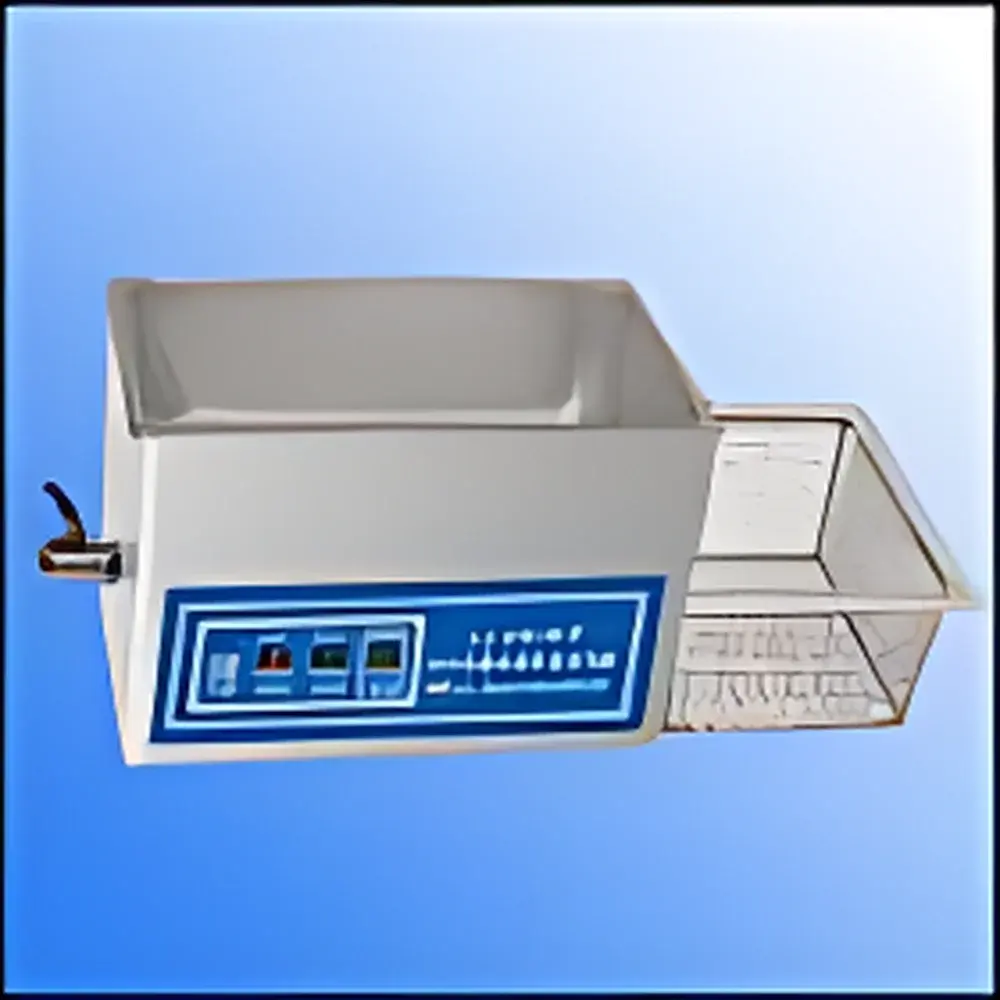
Shumei KQ-5200DB Benchtop Digital Ultrasonic Cleaner
| Brand | Shumei |
|---|---|
| Origin | Jiangsu, China |
| Model | KQ-5200DB |
| Type | General-purpose ultrasonic cleaner |
| Capacity | 10 L |
| Ultrasonic Frequency | 40 kHz |
| Ultrasonic Power Output | 200 W (adjustable 40–100%) |
| Heating Power | 600 W |
| Temperature Range | Ambient to 80 °C |
| Timer Range | 1–480 min |
| Internal Tank Dimensions (L×W×H) | 300 × 240 × 150 mm |
| Overall Dimensions (L×W×H) | 320 × 264 × 320 mm |
| Stainless Steel Mesh Basket | Included |
| Drain Valve | Manual |
| Noise Reduction Lid | Not included |
| Protection Features | Low-water detection, over-temperature, over-voltage, and over-current protection |
| Display | Digital LED with real-time and set-value monitoring for time, temperature, power, and cumulative operating hours (up to 999,999 h) |
| Construction | Inner tank and exterior housing fabricated from high-grade stainless steel (except select compact models) |
Overview
The Shumei KQ-5200DB is a benchtop digital ultrasonic cleaner engineered for precision cleaning, degassing, emulsification, homogenization, solvent extraction, particle size reduction, and cell lysis in laboratory, academic, and light industrial environments. It operates on the principle of ultrasonic cavitation: high-frequency sound waves (40 kHz) generate microscopic vacuum bubbles in the cleaning solution, which rapidly collapse to produce localized shockwaves and intense shear forces—effectively dislodging contaminants from surfaces without mechanical abrasion or chemical aggression. Designed as an integrated unit—with the ultrasonic generator and stainless steel tank co-located—the KQ-5200DB ensures consistent energy transfer, minimal signal loss, and stable acoustic field distribution across the 10-liter working volume. Its robust architecture supports reproducible results in routine QC/QA workflows, R&D sample preparation, and pre-analytical processing where particulate removal, surface decontamination, or interfacial disruption is critical.
Key Features
- Digital LED interface displaying real-time and set values for ultrasonic power (40–100% of 200 W), heating temperature (ambient to 80 °C), timer (1–480 min), and cumulative operational hours (up to 999,999 h)
- Integrated safety system with automatic shutdown triggered by low liquid level, over-temperature, over-voltage, and over-current conditions
- High-efficiency piezoelectric transducers (four units, 50 W each) bonded directly to the tank bottom for uniform energy distribution and long-term reliability
- 304 stainless steel inner tank (300 × 240 × 150 mm) and outer housing ensure corrosion resistance, structural integrity, and compatibility with aqueous and mild solvent-based cleaning media
- Included stainless steel mesh basket with argon-welded construction for secure sample placement and optimal acoustic coupling
- 600 W independent heating element enabling precise thermal control during sonication—critical for temperature-sensitive applications such as enzyme-assisted extraction or polymer dissolution
- Manual drain valve located at the tank base for controlled solution removal; no built-in pump or recirculation system
Sample Compatibility & Compliance
The KQ-5200DB accommodates a broad range of sample formats—including glassware (vials, cuvettes, chromatography columns), metal parts (surgical instruments, calibration standards), ceramic substrates, and polymer components—provided they are compatible with aqueous or low-to-moderate polarity solvents (e.g., water, isopropanol, ethanol, acetone, and diluted alkaline or acidic solutions). While not certified to ISO 13485 or FDA 21 CFR Part 11, its programmable parameters, digital audit trail (via cumulative hour counter), and repeatable operational profiles support GLP-aligned documentation practices in regulated laboratories. Users are advised to validate cleaning efficacy per application-specific protocols (e.g., ASTM D2271 for residue quantification or USP for cleaning validation in pharmaceutical settings).
Software & Data Management
This model does not incorporate PC connectivity, cloud synchronization, or proprietary software. All operation and parameter logging occur via the onboard microcontroller-based interface. The digital display retains user-defined settings across power cycles, and the cumulative hour counter serves as a maintenance tracking tool for transducer aging assessment and preventive service scheduling. For laboratories requiring electronic records, external data loggers or manual entry into LIMS systems is recommended. No firmware updates or remote diagnostics are supported.
Applications
- Routine cleaning of analytical glassware prior to HPLC, GC, or ICP-MS analysis to eliminate trace organic residues and adsorbed ions
- Removal of polishing compounds and embedded particles from optical lenses, semiconductor wafers, and MEMS devices
- Accelerated solvent extraction of plant metabolites, soil-bound contaminants, or tissue analytes
- Disruption of bacterial cell walls and eukaryotic cells for nucleic acid or protein isolation protocols
- Deagglomeration of nanoparticle suspensions and ceramic slurries prior to rheological or zeta potential measurement
- Preparation of reference standards and calibration materials requiring contaminant-free surfaces
FAQ
Is the KQ-5200DB suitable for use with flammable solvents?
No. Due to the absence of explosion-proof design, ventilation interlocks, or spark-resistant components, it must only be operated with non-flammable or low-flashpoint solvents under fume hood supervision.
Does the unit include a lid for noise reduction or vapor containment?
No. The KQ-5200DB ships without a sound-dampening lid. Operators should consider supplemental acoustic enclosures if ambient noise levels exceed occupational exposure limits (e.g., OSHA 29 CFR 1910.95).
Can the ultrasonic power be calibrated or verified traceably?
The unit lacks built-in power calibration functionality. Verification requires external hydrophone-based acoustic output measurement per IEC 61847 or ASTM E1065 standards.
What maintenance is required for long-term reliability?
Routine inspection of the stainless steel tank for pitting, verification of drain valve seal integrity, and periodic cleaning of transducer surfaces with isopropyl alcohol are recommended. Transducer performance should be assessed annually using aluminum foil erosion testing.
Is the heating function independent of ultrasonic activation?
Yes. Temperature control operates independently, allowing users to heat the bath before, during, or after sonication—enabling optimized thermal-sonic synergies for specific chemistries.



