
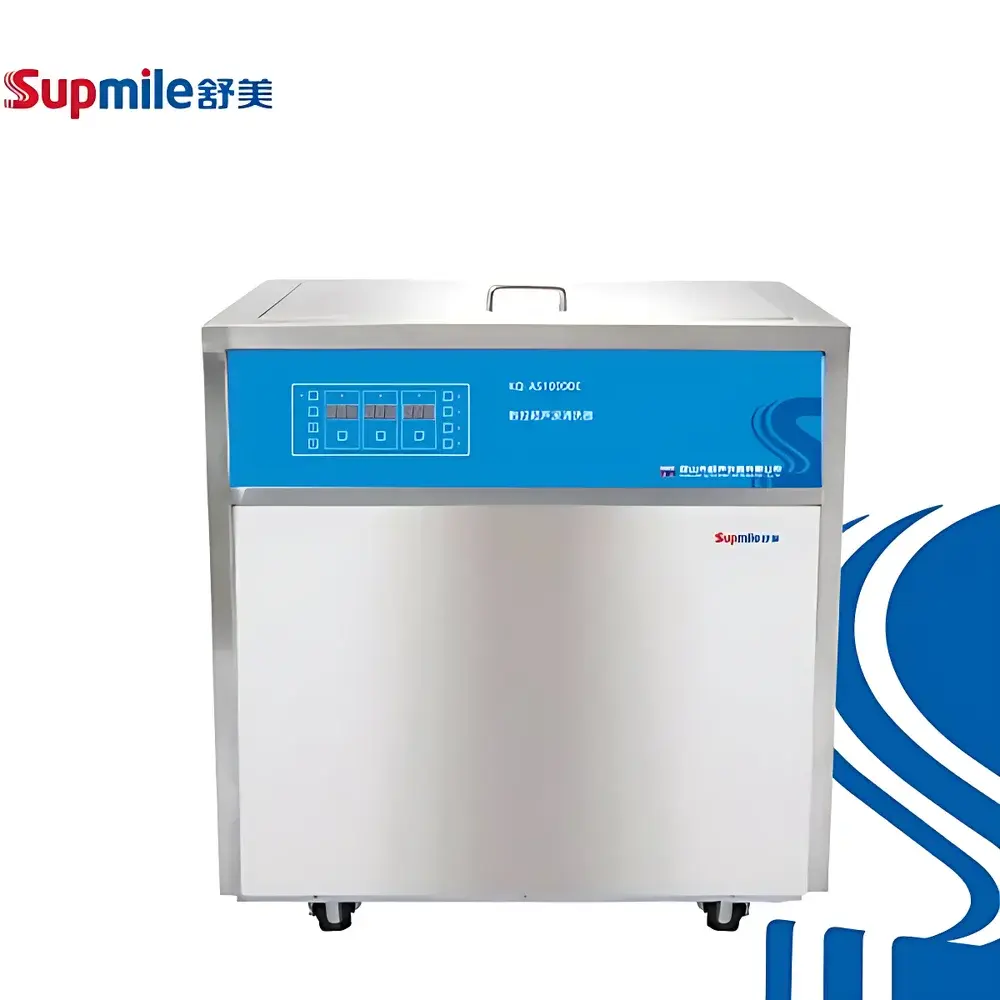
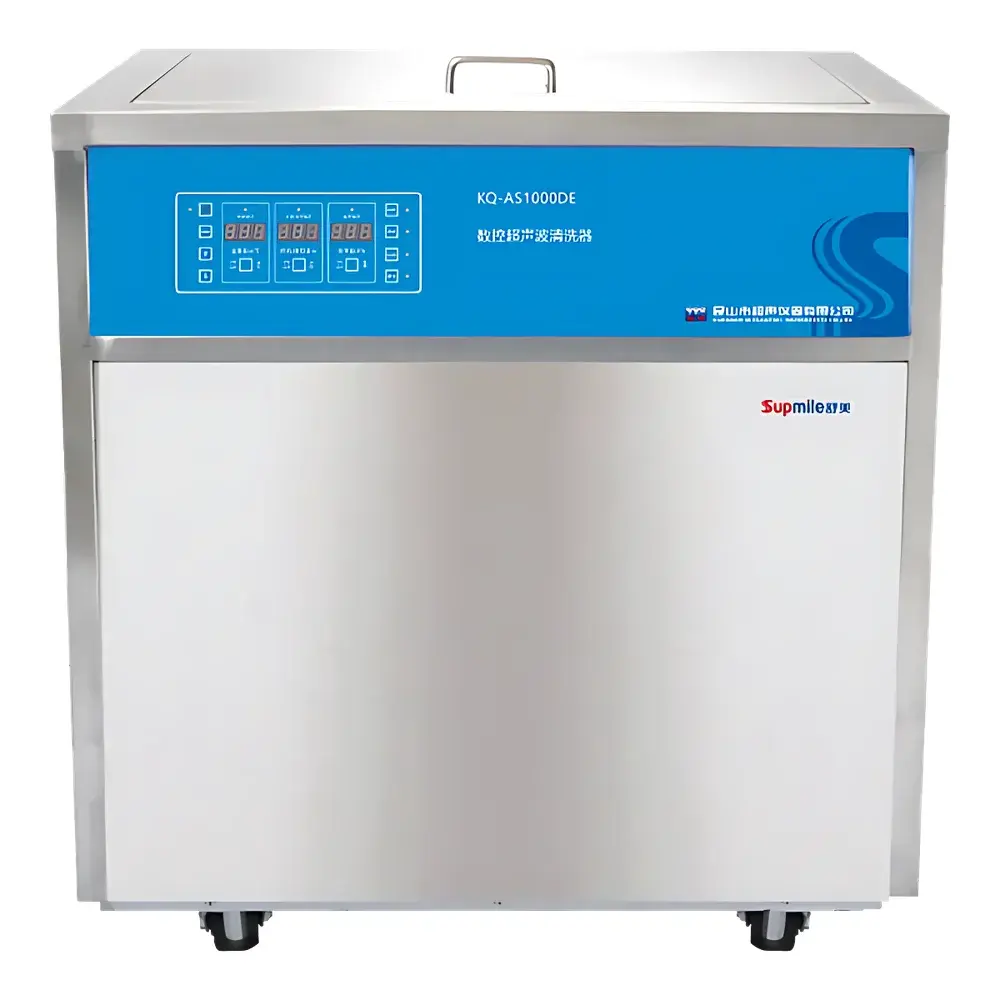
Shumei KQ-AS1000DE Digital Ultrasonic Cleaner
| Brand | Shumei |
|---|---|
| Origin | Jiangsu, China |
| Manufacturer Type | Direct Manufacturer |
| Equipment Type | General-Purpose Ultrasonic Cleaner |
| Capacity | 72 L |
| Ultrasonic Frequency | 40 kHz |
| Ultrasonic Power Output | 1000 W (Adjustable 40–100%) |
| Heating Power | 3000 W |
| Temperature Range | Ambient to 80 °C (Adjustable) |
| Timer Range | 1–480 min |
| Sound-Dampening Lid | Electrically Actuated |
| Automatic Fill/Drain | Electrically Controlled |
| Internal Tank Dimensions | 600 × 300 × 400 mm |
| External Dimensions | 800 × 750 × 810 mm |
| Construction Material | 304 Stainless Steel |
| Liquid Level Monitoring & Protection | Yes |
| Solution Filtration System | Integrated |
| Power Supply | AC 220 V / 50 Hz or AC 380 V / 50 Hz |
Overview
The Shumei KQ-AS1000DE Digital Ultrasonic Cleaner is a high-capacity, microprocessor-controlled cleaning system engineered for reproducible, residue-free cleaning of laboratory glassware, precision components, medical instruments, and industrial parts. It operates on the principle of cavitation—generating high-frequency acoustic pressure waves (40 kHz) in aqueous or solvent-based cleaning media to produce transient microbubbles that collapse with localized energy release, effectively dislodging particulate contaminants, organic films, and biofilms from complex geometries and microsurfaces. Designed for routine and demanding cleaning workflows in QC laboratories, R&D facilities, and manufacturing cleanrooms, the unit integrates robust thermal management, programmable process control, and fail-safe operational safeguards—all housed within a fully welded 304 stainless steel chassis compliant with ISO 13485-aligned fabrication standards.
Key Features
- Microcontroller-based digital interface enabling precise, repeatable parameter programming—including ultrasonic power (40–100% of 1000 W), heating temperature (ambient to 80 °C), and cycle duration (1–480 minutes).
- Integrated 3000 W heating element with real-time temperature feedback and dual-point monitoring (setpoint vs. actual bath temperature), ensuring thermal stability within ±1.5 °C across the full operating range.
- Electrically actuated sound-dampening lid with interlock safety switch, reducing ambient noise to ≤65 dB(A) at 1 m distance and minimizing heat loss and solvent evaporation.
- Automated electric fill-and-drain system with level-sensing logic, supporting unattended batch processing and integration into multi-step cleaning protocols.
- Onboard liquid level sensor with visual and audible low-level alarm, plus dry-run protection to prevent transducer damage during operation.
- Integrated filtration module with replaceable 50 µm mesh cartridge, enabling continuous recirculation and particulate removal during extended cleaning cycles.
- Comprehensive electronic protection suite: over-temperature, over-voltage, over-current, and no-solution detection—each logged with timestamped event flags in non-volatile memory.
Sample Compatibility & Compliance
The KQ-AS1000DE accommodates a wide range of sample types—including volumetric flasks, centrifuge tubes, surgical forceps, optical lenses, printed circuit boards, and ceramic substrates—without risk of surface erosion or dimensional distortion under standard operating conditions. Its 72 L capacity and 600 × 300 × 400 mm tank volume support large-batch processing while maintaining uniform cavitation distribution, verified per ASTM E1999-22 guidelines for ultrasonic cleaner performance mapping. The unit conforms to IEC 61000-6-3 (EMC emissions) and IEC 61000-6-2 (immunity), and its construction materials meet FDA-relevant criteria for indirect food-contact equipment (21 CFR §177.1520). While not certified for sterile processing per ISO 17664, it is routinely deployed as a pre-sterilization cleaning step in GLP-compliant laboratories adhering to USP and ISO 15883-1 validation frameworks.
Software & Data Management
All operational parameters and system events are displayed via a high-contrast LED interface with backlighting for low-light environments. The embedded controller stores up to 10 user-defined cleaning profiles, each retaining power level, temperature setpoint, timer value, and activation history. Event logs—including fault codes, start/stop timestamps, and temperature/power deviations—are retained for ≥30 days and exportable via optional RS-232 serial interface (not included) for integration with LIMS or electronic lab notebooks. Audit trail functionality satisfies basic ALCOA+ data integrity requirements for non-GMP environments; for full 21 CFR Part 11 compliance, external validation and electronic signature modules must be implemented at the facility level.
Applications
- Removal of polishing compounds, metal fines, and flux residues from machined metal parts prior to metrology or coating.
- Cleaning of HPLC vials, GC autosampler trays, and spectrophotometer cuvettes to eliminate carryover and baseline drift.
- Preparation of electron microscopy grids and TEM specimens requiring sub-micron particle-free surfaces.
- Decontamination of reusable endoscopic accessories in hospital central sterile supply departments (CSSD), aligned with AAMI ST79:2023 Annex D recommendations.
- Extraction support for environmental sample prep—e.g., PCBs from soil matrices or PAHs from sediment slurries—where mechanical agitation must avoid analyte degradation.
FAQ
What is the maximum recommended cleaning temperature for aqueous solutions?
The system supports heating up to 80 °C; however, for aqueous detergents containing surfactants or enzymes, a maximum of 60 °C is advised to preserve cleaning efficacy and prevent denaturation.
Can the unit operate continuously for 8 hours?
Yes—thermal management and duty-cycle design allow uninterrupted operation within specified ambient conditions (≤32 °C, <70% RH); periodic inspection of filtration cartridge and solution clarity is recommended every 4 hours.
Is the stainless steel tank electropolished?
No—the interior surface is mechanically polished 304 stainless steel (Ra ≤ 0.8 µm), suitable for general laboratory use but not classified as electropolished per ASTM A967.
Does the system include calibration documentation?
Factory calibration certificates for temperature and timer accuracy are provided; users must perform periodic verification per their internal SOPs using NIST-traceable reference standards.
What maintenance intervals are recommended for the filtration system?
The 50 µm filter cartridge should be inspected after each 10 cleaning cycles or daily in high-particulate applications, and replaced when visibly clogged or after 30 operational hours—whichever occurs first.



