
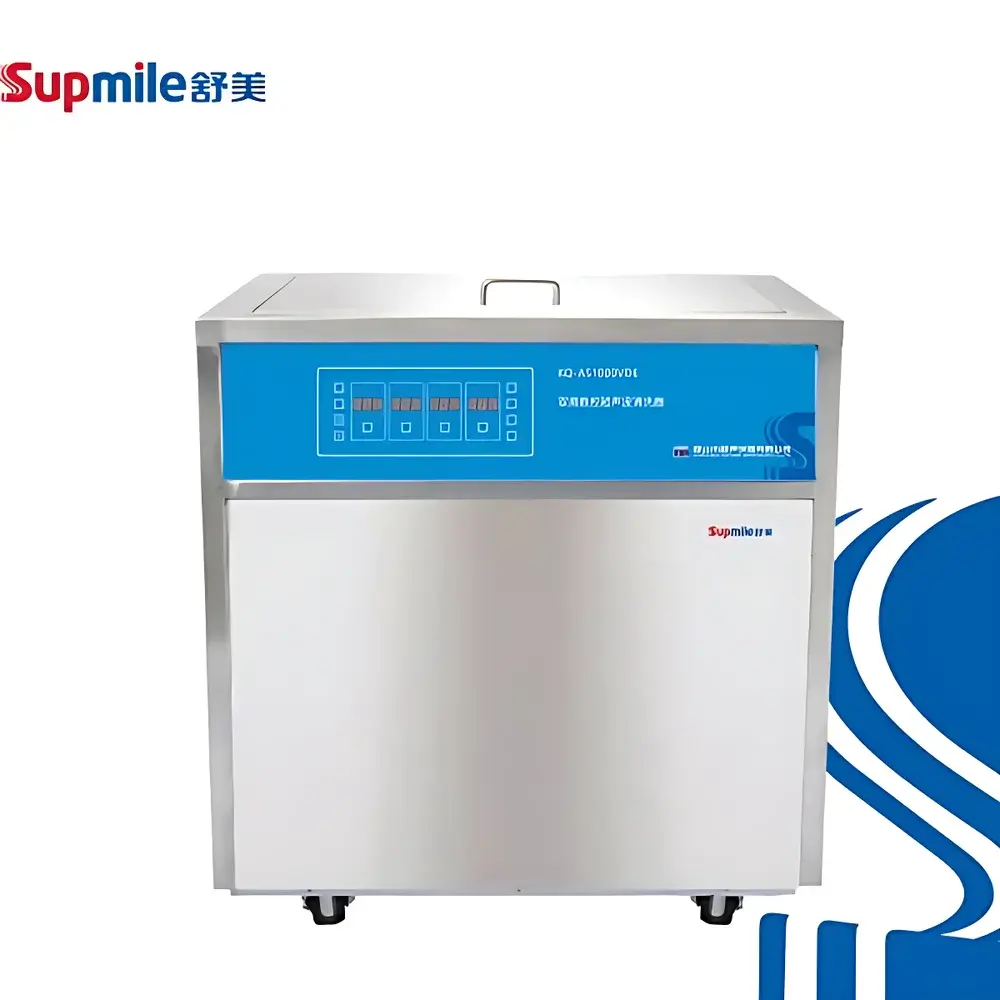
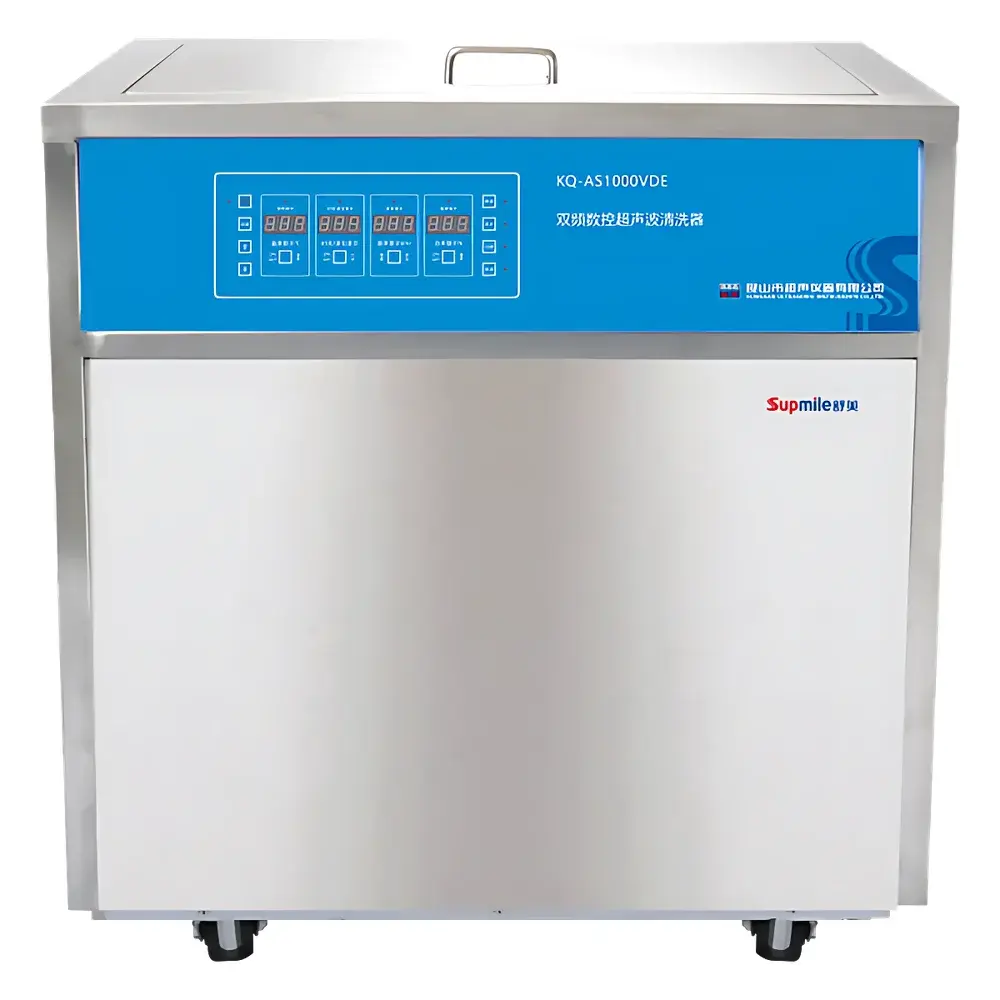
Shumei KQ-AS1000VDE Dual-Frequency Digital Ultrasonic Cleaner
| Brand | Shumei |
|---|---|
| Origin | Jiangsu, China |
| Manufacturer Type | Direct Manufacturer |
| Instrument Type | General-Purpose Ultrasonic Cleaner |
| Capacity | 72 L |
| Ultrasonic Frequencies | 45 kHz / 80 kHz |
| Total Ultrasonic Power | 1000 W |
| Power Adjustment Range | 40–100% |
| Heating Temperature Range | Ambient to 80 °C |
| Heating Power | 3000 W |
| Timer Range | 1–480 min |
| Frequency Switching Interval | 0–999 s |
| Lid | Motorized Noise-Reduction Cover |
| Drain/Inlet | Electrically Actuated |
| Tank Dimensions (L×W×H) | 600 × 300 × 400 mm |
| External Dimensions (L×W×H) | 800 × 750 × 810 mm |
| Tank Material | 304 Stainless Steel |
| Protection Features | Low-Level Liquid Detection, Over-Temperature, Over-Voltage, Over-Current, Empty-Tank Safety Lockout |
| Filtration System | Integrated Solution Filter |
| Power Supply | AC 220 V / 50 Hz or AC 380 V / 50 Hz |
Overview
The Shumei KQ-AS1000VDE Dual-Frequency Digital Ultrasonic Cleaner is an industrial-grade laboratory cleaning system engineered for high-reproducibility removal of particulate, organic, and inorganic contaminants from precision components, glassware, surgical instruments, semiconductor wafers, and analytical sample preparation vessels. It operates on the principle of acoustic cavitation—where controlled ultrasonic energy at two discrete frequencies (45 kHz and 80 kHz) generates microbubble implosion within the cleaning medium, producing localized shear forces and transient high temperatures (>5,000 K) that disrupt adhesion bonds without mechanical abrasion. The dual-frequency architecture enables optimized cleaning across heterogeneous sample geometries and contaminant types: lower frequency (45 kHz) delivers higher cavitation intensity for robust particulate removal, while higher frequency (80 kHz) provides finer resolution for delicate surfaces and sub-micron residue clearance. Designed for continuous operation in QC labs, medical device reprocessing units, and R&D environments, the unit integrates a 72 L stainless steel tank constructed entirely from ASTM A240 304 stainless steel—ensuring corrosion resistance against aqueous alkaline, acidic, and solvent-based cleaning solutions.
Key Features
- Dual-frequency ultrasonic generation (45 kHz / 80 kHz) with user-defined switching intervals (0–999 s), enabling adaptive cleaning protocols for multi-step decontamination workflows.
- Full digital control via embedded microprocessor: real-time display and programmable setting of ultrasonic power (40–100%), temperature (ambient to 80 °C), timer (1–480 min), and frequency transition timing.
- Integrated safety architecture including automatic shutdown upon low liquid level detection, over-temperature, over-voltage, over-current, and dry-tank conditions—fully compliant with IEC 61000-6-2/6-4 EMC and EN 61010-1 safety standards.
- Motorized noise-reduction lid with position-sensing actuation and interlocked safety cutoff—reducing operational sound pressure levels to ≤65 dB(A) at 1 m distance.
- Electrically actuated inlet and drain valves with flow monitoring, supporting automated fill-and-dump cycles in unattended operation modes.
- Onboard solution filtration system with removable stainless steel mesh filter (20 µm nominal retention) to extend bath life and maintain consistent cavitation efficiency.
- Heating module rated at 3000 W, delivering uniform thermal distribution with ±1 °C stability across the full 72 L volume.
Sample Compatibility & Compliance
The KQ-AS1000VDE accommodates a broad range of sample formats—including beakers, flasks, Petri dishes, pipette tips, endoscopes, optical lenses, MEMS devices, and printed circuit boards—via its large internal tank (600 × 300 × 400 mm) and included 304 stainless steel wire mesh basket. Its construction and operational parameters align with key international hygiene and validation requirements: cleaning cycle repeatability supports ISO 15883-1 (washer-disinfectors), ASTM F3127 (ultrasonic cleaner qualification), and FDA-recommended validation practices for reusable medical devices under 21 CFR Part 820. While not certified as a Class II medical device, its design facilitates IQ/OQ/PQ documentation for GMP and GLP-regulated laboratories. All electrical interfaces meet CE marking directives; no hazardous substances are used per RoHS 2011/65/EU.
Software & Data Management
The system features a non-volatile memory module that retains up to 100 user-defined cleaning programs—including power profiles, temperature ramps, dual-frequency sequencing logic, and dwell times—with timestamped execution logs stored onboard for audit trail purposes. Though lacking Ethernet or USB export, the interface supports manual data capture via RS-232 serial output (optional adapter) compatible with LabArchives, Electronic Lab Notebook (ELN) platforms, and LIMS integration. All parameter changes are logged with operator ID (via front-panel entry), date/time stamp, and pre/post-set values—meeting foundational traceability requirements for FDA 21 CFR Part 11 Annex 11 alignment when paired with institutional procedural controls.
Applications
- Pre-analytical sample preparation: removal of residual solvents, oils, or biological matrix from HPLC vials, GC autosampler trays, and ICP-MS nebulizer components.
- Medical device reprocessing: validated cleaning of laparoscopic instruments, biopsy forceps, and dental handpieces prior to sterilization.
- Electronics manufacturing: post-reflow flux residue removal from PCB assemblies and SMT stencils without solder mask degradation.
- Materials science: debubbling ceramic slurries, dispersing nanomaterials in suspension, and surface activation of polymers prior to coating.
- Pharmaceutical QA/QC: cleaning of tablet punches, capsule fillers, and dissolution apparatus vessels in accordance with USP and EP 2.6.27 guidelines.
FAQ
Is the KQ-AS1000VDE suitable for use with flammable solvents?
No. This unit is designed exclusively for aqueous and water-miscible cleaning solutions. Use with flammable or low-flashpoint solvents violates IEC 60079 and requires explosion-proof certification not present in this model.
Can frequency switching be synchronized with temperature ramping?
Yes—through sequential program steps, users can define discrete phases where frequency, power, and temperature change independently or concurrently, enabling complex multi-stage cleaning protocols.
What maintenance is required for long-term reliability?
Monthly inspection of transducer mounting integrity, quarterly replacement of the 20 µm filter element, and annual verification of temperature sensor calibration using NIST-traceable reference thermometers.
Does the unit support external trigger input for integration into automated lines?
Yes—dry-contact start/stop inputs are provided on the rear I/O terminal block, allowing synchronization with conveyor systems or robotic arms.
Is validation documentation available from the manufacturer?
Shumei provides a Factory Acceptance Test (FAT) report and material compliance certificates (RoHS, REACH, 304 SS mill test reports); full IQ/OQ protocols must be developed by the end user per ISO/IEC 17025 requirements.
Related Products



