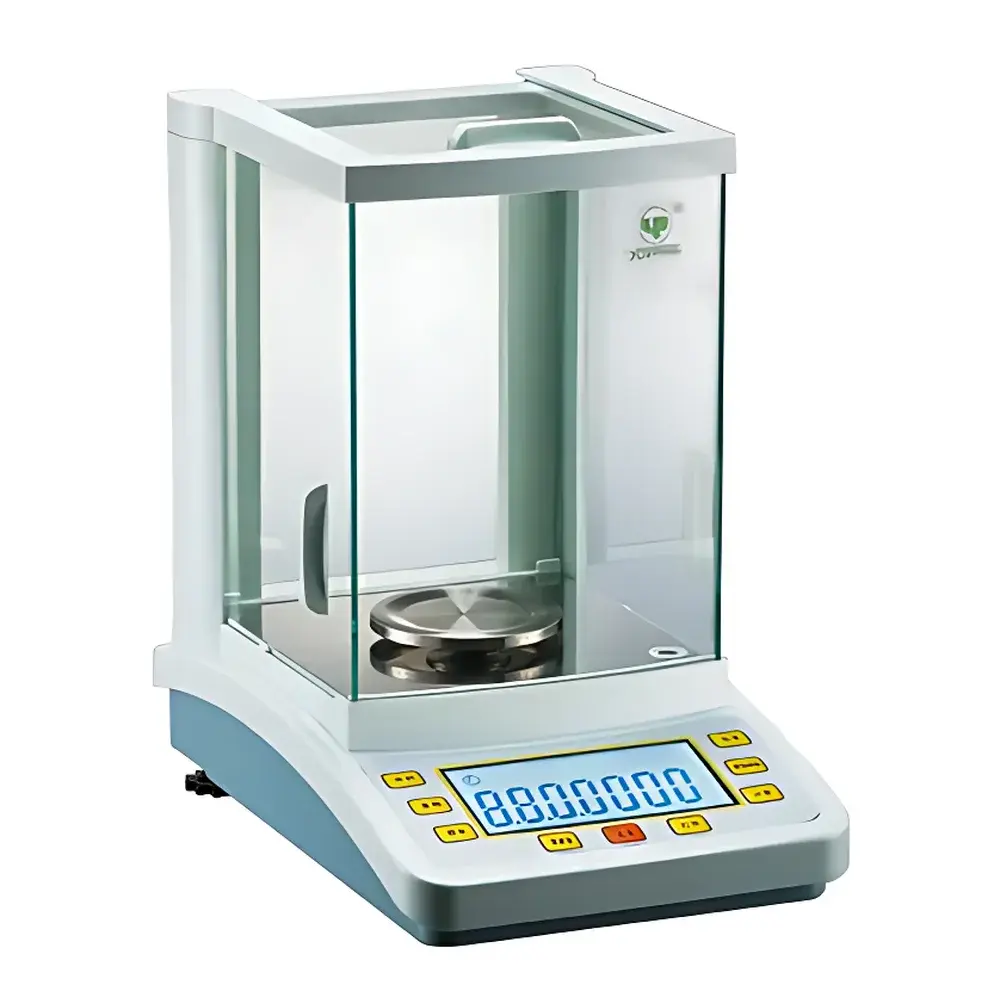
SHYP JA2003C Internal Calibration Analytical Balance
| Brand | SHYP |
|---|---|
| Origin | Shanghai, China |
| Model | JA2003C |
| Maximum Capacity | 200 g |
| Readability | 1 mg |
| Calibration Method | Internal Automatic Calibration |
| Pan Diameter | 90 mm |
| Dimensions (W×D×H) | 350 × 215 × 340 mm |
| Net Weight | 6.8 kg |
| Compliance | CE, ISO 9001 certified manufacturing |
| Interface | RS232C serial output |
| Display | Backlit LCD with real-time status indicators (warm-up, calibration, standby) |
| Environmental Operating Range | 10–30 °C, <80% RH non-condensing |
| Protection Class | IP42 |
| Software Compatibility | Standard ASCII protocol for LIMS/ERP integration |
Overview
The SHYP JA2003C is a precision internal calibration analytical balance engineered for routine quantitative analysis in quality control laboratories, academic research settings, and pharmaceutical production environments where traceable mass measurement at the milligram level is required. It operates on the principle of electromagnetic force compensation — a high-stability transduction method in which the downward gravitational force exerted by a sample is counterbalanced by a precisely regulated electromagnetic current. The resulting current is linearly proportional to mass and digitally converted into a stable, repeatable reading. Unlike external calibration workflows that introduce operator-dependent variables and environmental drift, the JA2003C integrates a motorized dual-cam internal calibration mechanism with factory-traceable reference weights, enabling automatic recalibration at user-defined intervals or upon power-on — ensuring metrological continuity without manual intervention.
Key Features
- Internal automatic calibration system with motor-driven dual-cam actuation and integrated stainless-steel reference masses, compliant with ISO 17025 traceability requirements when used within defined environmental conditions.
- Electromagnetic force restoration sensor with thermal drift compensation circuitry, delivering consistent repeatability ≤ ±0.002 g under stabilized ambient conditions (ASTM E898-22).
- Five-sided transparent draft shield constructed from optically clear acrylic, minimizing air turbulence while permitting unobstructed visual monitoring during weighing procedures.
- Backlit 128×64 pixel LCD display with dynamic status icons indicating warm-up progress, active calibration sequence, zero-tracking mode, and overload alerts.
- RS232C serial interface supporting standard ASCII data output at 9600 baud, compatible with laboratory information management systems (LIMS), electronic lab notebooks (ELN), and automated reporting software.
- Built-in below-balance hook for density determination, magnetic susceptibility testing, or suspended sample measurement per ASTM D792 and ISO 1183 protocols.
- Comprehensive application suite including piece counting (PCS), unit conversion (g, mg, ct, oz t, dwt), percent weighing, totalization, and auto-zero tracking with adjustable sensitivity threshold.
Sample Compatibility & Compliance
The JA2003C accommodates standard laboratory samples up to 200 g on its 90 mm diameter stainless-steel weighing pan. Its design supports compliance with Good Laboratory Practice (GLP) and Good Manufacturing Practice (GMP) documentation requirements through timestamped calibration logs (accessible via RS232) and built-in audit trail functionality. While not inherently 21 CFR Part 11 compliant due to lack of user authentication or electronic signature capability, it may be deployed in Part 11–regulated environments when paired with validated third-party data acquisition software that enforces access controls and immutable record retention. The instrument meets CE marking directives for electromagnetic compatibility (2014/30/EU) and low voltage safety (2014/35/EU), and is manufactured under an ISO 9001–certified quality management system.
Software & Data Management
Data export follows NIST-traceable ASCII formatting via RS232C, enabling seamless integration with Microsoft Excel, LabArchives, Thermo Fisher SampleManager, or custom Python-based validation scripts. Each transmitted record includes weight value, unit identifier, date/time stamp, and operational status flag (e.g., “CAL”, “STAB”, “OVER”). No proprietary driver installation is required; terminal emulation tools such as Tera Term or PuTTY suffice for raw data capture. Optional PC-based configuration utilities (available separately) allow adjustment of filter response time, auto-zero delay, and calibration scheduling parameters — all stored in non-volatile memory with battery-backed retention.
Applications
This balance serves core functions across multiple regulated and non-regulated domains: formulation of active pharmaceutical ingredients (APIs) per USP <41>; gravimetric preparation of calibration standards for ICP-MS and HPLC; moisture content determination using loss-on-drying protocols (ASTM D2231); catalyst loading in heterogeneous catalysis studies; powder blend uniformity testing in solid dosage form development; and educational demonstrations of mass conservation and stoichiometric calculations. Its 1 mg readability and internal calibration architecture make it especially suitable for applications requiring daily verification without reliance on external Class M1 or M2 test weights.
FAQ
Does the JA2003C support external calibration with user-provided weights?
No — the unit is designed exclusively for internal calibration. External calibration is neither supported nor recommended, as the sensor and feedback loop are optimized for the integrated reference mass set.
What is the warm-up time required before first use?
Minimum 30 minutes at stable room temperature (20–25 °C) is recommended to achieve thermal equilibrium of the electromagnetic sensor and analog front-end circuitry.
Can the balance operate continuously in a fume hood environment?
Not advised — exposure to corrosive vapors, rapid temperature gradients, or airflow exceeding 0.2 m/s will compromise repeatability and accelerate mechanical wear of the internal calibration cam mechanism.
Is the RS232 interface optically isolated?
No — the interface uses standard TTL-level signaling without galvanic isolation. Use of a USB-to-RS232 adapter with surge protection is recommended in electrically noisy industrial labs.
How often should internal calibration be performed?
Daily calibration is recommended for GLP-compliant operations; however, frequency may be extended to per-shift or pre-use based on risk assessment, environmental stability, and historical performance data per ISO/IEC 17025 clause 7.7.