
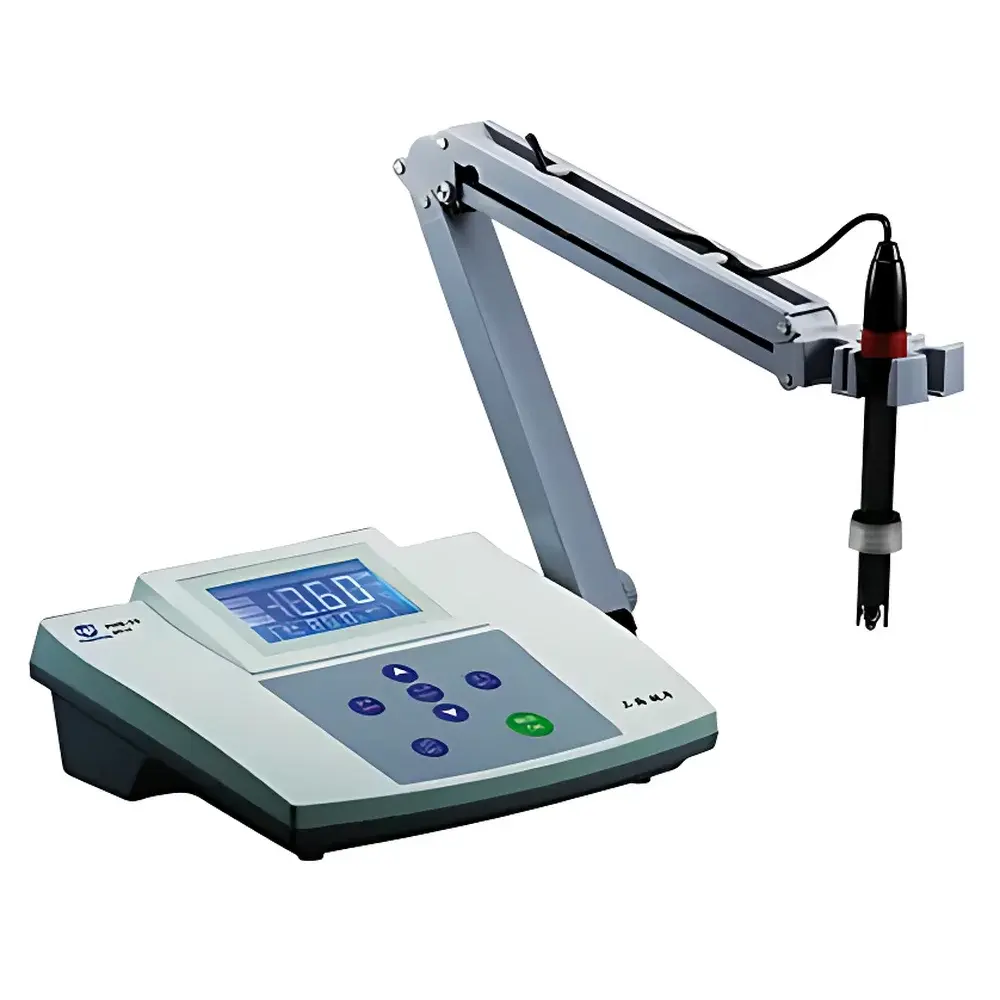
SHYP PHS-25 / PHS-3C Benchtop pH Meter
| Brand | SHYP (Shanghai Yueping Scientific Instrument Co., Ltd.) |
|---|---|
| Origin | Shanghai, China |
| Instrument Type | Benchtop pH Meter |
| Parameter Type | Single-Parameter (pH & mV) |
| Accuracy | ±0.02 pH ±1 digit |
| Measurement Range | pH 0.00–14.00 (PHS-25) |
| mV Range | 0 to ±1999 mV |
| Resolution | 0.01 pH / 1 mV |
| Temperature Compensation | Manual or Automatic (0.0–60.0 °C) |
| Input Impedance | ≥1 × 10¹² Ω |
| Input Current | ≤1 × 10⁻¹² A |
| Stability | (±0.05 pH ±1 digit) / 3 h |
| Power Supply | DC 12 V, 1.0 A |
| Dimensions | 220 × 160 × 65 mm |
| Weight | 1.5 kg |
Overview
The SHYP PHS-25 and PHS-3C are benchtop electrochemical instruments engineered for routine pH and millivolt (mV) measurements in academic teaching laboratories, quality control environments, and small-scale industrial process monitoring. Both models operate on the potentiometric principle: measuring the potential difference between a pH-sensitive glass electrode and a stable reference electrode immersed in an aqueous sample, converting it into a logarithmic pH value via the Nernst equation. The PHS-25 conforms to Chinese national instrument standard JJG 119–2018 for Class 0.05 pH meters, while the PHS-3C meets Class 0.01 specifications—making it suitable for applications requiring higher metrological rigor, including calibration verification and buffer standardization. Designed with a robust plastic housing and integrated electrode stand, these meters deliver consistent performance under ambient laboratory conditions without requiring environmental enclosures or vibration isolation.
Key Features
- LCD display with dual-parameter readout: simultaneous pH and mV values, with polarity indication for redox measurements
- Manual or automatic temperature compensation (0.0–60.0 °C), supporting both fixed-temperature input and external Pt100 sensor integration (via optional interface)
- One-point or two-point calibration protocol compliant with ISO 7888 and ASTM D1293, using standard NIST-traceable buffers (e.g., pH 4.01, 7.00, 10.01 at 25 °C)
- High-input-impedance amplifier (≥1 × 10¹² Ω) minimizes loading effects during measurement of low-conductivity samples (e.g., deionized water, ethanol–water mixtures)
- Stable DC power architecture (12 V, 1.0 A) eliminates AC line noise interference common in analog meters; no internal battery dependency ensures long-term baseline consistency
- Compact footprint (220 × 160 × 65 mm) and lightweight design (1.5 kg) facilitate placement on fume hoods, laminar flow benches, or mobile QC carts
Sample Compatibility & Compliance
The PHS-25/PHS-3C is validated for use with aqueous and mildly polar liquid samples having conductivity ≥50 µS/cm. It supports standard combination electrodes (e.g., SHYP E-201-C type) featuring Ag/AgCl reference systems and low-resistance glass membranes optimized for general-purpose analysis. Non-aqueous or high-viscosity samples require appropriate electrode selection and procedural validation per ISO 17025 clause 7.2.2. The instrument complies with electromagnetic compatibility requirements per GB/T 18268.1–2010 (equivalent to IEC 61326-1), and its electrical safety design conforms to GB 4793.1–2007 (IEC 61010-1). While not certified for GMP-regulated environments out-of-the-box, audit-ready operation—including manual calibration logs, electrode history tracking, and defined SOPs—is achievable when deployed within a documented laboratory quality system aligned with ISO/IEC 17025 or FDA 21 CFR Part 11 (with supplemental electronic record controls).
Software & Data Management
These models operate as standalone hardware units without embedded data logging or USB connectivity. All measurement records must be manually transcribed or captured externally via serial output (RS-232 interface available on select configurations, requiring optional cable and terminal software). Users implementing GLP or ISO 17025 workflows are advised to maintain bound logbooks with pre-numbered pages, signed entries for calibration, electrode conditioning, and sample ID traceability. For automated data capture, third-party DAQ systems compatible with TTL-level serial output can be integrated—enabling timestamped CSV export and basic statistical reporting (e.g., mean, SD, CV%) across replicate measurements.
Applications
- Educational labs: Student experiments in general chemistry, environmental science, and food technology curricula
- Water treatment facilities: Monitoring influent/effluent pH in municipal wastewater streams per EPA Method 150.1
- Pharmaceutical manufacturing: In-process checks of cleaning solution acidity during equipment sanitization (non-GMP critical use)
- Agricultural testing: Soil extract pH determination following AOAC 973.41 methodology
- Electroplating bath control: Real-time acid concentration tracking in sulfuric acid-based electrolytes
- Research prototyping: As a reference meter for validating custom sensor arrays or microfluidic pH detection modules
FAQ
What electrode types are compatible with the PHS-25/PHS-3C?
The meter is designed for use with standard BNC-connected combination pH electrodes rated for general-purpose aqueous measurement. SHYP E-201-C is the recommended model; other electrodes meeting impedance <100 MΩ and output voltage range ±1200 mV are functionally compatible.
Does the instrument support automatic calibration recognition (ARC)?
No. Calibration requires manual entry of buffer pH values prior to immersion; the device does not auto-detect buffer identity or concentration.
Can this meter be used for non-aqueous titrations?
Not without method validation. Its default calibration assumes aqueous activity coefficients. Measurements in solvents like methanol or acetone require empirical slope correction and separate temperature-dependent calibration curves.
Is there a CE or UKCA mark affixed to the unit?
No. As a domestically certified instrument sold primarily within mainland China, it carries CCC (China Compulsory Certification) but lacks EU or UK conformity markings.
What maintenance intervals are recommended for long-term accuracy?
Electrode storage in 3 M KCl solution is mandatory between uses; full recalibration before each analytical session is advised. Annual verification against certified reference materials (e.g., NIST SRM 186c) is recommended for ISO 17025-compliant operations.
Related Products





