
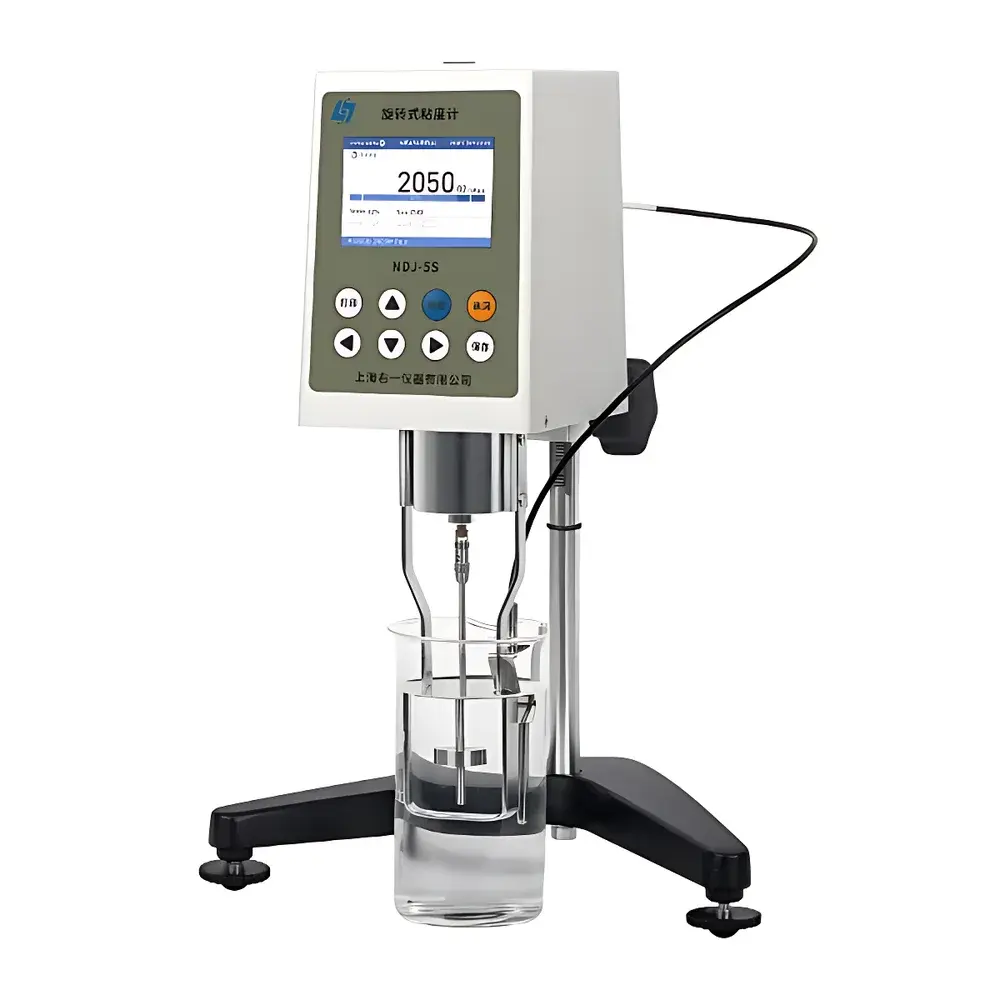
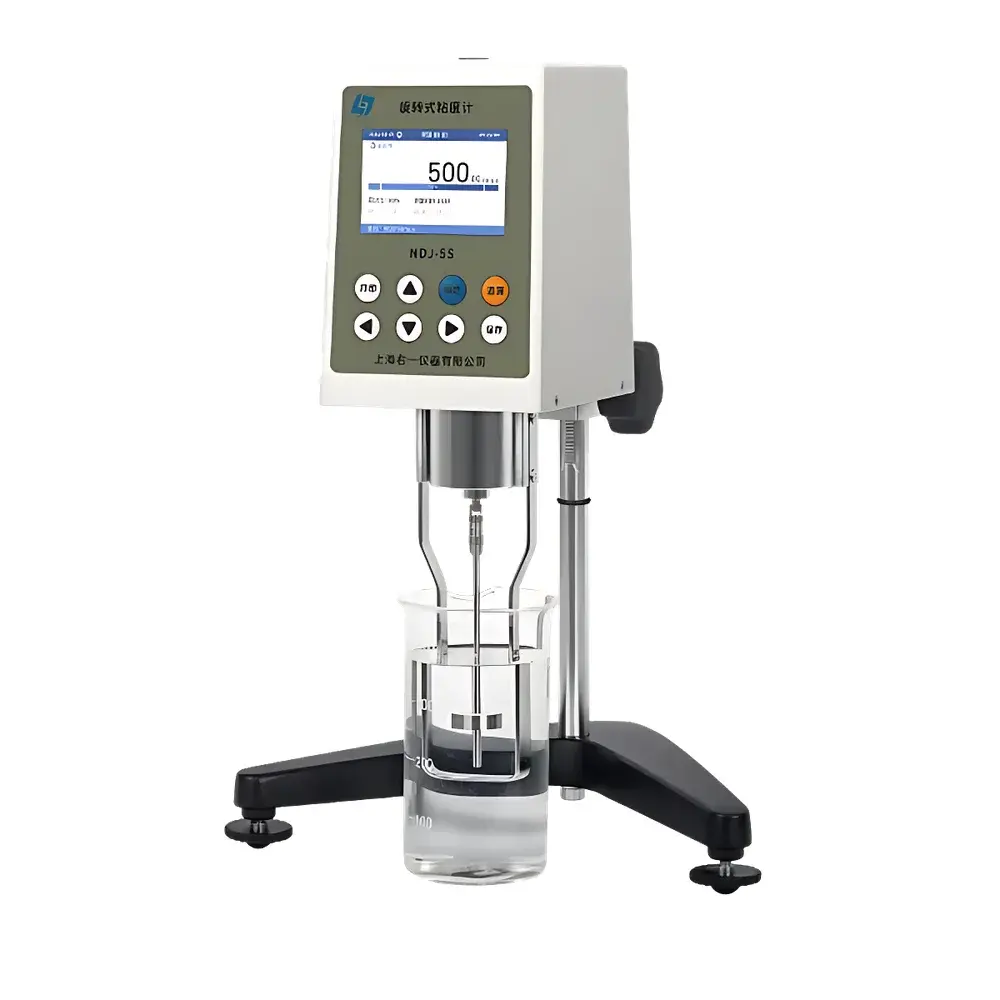
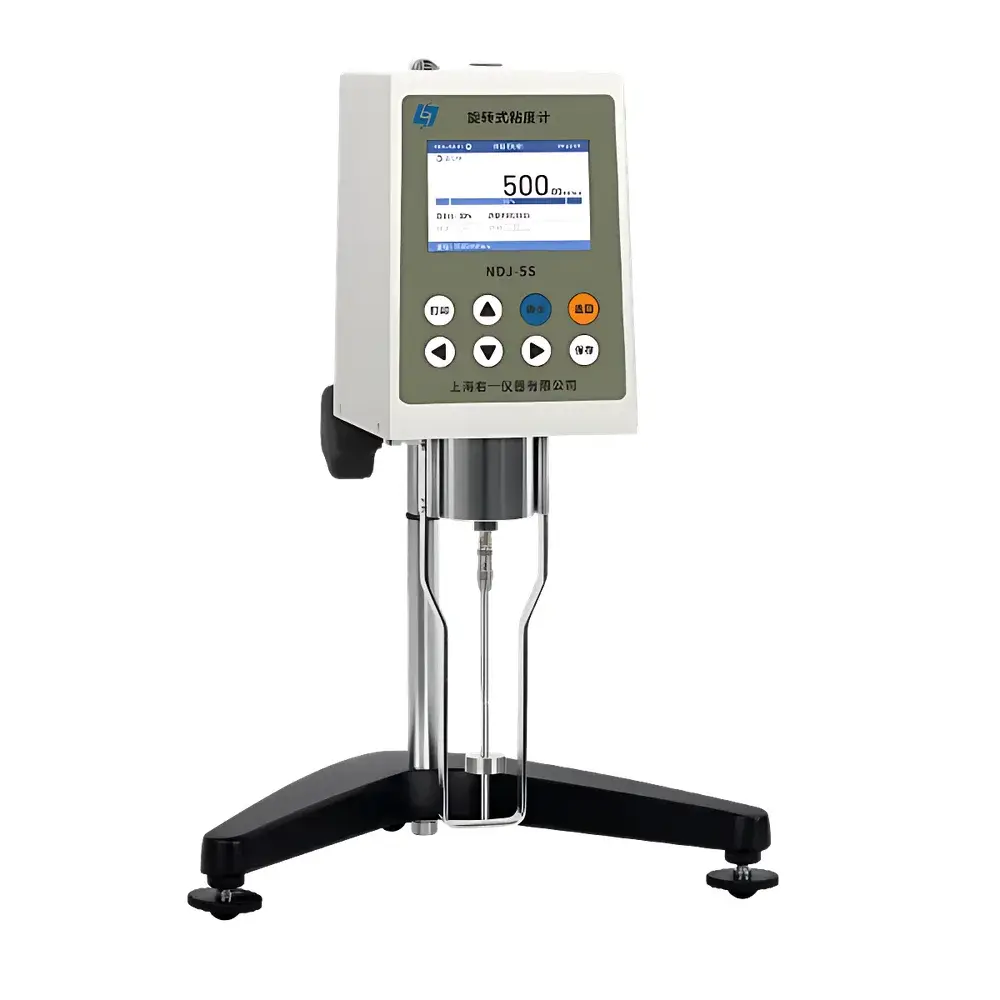
SHYY NDJ-5S Digital Rotational Viscometer
| Brand | SHYY |
|---|---|
| Origin | Shanghai, China |
| Manufacturer Type | Direct Manufacturer |
| Product Category | Domestic |
| Model | NDJ-5S |
| Instrument Type | Rotational Viscometer |
| Operating Environment | Ambient Temperature |
| Viscosity Range | 0.1–100,000 mPa·s |
| Temperature Range | 0–150 °C |
| Temperature Resolution | 0.01 °C |
| Temperature Accuracy | ±2 °C |
| Viscosity Resolution | 0.01 mPa·s |
| Measurement Accuracy | ±2% (for Newtonian fluids) |
| Repeatability | ±1% (for Newtonian fluids) |
| Speed Settings | 6, 12, 30, 60 rpm |
| Standard Spindles | #1–#4 |
| Optional Spindle | #0 |
| Display | 3.5-inch IPS color LCD |
| Data Storage | 50 measurement records |
| Communication Interfaces | USB, RS-232, optional temperature probe input |
| Power Supply | 100–240 VAC, 50 Hz ±10% |
| Dimensions | 280 × 260 × 290 mm |
| Net Weight | 6.8 kg |
Overview
The SHYY NDJ-5S Digital Rotational Viscometer is a precision-engineered instrument designed for routine and quality control viscosity measurements of Newtonian and mildly non-Newtonian fluids under ambient or controlled temperature conditions. Based on the Couette principle, it determines dynamic viscosity by quantifying the torque required to rotate a cylindrical spindle (spindle geometry defined per ASTM D2196 and ISO 2555) at a constant angular velocity within a sample. The device operates with four fixed rotational speeds—6, 12, 30, and 60 rpm—and supports four standard spindles (#1–#4), yielding 16 discrete measurement combinations across its full range of 0.1–100,000 mPa·s. Its robust mechanical architecture, integrated leveling system with adjustable feet and bubble level, and shielded one-piece housing ensure stable operation in shared laboratory environments where electromagnetic interference may affect signal integrity.
Key Features
- 3.5-inch high-resolution IPS color LCD display showing real-time viscosity, spindle number, rotational speed, sample temperature (with optional probe), torque percentage, and maximum measurable viscosity for the selected spindle/speed pair
- Microprocessor-based control system enabling precise data acquisition, automatic stabilization detection, and consistent timing logic across measurement modes
- Three operational modes: Quick Mode (auto-stops upon viscosity stability), Timed Mode (programmable up to 99 minutes), and Auto-Scan Mode (recommends optimal spindle/speed combination based on preliminary torque feedback)
- Onboard storage for 50 measurement records, including date/time stamp, spindle ID, speed, viscosity value, temperature, torque %, and duration
- Dual communication interfaces—USB and RS-232—for direct connection to printers or laboratory PCs; exports structured ASCII data logs containing all measured and configuration parameters
- Modular temperature capability: compatible with optional PT100 or thermistor-based temperature probes (0–150 °C range) supporting ASTM D445-compliant kinematic-to-dynamic viscosity conversion when density is known
- Configurable language interface (English/Chinese) and intuitive menu-driven keypad navigation—no touchscreen dependency ensures reliability in gloved or humid lab conditions
Sample Compatibility & Compliance
The NDJ-5S is validated for use with low- to medium-viscosity liquids exhibiting predominantly Newtonian behavior, including solvent-based adhesives, polymer solutions, food emulsions (e.g., sauces, dressings), pharmaceutical suspensions, paint bases, and industrial lubricants. It meets fundamental metrological requirements outlined in ISO 17025-accredited calibration practices for viscometers and aligns with test method frameworks referenced in ASTM D1084 (adhesives), ASTM D2196 (non-Newtonian paints), and USP (pharmaceutical viscosity testing). While not inherently 21 CFR Part 11 compliant, its audit-ready data export structure—including timestamped raw values and configuration metadata—supports integration into validated LIMS or ELN systems under GLP/GMP workflows when paired with appropriate procedural controls.
Software & Data Management
No proprietary software is bundled with the NDJ-5S; instead, it delivers vendor-agnostic ASCII-formatted output via serial or USB virtual COM port. This enables seamless ingestion into third-party platforms such as LabVIEW, MATLAB, Python (pySerial), or enterprise QC databases. Each exported record contains: measurement date/time, spindle identifier, rotational speed (rpm), dynamic viscosity (mPa·s), temperature (°C), torque (%), and total elapsed time. For laboratories requiring traceability, the instrument’s internal clock and immutable record numbering facilitate retrospective verification without reliance on external time synchronization. Optional firmware updates—distributed via SHYY’s technical support portal—maintain compatibility with evolving OS drivers and security standards.
Applications
- Quality assurance of batch consistency in adhesive formulation and curing monitoring
- Routine QC of food-grade syrups, dairy concentrates, and plant-based beverage suspensions
- Stability assessment of oil-in-water emulsions during shelf-life studies
- Viscosity profiling of waterborne coatings pre- and post-thinning
- Educational labs demonstrating shear-dependent flow behavior using standardized reference oils (e.g., Cannon-Manning series)
- Pre-screening of polymer melt precursors prior to capillary or rotational rheometry
FAQ
Is the NDJ-5S suitable for non-Newtonian fluid characterization?
It provides single-point viscosity readings at fixed shear rates and is not designed for full flow curve generation or yield stress determination. For thixotropic or shear-thinning analysis, a programmable rheometer with controlled shear rate ramps is recommended.
Can I use the NDJ-5S for elevated temperature measurements?
Yes—when equipped with an optional temperature probe and thermostatted bath, it supports viscosity measurements from 0 °C to 150 °C with ±2 °C accuracy, provided thermal equilibrium is verified per ISO 3219.
What calibration standards are recommended?
Certified viscosity standards traceable to NIST or equivalent NMIs (e.g., Cannon, Brookfield, or Paratherm oils) should be used at two or more points spanning the intended operating range, following ISO 17025 calibration intervals.
Does the instrument support automatic viscosity unit conversion?
Yes—it calculates and displays kinematic viscosity (mm²/s) when user-input density data is entered, complying with ASTM D445 calculation methodology.
How is repeatability ensured across operators?
The fixed-height spindle immersion depth (defined by the built-in guard leg), standardized spindle cleaning protocol, and auto-stabilization logic minimize operator-induced variability—achieving ±1% repeatability for Newtonian reference fluids under controlled conditions.



